




El Fasher one year on: Sudanese human rights groups demand truth about crimes, attrocities at fall of seige
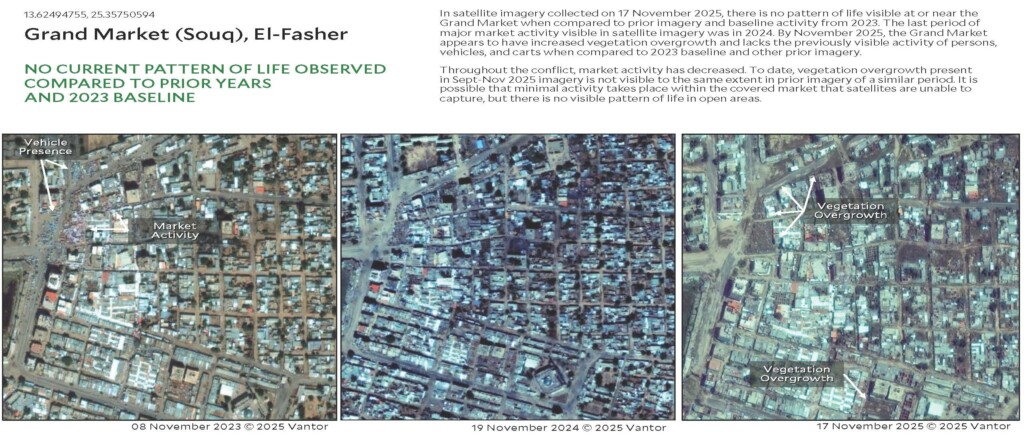
Satellite image of the Grand Market (Souk) of El Fasher dated 12 November 2025 shows ‘no current pattern of life compared to prior years and 2023 baseline' (Image: Yale HRL / Vantor)
Four Sudanese human rights organisations have called for the protection of civilians, independent investigations into alleged crimes, and accountability for those responsible in a joint statement marking the first anniversary of the fall of El Fasher, the capital of North Darfur.
The Sudanese Human Rights Monitor, the African Centre for Justice and Peace Studies, the Darfur Bar Association, and the Al Khatim Adlan Centre for Enlightenment and Human Development said ending impunity required independent and transparent investigations, accountability based on evidence, guaranteed humanitarian access, and redress for victims without discrimination or selectivity.
The organisations said the anniversary was an opportunity to call on all parties to fulfil their legal and moral responsibilities and renew their commitment to protecting civilians, establishing the truth, and securing justice without discrimination.
The four signatories reaffirmed their commitment to independently and professionally monitoring and documenting violations, defending victims’ rights and dignity, strengthening the rule of law, and pursuing justice and guarantees against the recurrence of abuses.
The statement stressed that protecting civilians required an end to violations, independent investigations, and accountability for those responsible for crimes. Victims’ rights must be upheld on the basis of evidence and individual responsibility, with guarantees of a fair trial.
Siege of El Fasher and incitement to violence
El Fasher came under a large-scale assault in late October 2025 following a prolonged siege and a severe deterioration in humanitarian conditions. Numerous credible reports have documented serious violations against civilians, including killings, detention, torture, widespread sexual violence, looting, the destruction of infrastructure essential to civilian life, and attacks on people fleeing the city.
The organisations expressed concern over the growing use of ethnic rhetoric, hate speech, and incitement to violence and revenge. They warned that such language, including statements by individuals or entities linked to the warring parties and material circulated through the media and digital platforms, posed a direct threat to social cohesion and risked fuelling further violence.
They urged the warring parties, political and military leaders, community representatives, and media organisations to reject incitement to violence, discrimination, and collective revenge. They also called for investigations into incitement to crimes and accountability for those responsible, in accordance with the law and available evidence, while respecting legitimate freedom of expression.
The four organisations stressed that criminal responsibility was individual and must not be attributed to entire population groups or used to justify collective punishment on ethnic or political grounds.
Protection of detainees and transparent investigations
The organisations called on those controlling detention facilities to disclose where detainees were being held and the grounds for their detention, notify their families, guarantee access to lawyers, allow detainees to challenge the legality of their detention, and provide the necessary care.
They also demanded independent investigations into deaths in custody and allegations of torture, ill-treatment, enforced disappearance, and arbitrary detention, as well as access to detention facilities for independent bodies.
The signatories expressed concern that the findings of several announced investigative committees examining serious violations and incidents during the war had not been published.
They urged the relevant authorities to disclose investigation findings, recommendations, and the outcomes of referrals for judicial proceedings. Establishing investigative committees, they stressed, did not replace independent criminal investigations or prosecutions where there were legal grounds to pursue them.
Humanitarian crisis and aid access
The humanitarian crisis in Darfur and Kordofan is worsening as a result of fighting and displacement, amid the near-total collapse of essential infrastructure, declining agricultural production and income sources, funding shortages, insecurity, and restrictions on humanitarian access.
The four organisations called for unjustified obstacles to aid deliveries to be removed. These include security and logistical restrictions, administrative and bureaucratic delays involving registration, permits and approvals, and restrictions on the movement of aid workers and supplies.
They condemned attacks on relief trucks carrying assistance to people facing starvation. They also highlighted restrictions on volunteers working in emergency response rooms and community initiatives, who face limitations on their movement and ability to serve their communities, including arrest, enforced disappearance, and killing.
The signatories called on the authorities in Port Sudan and Nyala, each within the areas under their effective control, to review procedures obstructing humanitarian operations and ensure that they were transparent, proportionate, and processed promptly.
All parties to the conflict and other actors exercising effective control were urged to protect humanitarian workers, facilitate the safe passage of supplies, and prevent aid from being looted or unlawfully diverted.
Accountability and reparations
The organisations stressed the need to investigate crimes and violations and hold accountable anyone found responsible for committing them, ordering them, or contributing to them, in accordance with international human rights law, international humanitarian law, and the rules applicable to each case.
Military rank, official status, or political and organisational affiliations must not shield individuals from criminal accountability under Article 25 of the Rome Statute, the statement said.
The signatories called on relevant national, regional, and international mechanisms to continue documenting violations, conducting investigations, preserving evidence, and supporting independent and effective judicial processes, including the work of the International Criminal Court on Darfur.
They also stressed that victims had the right to know the truth and the fate of missing people, and to access effective remedies and reparations. These should include compensation, rehabilitation, and guarantees against the recurrence of violations.
Survivors and victims’ families must also be protected from reprisals and stigmatisation.
Recommendations
The organisations urged the parties to the conflict and armed groups to respect the rules protecting civilians, halt unlawful attacks, prevent incitement to violence and collective revenge, release detainees, and stop violence against humanitarian workers.
Those controlling detention facilities were called on to disclose the whereabouts of detainees and the grounds for their detention, safeguard their legal rights and basic needs, allow independent bodies access to them, and investigate deaths and allegations of torture, ill-treatment, and enforced disappearance.
The Sudanese Armed Forces and the Rapid Support Forces, both of which have established investigative committees, were urged, alongside the judicial authorities, to publish investigation findings and the measures taken in response, clarify the outcomes of judicial referrals, ensure the independence of investigations, and protect victims and witnesses.
The organisations also called on the authorities, parties to the conflict, and those controlling supply routes to remove unjustified obstacles to humanitarian assistance, guarantee the safe passage of aid workers and supplies, and refrain from using administrative procedures or security restrictions to obstruct relief operations without legitimate grounds.
Finally, they urged donors, humanitarian organisations, and international mechanisms to take concrete steps to protect civilians. These should include supporting international investigative mechanisms, ensuring humanitarian access, applying pressure to end violations, providing the funding needed to address food insecurity and malnutrition, expanding essential services in affected areas, and supporting independent documentation, evidence preservation, and relevant judicial processes.
 and then