




Sudan after three years of war: ‘Bleak scenarios as crisis deepens’
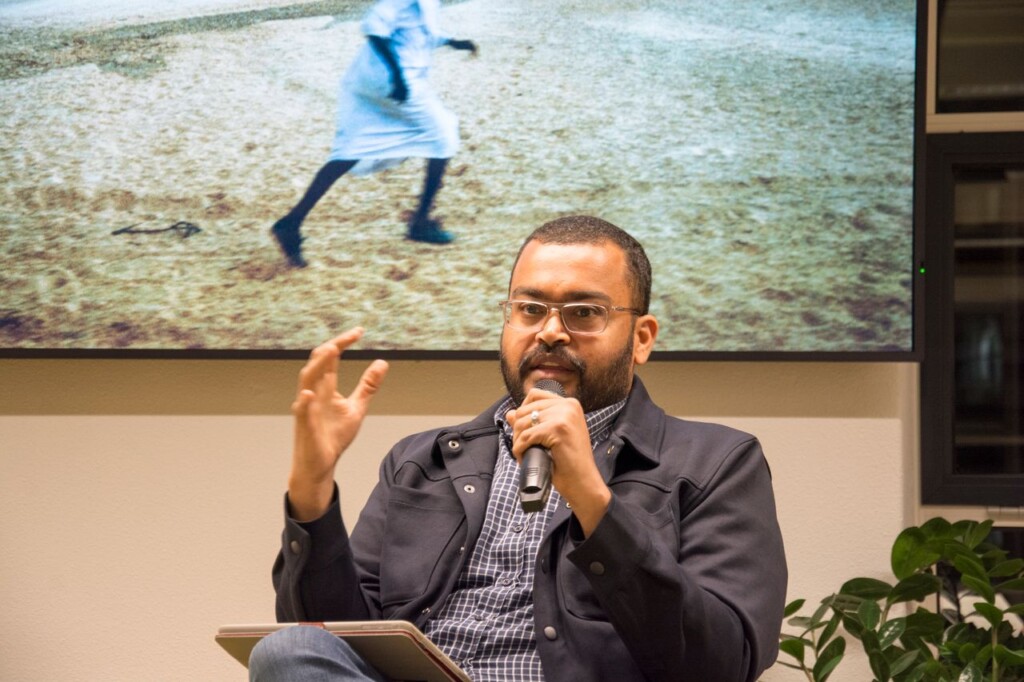
Ahmed Kodouda speaking at the Sudanese Media Forum event in The Hague, December 9, 2025 (Photo: Radio Dabanga)
Report by Abdelmoneim Madibu
As Sudan’s war nears its fourth year, the country faces a more dangerous phase, with no prospect of military victory or political settlement. Fighting has entrenched in Kordofan, while millions endure hunger, displacement, and collapsing services. Political and humanitarian analyst Ahmed Kodouda warned that Sudan stands at “a real and dangerous crossroads”, as the war increasingly focuses on consolidating areas of influence rather than achieving decisive victory.
Speaking to Radio Dabanga in an interview yesterday, he said fighting has intensified in recent weeks, particularly in Kordofan, displacing more than 65,000 people in the past two months alone.
Kodouda said both the Sudanese Armed Forces (SAF) and the paramilitary Rapid Support Forces (RSF) continue to strike areas under their control. He cited drone attacks on the Merowe Dam and bombardments in parts of Darfur. Cities in South Kordofan such as Delling and Kadugli remain under siege, he said, facing extremely severe conditions with clear signs of famine.
‘Worsening famine’
More than 33 million Sudanese now face acute food insecurity, making Sudan one of the world’s worst humanitarian crises. Kodouda told Radio Dabanga that the situation will deteriorate further after the World Food Programme announced plans to cut food rations from January 2026 due to a major funding gap.
“The reductions will reach 70 per cent in famine affected areas and 50 per cent in areas at risk,” he said, warning of an unprecedented humanitarian collapse in the coming months.
‘No military horizon’
After nearly three years of war, Kodouda said there is no realistic prospect of a military resolution for either side. He said Sudan has become effectively fragmented on the ground, amid continued fighting and widespread exhaustion.
‘Faltering politics’
Kodouda referred to the African Union’s support for an initiative proposed in December by Prime Minister Kamil El Tayeb Idris, which included an internationally monitored ceasefire and the withdrawal of the RSF into camps. The RSF rejected the proposal.
He also pointed to a joint African Union and UAE call for an unconditional humanitarian truce, which the Sudanese Foreign Ministry opposed, followed by criticism from civil and political forces questioning the neutrality of regional mediation.
Kodouda said the recently announced civilian Cairo Charter represents a positive step, stressing that a unified civilian front is essential for any future peace process.
‘Three scenarios’
Kodouda outlined three possible scenarios. The first, and most hopeful, is the success of current diplomatic efforts to secure a humanitarian truce that could lead to a permanent ceasefire, citing recent Saudi and US diplomatic activity.
The second scenario is an armed stalemate, with frozen front lines in Kordofan and a de facto division of the country, leaving the state fragmented and paralysed.
The third, and worst case, scenario is a prolonged war marked by escalating regional intervention and the total collapse of the Sudanese state.
‘Urgent priorities’
Kodouda told Radio Dabanga that the immediate priority is a comprehensive cessation of hostilities, the opening of humanitarian corridors and a permanent ceasefire. “Hunger has become a daily reality in many areas,” he said, calling for coordinated regional and international pressure, a clear timetable and effective monitoring mechanisms to prevent further delay and loss of life.

 and then