





Analysis: ‘Drones and satellite developments challenge value of traditional naval bases’
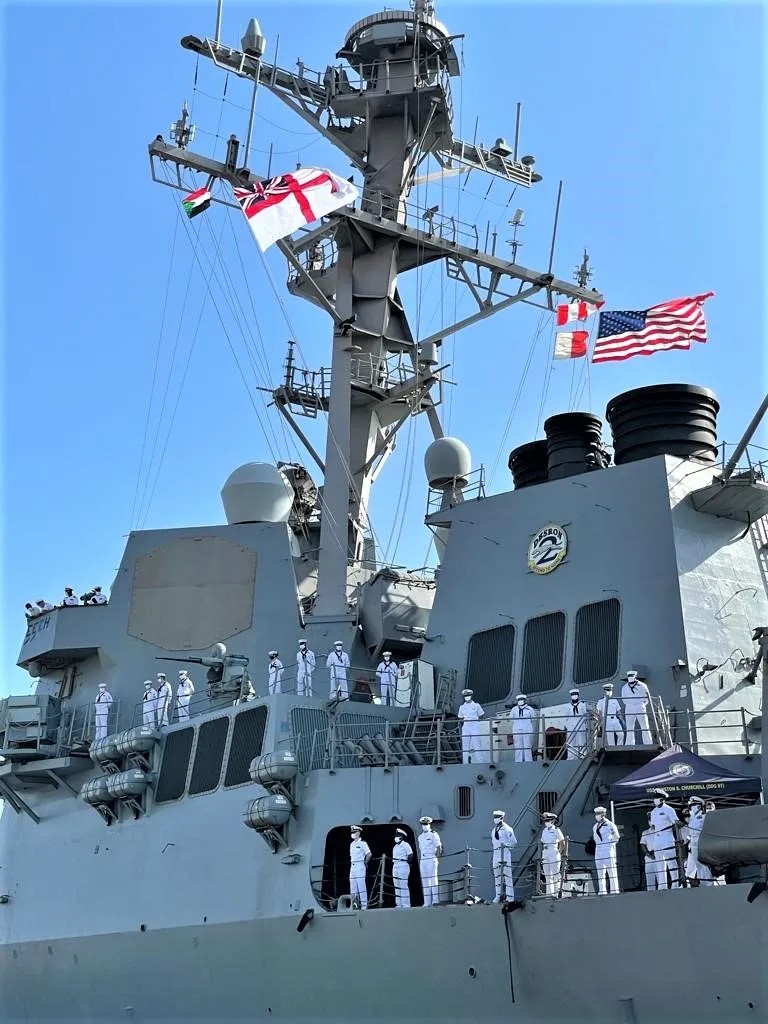
The USS Winston S. Churchill arrives in Port Sudan on March 1, 2021. (Photo: US Embassy Sudan)
Report by: Suleiman Siri
The reopening of the file concerning a Russian military base on Sudan’s Red Sea coast has reignited debate in political and media circles, as the United States warns against proceeding with the deal. The Wall Street Journal reported that the Sudanese government has offered Russia the opportunity to establish its first naval base on the African continent — a move that could shift the balance of power in one of the world’s most strategic maritime corridors.
According to the newspaper, Sudanese officials said the proposal includes a 25-year agreement allowing Moscow to deploy up to 300 troops and four warships, including nuclear-powered vessels, in Port Sudan or another naval facility along the Red Sea.
Under the proposal, Sudan would receive advanced weapons at preferential prices, alongside Russian promises of investment in the mining sector — particularly gold, one of Khartoum’s most important economic resources, the Wall Street Journal revealed.
A senior US official warned Sudanese leaders that “moving ahead with establishing such a facility, or any other form of security cooperation with Russia, will deepen Sudan’s isolation, worsen the current conflict, and expose the region to further instability.”
“El Burhan is playing with fire”
Military and security expert Major General Hashem Abu Rannat says the world is divided, albeit informally, into Western and Eastern spheres of influence — particularly between the US and Russia — each seeking strategic footholds whenever opportunities arise.
Speaking to Radio Dabanga, he said former president Omar El Bashir had long sought to entice Russia with access to the Red Sea, reviving Moscow’s ambitions dating back to the 1970s to dominate the Horn of Africa by forming a strategic belt linking Ethiopia, Somalia, South Yemen, and Djibouti. These attempts failed with the collapse of the Soviet Union.
Western countries and Sudan’s neighbours became alarmed, he said, when Bashir also began offering facilities to Iran and Türkiye on Sudanese islands in the Red Sea. But the December 2018 Revolution and Bashir’s removal in April 2019 halted all of this.
Abu Rannat says that following General Abdelfattah El Burhan’s recent coup and growing international isolation, “he has begun brandishing this card from time to time, despite knowing that such a base is impossible to implement.”
He warns that Burhan’s actions may be taken seriously by the United States, noting that Washington is not a power easily intimidated when its global interests are at stake. He added, “Bashir fell for the same reckless behaviour — and I believe Burhan is playing with fire.”
A ‘zero-sum marathon’
However, writer and political analyst Khalid Taha, a specialist in Horn of Africa affairs, argues that the competition over the “Flamingo Naval Base” is part of a “zero-sum marathon” that yields no genuine strategic benefit to either side, except preventing rivals from gaining it.
He says great-power competition in the Red Sea — one of the world’s most important waterways — is escalating sharply, with Flamingo positioned at its centre as a potential strategic anchor coveted by Russia and the United States alike.
“But the deeper question,” he argues, “is no longer who will secure the base, but whether traditional naval bases retain their relevance in an era where military geography is shifting towards technology and remote surveillance.”
Taha believes that the United States, with its entrenched regional presence and extensive alliances from the Gulf to the Horn of Africa, retains strong influence over any maritime-access arrangements. Yet its regional image has become tied to traditional geopolitical contests, at a time when some regional actors are seeking to balance between global powers.
Russia, by contrast, positions itself as a counter-balancing force, offering arms and partnerships with fewer political conditions. For years, it has sought a permanent foothold on the Red Sea to support operations in “warm waters.” Despite having less influence than Washington, Taha says Russia’s flexible offers make it a player that cannot be ignored.
Superiority lies with technology
According to Taha, the most significant shift is the declining importance of conventional naval bases. Advances in satellites, drones, and long-range sensing systems have shifted strategic advantage towards technological surveillance rather than large, fixed installations.
“The key question,” he says, “is what use is winning a base when the future depends on information dominance rather than controlling physical space?”
He notes that Sudan’s theoretically strategic geography could serve as leverage — but the weakness of the state, institutional fragmentation, and inability to make coherent strategic decisions render such advantages unusable. “A deal of this magnitude requires legitimate and capable institutions, which are simply not present today,” he says.
He adds that Washington’s warning — that creating a Russian base would “increase Sudan’s isolation and deepen the conflict” — signals a readiness to use pressure tools, including sanctions, restricting aid, delaying debt relief, and influencing Gulf and European positions.
“In the end,” Taha concludes, “real advantage in the Red Sea will belong to those who command technology and information, not merely those who hold a patch of coastline.”
‘Political blackmail’
Political analyst Fathi El Daw describes the offer made by the “Port Sudan government” to Russia as political blackmail.
Speaking to Radio Dabanga, he mocked what he called the “laughable” behaviour of the Port Sudan authorities, whose statements about the Russian base, he said, have no real substance.
He dismissed talk of new alliances or power struggles as media exaggeration, calling it a distraction for the public. “These things amuse people briefly — and are quickly forgotten,” he added.
El Daw believes General Burhan imagines the Russian-base issue will strengthen his position against US pressure, although “it carries no real meaning.”
“Many dictators think that simply having strategic coastlines allows them to manipulate global powers at will,” he said. “This is absurd. Dictators rarely understand political realities and imagine the world moves according to their wishes rather than the actual conditions on the ground.”
A strategic outlet, but international constraints
El Daw emphasises that while the Red Sea is indeed a crucial corridor, “nothing is ever that simple.” He criticised the government for pursuing a naval base deal while the country is engulfed in war and unable even to feed its starving population with international aid.
He said Washington’s swift response — warning that such steps would increase Sudan’s isolation — is exactly what should be expected.
“These matters are governed by international calculations, political balances, and strategic considerations,” he said. “The Port Sudan government’s statements are temporary distractions that some people entertain themselves with before forgetting.”
However, El Daw added that such positions are carefully monitored in UN and US circles. “This requires little effort from either,” he said.
He urged Sudanese citizens to focus on the harsh reality they face — widespread atrocities and suffering — rather than on “these ridiculous announcements” about granting Russia a naval base.
“If Sudanese people must endure the tragedy of war,” he said, “they are also forced to listen to the farce coming from these ‘irresponsible’ officials in Port Sudan.”
‘Inflaming the American position’
Military and security expert Major General Dr Mutasim Abdelqader believes certain actors have deliberately revived the Russian-base issue to provoke a negative American stance towards Sudan — especially following recent remarks by the US President that he now fully understands the situation in Sudan after being briefed by Saudi Crown Prince Mohammed bin Salman.
Abdelqader denies that the Sudanese government has made any offer to Russia at this stage — or vice versa. He argues that Russia, preoccupied with its war in Ukraine, is inward-looking and has no interest in opening a base in Sudan or anywhere else. He cites Moscow’s scaling back of commitments in Syria as evidence of its desire to reduce its burdens.
Sudan has the right to grant what it wishes
Major General Abdelqader insists that Sudan is entitled to grant any state a military base on its shores if it chooses. He says Sudan’s coastline is particularly strategic, as the western Red Sea is bordered by Eritrea, Sudan, and Egypt — with Sudan centrally positioned between them. Somalia’s stretch of the Red Sea, he notes, is minimal and weak, while Sudan has deep-water ports, including the undeveloped Abu Amama site.
He believes Sudan could play a major strategic role in Red Sea security, positioned opposite Saudi Arabia and neighbouring Egypt, and located at a crossroads between East Africa, Europe, the Middle East, and Asia.
He maintains that Sudan does have the political and institutional capacity to approve such an agreement — but stresses that, for reasons known to the Sudanese government, “there is no such proposal at this time, and Sudan has not used this issue as a bargaining card at any stage.”




 and then