





‘Sudan govt scramble to shore-up Sudanese Pound could backfire’
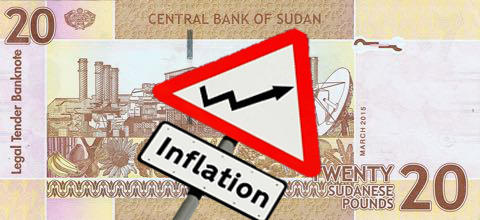
Sudanese Pound inflation (Graphic: RD)
As the Sudan government bets on import bans to steady a sliding currency, economists warn of the potential negative consequences of banning a range of imported goods if no domestic substitute is ready.

In an interview with Radio Dabanga, prominent Sudanese economist Dr Haitham Fathi comments on the reports that Sudan’s Transitional Council of Ministers had banned the import of more than 40 categories of goods it deems “luxurious and unnecessary”, in an effort to stem the deterioration of the exchange rate of the Sudanese Pound (SDG), ease pressure on the economy, and rationalise the use of foreign currency. The stated aim is to support the national economy by curbing imports considered non-essential under current conditions.
Reports of a decision by the Prime Minister to prohibit import of more than 40 items—including cement, rice, dairy products, soap and cosmetics—leaked yesterday. The Trade Minister later said she would issue a revised list after reviewing the measure. Observers said the episode reflects “the confusion gripping the country”.
The Sudanese Pound continues to weaken on the parallel market, trading at more than SDG 4,100 to the dollar. Commercial banks quote lower rates: Al Salam Bank at SDG 3,900 and Omdurman National Bank at SDG 3,350.
‘Risk of backfiring’
Economist Dr Haitham Fathi, told Radio Dabanga that the policy could have a strong adverse effect given the absence of ready domestic alternatives. Factories and national capital are already under strain, he noted, pointing to the economy’s weak capacity for self-sufficiency.
He expects the decision to trigger disruption in the flow of goods, compounding the hardship of the Sudanese public, already grappling with poverty, unemployment, and economic pressure.
“Import bans,” he argues, “signal a shortage of foreign currency and may increase demand for dollars on the parallel market, pushing up the exchange rate and fuelling new waves of inflation. Prices of essential goods—including medicines and food—could rise further.”
Fathi underlines that the policy reprises earlier measures that yielded similar results: a higher US dollar rate, inflationary surges, increased demand for foreign currency on the parallel market and a widening gap between official and parallel rates, all contributing to a weaker domestic currency.
Fathi adds: “The real challenge for the government is to secure sufficient US dollar inflows to avert crises, rather than merely postponing them.”
He also criticised the lack of prior consultation with Sudan’s private sector, which, he said, has proposals for reviving domestic industry. Opening exemptions—such as for Egyptian beans—could undermine credibility and divert trade to the parallel market.
Remedies and proposals
Fathi calls for a review of the decision and engagement with the private sector, alongside a parallel assessment of past policies. He urged policymakers to think “outside the box” in finding ways to generate foreign currency.
He stressed the need for studies on localising the production of essential and non-essential goods, tackling the root causes behind the decision and adopting new, innovative strategies to avoid repeating past crises.
Potential upsides
On the subject of local production, economist Abu El Qasim El Siddiq warns that failing to include many imports benefiting Egypt’s export sector—and those of other countries—could harm Sudanese producers, given the superior quality and lower prices of imported goods.
He told Radio Dabanga that many factories in Khartoum and major regional cities have resumed operations and are producing ample quantities of several goods on the banned list, sufficient to meet domestic demand even after the war.
Halting imports of some goods may encourage smuggling, he said, but this can be mitigated by strengthening enforcement, particularly through modern methods such as drones and advanced surveillance technologies.
Sudan’s trade balance has long been skewed, he noted, not only because of the mismatch between imports and exports but also due to reliance on remittances from expatriates to bridge the gap in import payments.
Stopping imports, he argued, would benefit domestic producers and boost profits as output rises to meet local demand. Higher production could help curb price increases.
Reducing imports is also, globally, one way to dampen demand for hard currency and limit speculation in the foreign-exchange market, which, alongside other measures, may help stabilise the Pound, he concludes.




 and then