





UNFPA: ‘Sudan’s capital Khartoum is a ghost town… Sudanese women ‘carry their homeland on their shoulders’
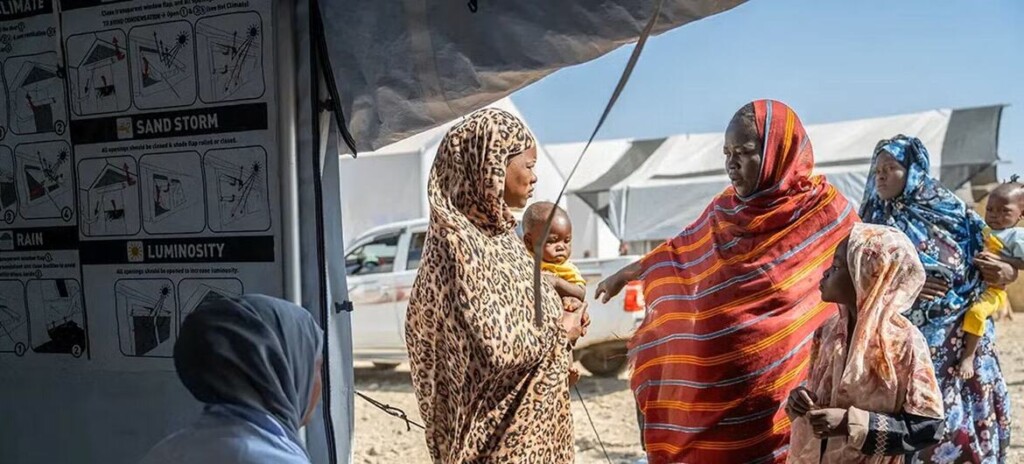
A health worker from the United Nations Population Fund (UNFPA) speaks with women and children at a mobile clinic in Abu El Naja camp for displaced people in Sudan (Photo: © UNFPA)
The UN Population Fund (UNFPA) has described parts of the capital Khartoum as a “ghost town” teeming with burnt buildings and darkness, “however, people are coming back to it, because no one wants to stay indefinitely inside displacement camps.” Speaking to reporters in Geneva from Cairo, UNFPA deputy executive director for management, Andrew Saperton said that during his recent visit to Sudan, he saw “a country trying to come back to life, even as the war continues.”
He said that Sudanese women continue to “carry their homeland on their shoulders” as they seek to secure a decent life for themselves and their children, despite the ongoing war and insecurity that hangs over the country.
Recent violence has left thousands of women and adolescent girls without access to emergency obstetric care and clinical care for rape cases.
The conflict and attacks on Sudan’s healthcare infrastructure continue to disrupt essential medical services and put the lives of civilians at risk, disrupting a large part of Sudan’s health system, with only 63 per cent of health facilities partially functioning.
Recovery accelerates return
Saperton points out that the camps in eastern Chad, which he also recently visited, provide temporary refuge for Sudanese who have fled their country, and that the government and humanitarian agencies are doing their best to support them.
‘When people are given a choice, they always prefer to go home…
“But you have no doubt. They are miserable places to live. In one camp, the delivery room was receiving about 30 births a day in very poor sanitary conditions, in many cases without the use of anesthetics. In addition, 10 per cent of these births were by caesarean section. No woman should have to give birth under such circumstances.”
While the conflict has put the health system under enormous pressure, Saperton pointed to some signs of recovery. For example, the fund is contributing to the reconstruction of the Dayat Hospital in Khartoum, providing it with the necessary medical staff and equipment, making it “one of the largest maternity hospitals in Africa, capable of accommodating more than 50 deliveries per day, and for the first time, will provide its services free of charge thanks to government investments”, he said.
“These types of services allow for the possibility of returning, because when people are given a choice, they always prefer to go home,” he said.
Insecurity inherent in everyday life
The women and girls he spoke to in the safe spaces of Port Sudan and Khartoum “did not describe insecurity as isolated incidents, but as an inherent condition of everyday life”, Saperton said, and yet their resilience was evident.
“I have witnessed in many ways how the women of Sudan carry their homeland on their shoulders. They want not only access to food, but also access to basic health care and safety, the opportunity to earn an income to feed themselves and their children, and to enroll their children in school.”
He stressed that the starting point for recovery is a sustainable ceasefire and lasting peace, noting that the reconstruction process, once that peace is achieved, will require large-scale investments in health protection and other civil services.
In the meantime, he stressed that humanitarian aid is a lifeline for Sudanese and that humanitarian appeals must be funded. He warned that if urgent support is not available, UNFPA will be forced to further reduce its support and services, adding that protection services are currently only 20 per cent funded, while health services are only 14 per cent.
Destruction at Ibrahim Malik Hospital
Saperton, recently visited Ibrahim Malik Hospital – Khartoum’s main medical facility – to assess the scale of the massive destruction to its infrastructure.
“As you can see around me, there is massive destruction. Some are intentional, some are unintentional. The comprehensive health facility, which was the main medical facility in Khartoum, was completely destroyed during this conflict. Look around. It is man-made destruction. There is no reason, justification or justification for this anywhere in the world.”
The hospital complex was heavily damaged during the war, resulting in damage to vital medical equipment, baby incubators, ambulances, and water supply facilities. Despite the scale of the destruction, local health workers and humanitarian partners have begun clean-up and reconstruction efforts to restore basic medical capacity.
Saperton: “I look around and I see traces of bullets and shrapnel from the equipment. I see bullet holes in the water supply, which is a very important supply for the hospital. We won’t let that discourage us. We will not let that dissuade us. Because when everybody is trying, you know, to focus on the worst in the world, we have to get used to that, and what we should be striving to do is see the best in the world. I have seen some of that here today in the enthusiasm, determination, and genuine dedication of the workers, the medical staff, and our partners on the ground to rebuild, and we have to rebuild.”
The collapse of infrastructure coincides with an unprecedented displacement crisis, with Sudan currently registering the highest number of displaced people globally.
Worst displacement statistics
“This country has one of the worst levels of IDPs in the world. I visited camps last week, where hundreds of thousands of people, especially women and girls, are living in dire conditions. But they want to come back. They are returning to Khartoum. They are starting to come back. But we need to provide them with basic infrastructure to enable them to return and regain some of the semblance of normalcy that they have left behind. We are indeed working on it, and we will continue to work. We have seen some progress today. The wings began to complete. The equipment began to arrive. We have to speed up because through all this darkness we will show that we are going to bring some light to this place, and we will shine that light on the people of Sudan.”
As families, especially the most vulnerable women and girls, begin to try to return to Khartoum, the restoration of basic health facilities remains critical to providing basic care and stability. In March, UNFPA supported 83 health facilities in 16 states, providing sexual and reproductive health services to 62,200 people, and GBV prevention and protection services to more than 102,000 individuals. UNFPA has appealed for $129.2 million. To date, only 29 per cent of the required funding has been secured, leaving a funding gap of $92 million to meet urgent health and protection needs across Sudan.

 and then