




Sudan’s ERC committee: ‘Residual Islamic Movement funds abroad perpetuate war’
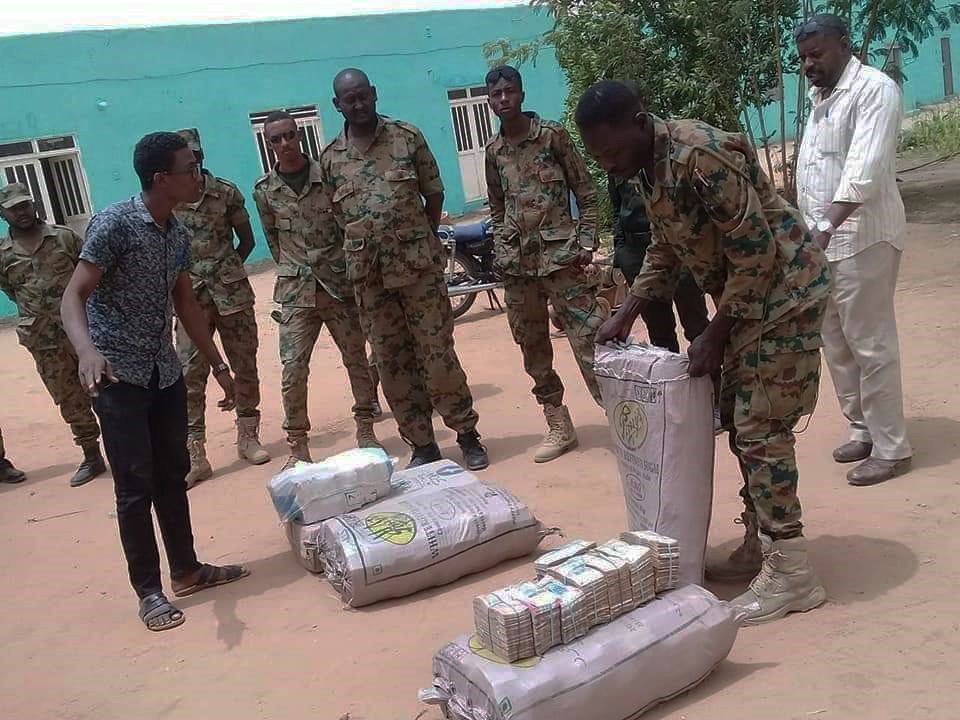
Officers display some of the cash hoard allegedly found at the residence of deposed dictator Omar Al Bashir in April 2019 (File photo: Office of Attorney General of Sudan)
Report by Suleiman Siri for Radio Dabanga
Sudan’s Committee for Removing Empowerment and Dismantling the June 30 1989 Regime (ERC)* has announced a renewed focus on targeting financial networks abroad, aiming to dry up sources of funding and pursue assets linked to the Islamic Movement outside the country. The committee also revealed that it is undertaking a series of updates and broad structural changes to better organise its work in line with its objectives for the next phase. This includes expanding its activities beyond Sudan, with the potential involvement of experts across multiple fields and the establishment of a specialised advisory body.
El Tayeb Othman Youssef, the committee’s secretary-general, told Radio Dabanga that it has remained in continuous session to determine how best to implement these updates. The changes follow the decision to resume the committee’s work from outside Sudan and are intended to align its operations more closely with its overarching goals.
Since its formation during Sudan’s transitional period, Youssef said, the committee has pursued two primary objectives: dismantling the remnants of the former regime from key positions within state institutions, and combating corruption while recovering state funds.
However, he acknowledged that it is currently impractical for the committee to carry out the first of these tasks. Removing entrenched cadres from state institutions, he said, falls under the authority of government bodies such as ministers and state governors. As a result, the committee has shifted its focus towards recovering funds.
Focus on combating corruption
Youssef confirmed that the committee is now concentrating on combating corruption and reclaiming assets. “The reality is that, given recent developments, the committee has had to restructure its operations to keep pace with these changes,” he said.
A central element of this effort involves cutting off funding streams and tracking the assets of Islamist organisations. According to the committee, a significant portion of these funds is being used to finance and sustain the ongoing war, while another portion is held in private accounts in the post-war period — a situation Youssef described as widely known among Sudanese citizens.
He added that these developments require the committee to update its tools, mechanisms and working methods, particularly given that many of its members are now operating from outside Sudan. This includes adopting modern technologies and establishing a secure electronic system to protect documents, data and information.
Youssef also stressed the importance of safeguarding individuals who may wish to cooperate with the committee from abroad. He said the proposed system would need to guarantee the highest levels of confidentiality and data protection.
Expertise firms
The committee has sought assistance from specialised consulting ‘expertise’ firms, though Youssef noted that such efforts depend on securing adequate funding — a priority at this stage.
He added that the committee is working to broaden its network of cooperation by engaging a group of Sudanese experts to form a supporting advisory body. This would include specialists in law, economics and media, as well as experts in international relations and those with established links to international organisations and institutions involved in implementing the designation of the Islamic Movement in Sudan and its affiliated groups as a terrorist organisation.
The committee is also updating its databases, documents and lists of individuals and entities, in line with changes to the structures and organisational practices of the former regime. The aim, Youssef said, is to improve the accuracy of information and enhance overall efficiency.
He emphasised that these steps form part of the committee’s current programme of work, alongside efforts to strengthen cooperation through various international channels in the future.
Youssef has previously stated that cooperation with international institutions is essential because much of the Islamic Movement’s financial assets are located outside Sudan. “While working inside Sudan, the committee uncovered significant evidence of funds held abroad,” he said.
* The full name of the committee is the Committee for Dismantling the June 30 1989 Regime, Removal of Empowerment and Corruption and Recovery of Public Funds. It was established by the government of Abdallah Hamdok in November 2019 with the aim to purge Sudan of the remnants of the ousted regime of dictator Omar Al Bashir (1989-2019). Empowerment (tamkin) is the term with which the Al Bashir government supported its affiliates by granting them far-going privileges, including government functions, the setting-up of various companies, and tax exemptions.
 and then