




Sudanese army’s ‘provisional nod’ to US ceasefire proposal reshapes negotiation landscape
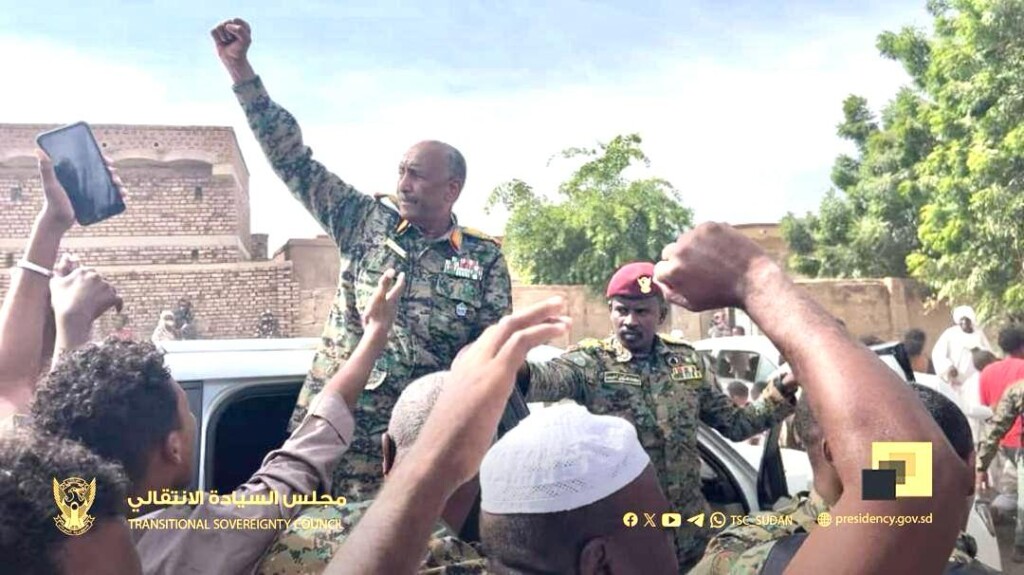
Head of the Sovereignty Council and Commander-in-Chief of the SAF, Lt Gen Abdelfattah El Burhan, visiting El Sariha in El Gezira on 2025 (File photo: Transitional Sovereignty Council)
By Ashraf Abdelaziz for Radio Dabanga
The latest US proposal for a ceasefire and an end to the fighting in Sudan has prompted mixed reactions, particularly after the Sudanese Armed Forces (SAF) reportedly gave their conditional approval. This has subsequently been downplayed by Massad Boulos, US Senior Advisor for Arab and African Affairs, who says that the USA continues discussions and to press the parties on specific proposals, with multiple substantive issues yet to be accepted and/or that have been outright rejected. He says that any official agreement would be formally announced.
In a statement on X yesterday, Boulos clarifies: “Some recent commentary and reports have mischaracterised current efforts to negotiate a humanitarian truce and peace plan for Sudan. Recent claims that key issues have been fully accepted are inaccurate, as are claims that there is only a single issue remaining. We continue discussions and to press the parties on specific proposals, with multiple substantive issues yet to be accepted and/or that have been outright rejected. Any official agreement would be formally announced. Meanwhile, public comments, speculation, or alleged documents showing agreement or ‘settled’ issues are neither official nor helpful. Our focus remains on facilitating serious, constructive engagement and dialogue that can deliver a humanitarian truce and a plan for a comprehensive and lasting peace and political transition in Sudan.”
However, should the SAF indeed agree to the US proposal, analysts agree that it will effectively reshape the negotiating landscape against a backdrop of shifting military realities and mounting domestic and international political pressure.
Balancing power and setting the victor’s agenda
Political analyst and commentator Qurashi Awad told Radio Dabanga that reports indicate the United States has proposed a ceasefire that includes provisions such as a mutual withdrawal from areas under each side’s control.
What is new, he said, is the army’s agreement in principle, albeit with reservations that revive its long-standing demand that the Rapid Support Forces (RSF) withdraw from towns and cities. Those are the same conditions previously set out by Prime Minister Kamil Idris before the United Nations.
Observers see this as the sort of ‘victor’s terms’ normally imposed after an opponent has been decisively defeated and called upon to surrender. Yet that is not the reality on the battlefield. Peace settlements are generally built on what he described as an “uneasy balance of power” and an implicit acknowledgement that neither side can achieve a military victory.
Awad argued, however, that the army’s conditions are now more realistic because the RSF is entering a period of decline. He pointed to the army opening new fronts in West Darfur, defending El Obeid, recapturing Kurmuk, increasing international pressure including a European Parliament condemnation and growing pressure on the United Arab Emirates, as well as internal ethnic divisions within the RSF.
He also described the army’s acceptance of transferring power to an “agreed” civilian government, rather than an “elected” one, as a significant shift. Likewise, its acceptance of excluding extremist groups could, in his view, allow political successors to the dissolved National Congress Party to re-emerge under new banners rather than in their former guise.
‘A sedative position’
Journalist and political analyst Sibawayh Yousif told Radio Dabanga that the army’s insistence that the RSF withdraw from towns before signing a ceasefire amounts to little more than ‘a sedative position’ – an attempt to ease the anger and pressure coming from domestic groups that favour continuing the war.
In reality, he said, information emerging from recent discussions suggests there has already been practical coordination on the separation of forces and other security arrangements. That indicates withdrawals form part of a broader package already agreed between the two warring sides under the US proposal.
What the army is saying publicly, he argued, is little more than a political manoeuvre designed to placate those opposed to a negotiated settlement, even though these issues were not part of the mutual negotiations themselves.
Reuters leaks and sidelining Kabashi
Taher El Moatasim, editor-in-chief of Sawt Al Umma newspaper, told Radio Dabanga that the recent meeting of Sudan’s Security and Defence Council was a direct response to a Reuters report on documents exchanged between the US administration and the Sudanese military.
He said official statements urging the public to ignore rumours should not be interpreted as an attempt to avoid responding to Washington. Rather, they were a response to leaks from sources close to the Sovereignty Council concerning a meeting between Lt Gen Shamseldin Kabashi and Massad Boulos.
According to El Moatasim, the Security and Defence Council was seeking to retain exclusive control over the peace process by authorising only its chairman to deal with the issue, effectively preventing Lt Gen Kabashi from pursuing any separate initiatives.
Military expert: Security and Defence Council meeting marks a strategic turning point
Brig Dr Jamal El Shaheed, a specialist in security and military affairs, described the recent Security and Defence Council meeting, chaired by Gen Abdelfattah El Burhan, as a highly significant moment in the state’s management of both the war and the peace process.
Speaking to Radio Dabanga, he said the meeting came at a time of rapid military developments and battlefield gains by the Sudanese Armed Forces and allied forces. That, he said, reflected an official recognition that developments on the battlefield would have a direct bearing on the political process and the prospects for any future settlement.
In his view, the council’s praise for the armed forces was not merely symbolic but represented a clear assessment of the changing balance of power.
El Shaheed added that the council’s insistence that it alone has authority over matters of war, peace and negotiations sends a clear message both domestically and internationally. It underlines the state’s determination to maintain centralised control over strategic decision-making and prevent competing initiatives from weakening Sudan’s negotiating position.
He also welcomed the council’s dismissal of reports concerning national security, describing it as evidence of a strong awareness of the importance of information discipline at a sensitive stage, helping to protect national security from rumours circulating on social media.
At the same time, he said the council’s welcome for peace initiatives demonstrated that Sudan’s leadership views military action as a means of achieving peace and stability rather than an end in itself, provided any settlement reflects the realities on the ground and safeguards the rights and aspirations of the Sudanese people for development and prosperity.



 and then