




‘Quintet-brokered Addis dialogue on Sudan is flooding the political process’
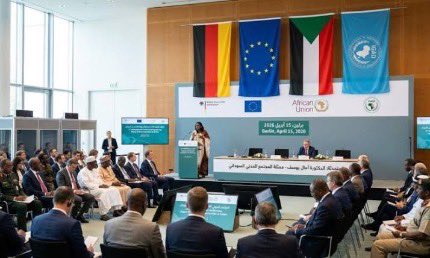
Preparatory Workshop for the Berlin Conference in Addis Ababa (File photo: Supplied)
Meetings organised by the ‘quintet’ group in the Ethiopian capital Addis Ababa from June 3 to 5, aimed at bringing together all Sudanese parties who did not take part in Third International Conference on Sudan in Berlin on May 15, are in jeopardy, as several alliances, political parties, and civil forces have declined invitations to attend in protest against the involvement of new forces and “the flooding of the political process,” Radio Dabanga has learned.
The series of meetings in Addis from June 3 to 5, convened by the ‘quintet’ group — comprising the African Union, IGAD, the United Nations, the European Union, and the League of Arab States — is aim at bringing together all Sudanese who did not take part in Third International Conference on Sudan in Berlin on May 15.
The editor-in-chief of Al-Umma newspaper, the media voice for the National Umma Party (NUP), Taher El Mutassim, told Radio Dabanga: “The meetings called by the Quintet group in Addis Ababa on June 3, will not succeed, according to information about changes in attendance at the meeting, in an attempt to create a new bloc that will be pushed to represent parties from inside Sudan. This is what the components that participated in the previous meetings, namely the Civic Democratic Alliance for Revolutionary Forces (Sumud), the Democratic Bloc, the SPLM-N Abdelwahid, and the Popular Movement in the North, reject.”
He added that many coalition leaders believe that this represents “a drowning of the political process with multiple fronts”.
Threats to withdraw
The People’s Congress Party, led by Dr Ali el Hajj, warned that some parties are seeking to include civil forces and figures linked to the National Congress Party (associated with the deposed Omar Al Bashir regime) among the participants in the preparatory meeting for the Sudanese-Sudanese dialogue scheduled for June 3. He said: “such attempts would discredit the meeting, undermine dialogue, and may push political forces to refrain from attending”.
The People’s Congress threatened to immediately withdraw from the preparatory meeting for the Sudanese-Sudanese dialogue in the event of the participation of elements of the National Congress, considering this as collusion by some members of the five-member mechanism to abort efforts aimed at unifying political forces and strengthening their efforts to end the war that has been ongoing since April 15, 2023.
He held the ‘quintet’ mechanism fully responsible for any rift that might affect the unity of political forces and slow down the achievement of a solution to the current crisis.
Call for a boycott
Baath Party leader Mohamed Zia El Din called for a boycott of the five-member meeting in Addis Ababa, noting that there is a lack of clarity about the invited parties.
He said that this step comes at a remarkable time immediately following the success achieved by the Sudanese political and social forces in the Kenyan capital Nairobi last week, which endorsed the “Sudanese Declaration of Principles” towards building a new homeland, and considered this a real breakthrough that reflects a national will that rejects war and seeks sustainable peace.
“This deliberate dumping and expansion of participation without clear criteria effectively weakens the chances of national consensus and opens the door to the participation of more entities supporting the war.”
He pointed to information that a new entity is being prepared for security in Port Sudan to participate in the Addis meeting, in the absence of the bloc that participated in Berlin, which reinforces fears of creating confrontations and fragmenting national positions.
He called on all political and social forces opposed to the war, which established the Quartet’s outcomes and complemented them with the Nairobi results, “to declare a serious and decisive boycott of the Addis Ababa call, and to refuse to engage in these meetings, which only produce more complications in the scene”.
 and then