




Criticism mounts over Sudan-Türkiye Suakin gas terminal memo
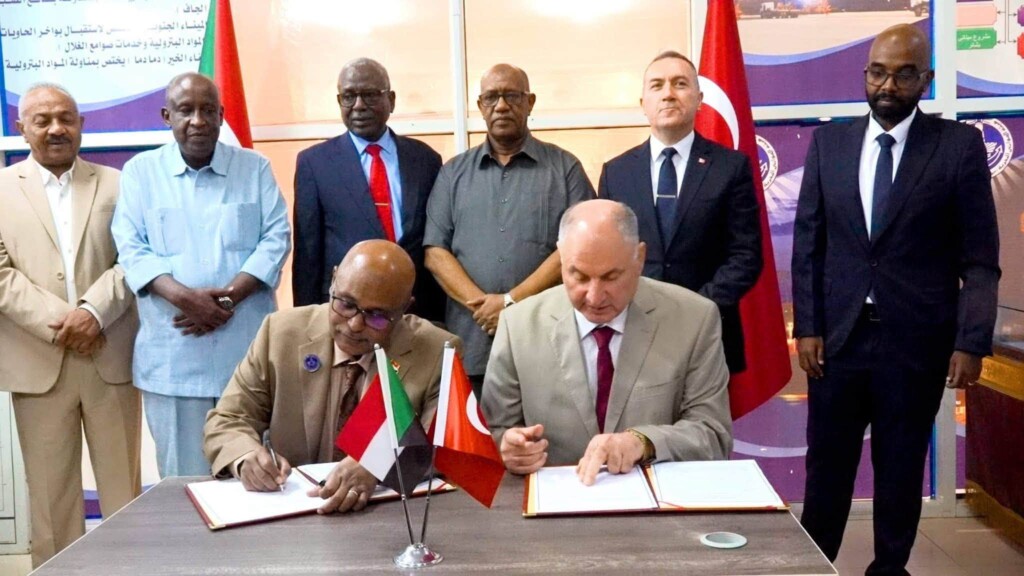
The Sea Ports Corporation, headquartered in Port Sudan, signed a memorandum of understanding with the Turkish company Argaz - July 2026 - (Photo: SUNA)
The signing of a memorandum of understanding between Sudan’s Sea Ports Corporation and the Turkish Argaz Group to build the first specialised gas terminal in Suakin on Sudan’s Read Sea Coast sparks widespread debate and raises questions about the nature of the deal, as well as the government’s lack of transparency over why the project is not put out to competitive tender for qualified international companies.
The corporation’s director-general, El Gilani Mohamed, says the project involves building Sudan’s first specialised gas terminal with a storage capacity of 28,000 cubic metres.
Sharp criticism
However, Dr Adel Ibrahim, a former energy minister in the transitional government led by Dr Abdalla Hamdok, delivers sharp criticism of both the memorandum and the procedures followed to reach it. He says Turkish companies are not the only firms operating in this sector, nor are they particularly well known for developing gas port projects.
Speaking to Radio Dabanga, Ibrahim explains that Turkish companies may have experience in constructing ports and marine berths, including facilities for gas carriers, which require dedicated docking infrastructure. But, he says, that does not necessarily mean they specialise in building gas terminals and their associated facilities.
An old idea revived
Ibrahim says a gas berth and storage facility at one of Sudan’s Red Sea ports would be an important strategic project for the country’s energy future. Yet he argues that, despite its importance, the proposal is an old one that repeatedly resurfaces before disappearing with political change.
‘The project emerges into the public eye every time and then dies with political changes…’ — Dr Adel Ibrahim, former energy minister of Sudan
“The project emerges into the public eye every time and then dies with political changes,” he says.
He adds that the announcement leaves an initial impression of confusion, particularly because the authorities do not appear to have followed the official procedures and channels that should ensure transparency and clarity in implementing projects of this scale.
He notes that the initiative remains only at the memorandum-of-understanding stage, which by itself is insufficient and does not indicate an advanced phase of development. That, he says, raises numerous questions, beginning with whether proper planning, feasibility studies and site selection have been completed.
Clear stages required
The energy expert says any project of this size should pass through clearly defined stages, beginning with design, technical studies, and completion of all engineering requirements before moving to contracting, competitive tenders and the prequalification of capable companies. The financing mechanism should also be identified, particularly as the project involves gas storage facilities and a dedicated terminal.
The former transitional government official also says the Sudanese army’s exclusive control of gas projects through Military Industry Corporation continues to cause concern. He says he fears the decision remains in force, adding: “I do not know what relationship the army has with this project, which is still only at the memorandum-of-understanding stage.”
He says that during the transitional government led by Dr Abdalla Hamdok there were attempts to complete a berth project at Port Sudan. However, officials discovered that the army held an exclusive monopoly over gas projects under a decree issued by former president Omar Al Bashir. He expresses regret that Transitional Sovereignty Council chairman Abdel Fattah Al Burhan sided with the military.
“We tried to cancel the army’s monopoly over gas projects, but he refused and insisted that the army retain exclusive control. The project stopped there as far as the Ministry of Energy was concerned, amid disagreements between us and the military during the first revolutionary government, and it went no further,” he says.
Cheapest fuel
Ibrahim says that, from both technical and economic perspectives, strategic energy projects in Sudan should be linked to the national energy plan. Given the close relationship between electricity generation and gas infrastructure, he argues that any gas storage facilities should be accompanied by electricity-generating turbines at the port so that the gas can also be used to produce power.
He says Sudan’s electricity sector should prioritise thermal generation using natural gas, describing it as one of the world’s cheapest fuels, followed by solar power. He stresses the project’s importance for both electricity generation and industry.
He explains that the scheme consists of two parts: offshore works and onshore civil engineering works, noting that other international companies also specialise in such projects.
Ibrahim says projects of this kind should be awarded through established legal procedures and with a high degree of transparency so that the Sudanese public can be fully informed and confident that proper procedures are followed without giving rise to questions or suspicion.
The former Hamdok government official says public mistrust has become attached to government projects, particularly under the Port Sudan administration, arguing that citizens have every right to question decisions given what he describes as confusion in project management.
He cites several examples, including a bridge maintenance project that is cancelled after being tendered and a project involving the Sudanese Information Company for the Central Bank of Sudan that is cancelled before signing. He says these cases reflect clear confusion, demonstrate a lack of transparency and, in his view, point to “malicious” intentions or corrupt practices that have harmed the country.
Ibrahim expresses hope that the war ends and that peace and stability return to Sudan, allowing government performance, project implementation and all matters affecting the interests, lives, and wellbeing of the Sudanese people to improve.

 and then