





Sudan’s El Burhan pledges guarantees, sets out amnesty rules for dialogue
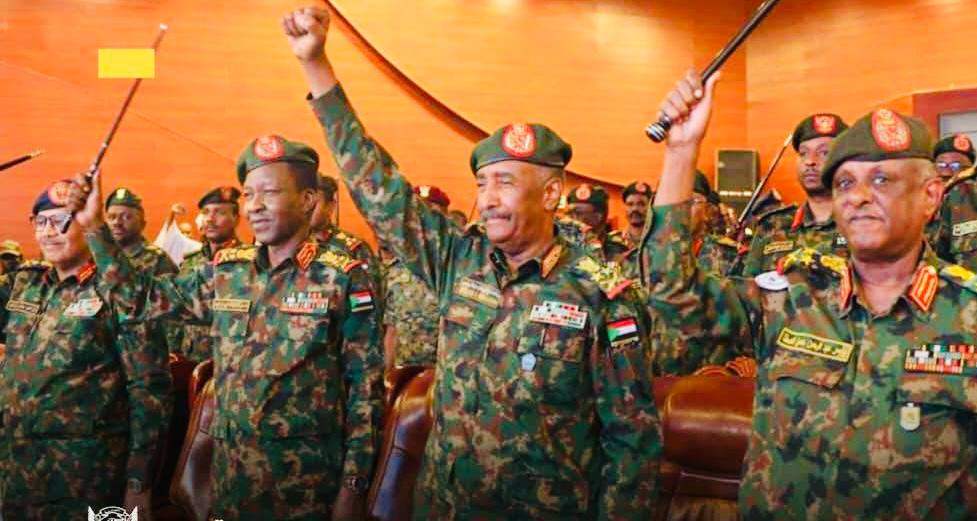
Sudan’s Sovereignty Council chair and army chief, Gen Abdelfattah El Burhan with his military commanders at Army Day celebrations, from right to left: Lt Gen Yasser El Atta, Shamseldin Kabbashi, and Ibrahim Jaber, Friday 14 August 2026, Khartoum (Photo: Supplied)
Sudan’s Sovereignty Council chair and army chief, Gen Abdelfattah El Burhan, has pledged to provide the necessary legal, political, and security guarantees for the planned Sudanese-Sudanese dialogue inside the country, while stressing that the state will not organise the dialogue or determine its agenda or outcomes.
Speaking on Friday evening at celebrations marking the 72nd anniversary of the Sudanese Armed Forces (SAF), El Burhan said the call for the dialogue had come from a national group that had come together on its own initiative to launch a purely Sudanese dialogue, beginning inside the country and bringing together all political and community forces, while placing citizens’ suffering and their right to peace at the heart of its objectives.
As previously reported by Radio Dabanga, the call by El Burhan, for dialogue inside Sudan, coupled with reports of a forthcoming presidential amnesty, has prompted widespread reaction among political forces, civil-society organisations, and the Sudanese public.
In his speech on Friday, El Burhan added that the group had “presented its vision for working as an independent national mechanism to prepare for an inclusive Sudanese dialogue, aimed at achieving broad national consensus and putting our country on the path to stability”.
He said the group had asked the state to provide the necessary guarantees for the dialogue to take place, facilitate the participation of its parties, and protect their safety. He said he had agreed to provide logistical support and the necessary legal, political, and security guarantees, while stressing that the state would not organise the dialogue or determine its agenda or outcomes, in respect for its independence and to safeguard its national credibility.
He stressed that the guarantees did not mean that the state owned the dialogue, determined its participants, drew up its agenda, controlled its outcomes, or provided it with political sponsorship.
He explained that any action taken by the state against a participant in the dialogue would not constitute an amnesty, but rather a suspension of criminal proceedings that the state had previously initiated against that person. He said that dropping a charge should not be portrayed as an exemption from responsibility if the person was ultimately found to be liable, but rather as the termination of criminal proceedings that had not yet resulted in a conviction.
“It is important to clarify that suspending proceedings against participants in the dialogue, in cases where the complainant or rights-holder is a private individual or entity, does not constitute a final relinquishment of that party’s rights,” El Burhan said. “Rather, it constitutes temporary immunity required to create suitable conditions for dialogue and ensure that its participants can take part without fear of legal action that could prevent their participation. This temporary procedural immunity has no effect on the substantive rights of the parties concerned or on the final outcome of the proceedings. Once the reason for the suspension has ceased to exist, the proceedings will resume in accordance with the law.”
He stressed that participants would have immunity for opinions and positions expressed during the dialogue, saying the guarantees would provide “full and permanent legal immunity preventing any criminal, civil, or administrative proceedings from being taken against any participant under any law, where the basis for such proceedings is an opinion, position, proposal, or statement made by that person within the dialogue sessions or in connection with them”.
He said this protection extended to what participants said freely during discussions, meaning that their statements or opinions expressed during the dialogue could not be used as the basis for opening a case, bringing a lawsuit, or taking any legal action against them in the future.
He stressed that the purpose of the immunity was to guarantee freedom and frankness in the dialogue, and to enable participants to express their opinions and positions without fear that their participation or anything they said during the dialogue could become grounds for legal accountability.
El Burhan said the success of the dialogue depended not only on providing guarantees to its participants, but also on creating a wider environment in which freedoms prevailed, allowing citizens and political and community forces, including those not directly participating in the dialogue sessions, to freely express their views and positions on the issues under discussion.
He said the national dialogue should not be a closed process limited to those sitting around its table, but should take place in an open public space that allowed society to engage with it, express opinions on its subjects and outcomes, and criticise or support them without fear or restriction.




 and then