





Two Egyptians killed in Khartoum as Sudan probes deadly strikes on miners by Egyptian forces
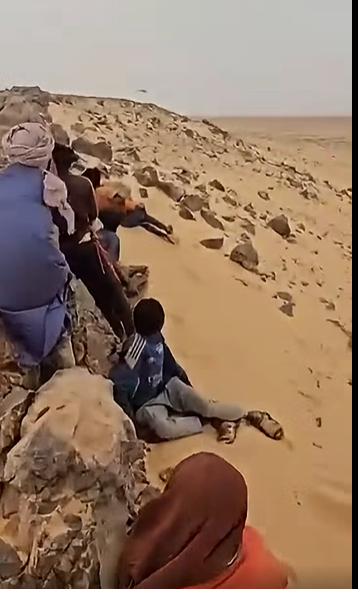
Sudanese artisanal miners take cover from a military aircraft, October 13, 2026 (Photo: Social media)
Two Egyptian truck drivers were shot dead in Khartoum on Monday, days after reported Egyptian airstrikes killed dozens of Sudanese miners near the Egyptian border, as calls grow for investigations into the deaths and protection for civilians caught up in cross border security operations.
Egypt’s Foreign Ministry said a third Egyptian national sustained injuries in the shooting at a local market in Khartoum on Monday afternoon. The ministry said Egyptian Foreign Minister Badr Abdelatty had instructed the country’s ambassador to contact Sudanese authorities, establish the circumstances of the incident and arrange the repatriation of the two bodies.
Sudanese authorities arrested a 23-year-old suspect carrying a Kalashnikov rifle, according to sources close to the police. The sources said he initially told investigators that he had acted in revenge for his brother, who died alongside Sudanese miners in the bombing near the Egyptian border.
The reported motive has not been independently verified. The shooting comes amid heightened tensions following the deaths of Sudanese miners in the border area, where Egyptian authorities have acknowledged a campaign against reported illegal gold mining.
‘El Burhan orders probe as calls for accountability grow’
Sudanese Armed Forces (SAF) Commander and Transitional Sovereignty Council President Lt Gen Abdelfattah El Burhan has ordered a fact-finding committee to investigate the deaths of Sudanese miners near the Egyptian border.
This follows a similar probe conducted in the wake of a reported attack by Egyptian forces earlier this year on June 17 and 18.
The investigation comes amid conflicting reports about the death toll, which Emergency Lawyers puts at least 72, and growing calls for transparency over the circumstances of the strikes.
The Egyptian military said it was conducting what it described as the third phase of a campaign against illegal gold extraction in the Eastern Desert, involving armed forces and civilian police after warnings to those it described as criminal elements.
The military said the operation aimed to secure Egypt’s borders and protect its national wealth. It also urged the public to rely on official information and rejected what it described as misleading rumours intended to undermine relations between the Egyptian and Sudanese peoples.
Vehicles transported surviving miners and injured people towards Port Sudan, where the city’s resistance committees announced a blood donation campaign for the wounded.
‘UN warns of mounting civilian casualties’
The United Nations Office for the Coordination of Humanitarian Affairs (OCHA) has expressed grave concern over continued airstrikes and drone attacks across Sudan, warning that civilians displaced by the war face renewed danger even in places where they sought refuge.
OCHA reported that dozens of people were killed in Saturday’s bombing of traditional gold mining sites near the Egyptian border. It also cited reports of at least four civilian deaths, including a woman and three children, in strikes on Kadugli, South Kordofan, on the same day.
In West Kordofan, a drone attack reportedly killed at least 12 civilians and injured eight at a building sheltering displaced families in En Nuhoud on Friday. Another attack in Ghubeish locality killed five civilians, including three children, in a residential neighbourhood housing displaced people.
The UN also condemned drone attacks reported to have killed more than 30 civilians near a displacement camp in Wad El Mahi, Blue Nile State, on Friday.
OCHA called for compliance with international humanitarian law, the protection of civilians and civilian infrastructure, and accountability for serious violations.
‘Egyptian initiative demands transparency and civilian protection’
Shaimaa Sami, executive director of the Egyptian Madad Initiative, called on the Egyptian and Sudanese governments to explain the circumstances of the bombing and disclose the number of people killed and injured.
Speaking to Radio Dabanga, Sami urged the authorities to grant journalists, human rights groups and humanitarian organisations access to the affected areas. She also called for medical care for the wounded, compensation for victims’ families and safe routes for civilians fleeing the conflict.
Sami warned that gold mining, smuggling, human trafficking and networks financing the war economy overlap along the border, making it difficult to distinguish those involved in illicit activities from civilians caught in the area.
She stressed that combating illegal mining and securing borders did not remove states’ obligations to protect civilians. Warning leaflets, she added, did not absolve those carrying out military operations of their duty to distinguish civilians from combatants and take all feasible precautions to prevent civilian casualties.
Sami also called for stronger humanitarian and international protection near the border, particularly for women and children fleeing Sudan, who face risks from military operations, exploitation and trafficking. She urged closer involvement by the United Nations refugee agency, the International Organization for Migration and the International Committee of the Red Cross.
The initiative stressed that civilians fleeing the war must be able to seek asylum safely and that border security operations must not come at the expense of civilian lives.

 and then