




Six-month jail term over Facebook post sparks outrage in Sudan

Ayman Hariri, member of the El Gedaref Resistance Committees, sentenced over a Facebook post (Photo: El Gedaref Resistance Committees via Facebook)
A court in El Gedaref has sentenced Resistance Committees member Ayman Hariri to six months in prison and fined him 2,000,000 SDG over a Facebook post yesterday, triggering widespread condemnation from political figures, lawyers, and civil groups.
The court convicted Hariri under Articles 24 and 25 of Sudan’s Cybercrimes Law for a post he published on April 19 2024, criticising arrests carried out at the Youth House, a building originally designated to shelter displaced people and host emergency response rooms before authorities dissolved the emergency rooms and handed the site to a security cell.
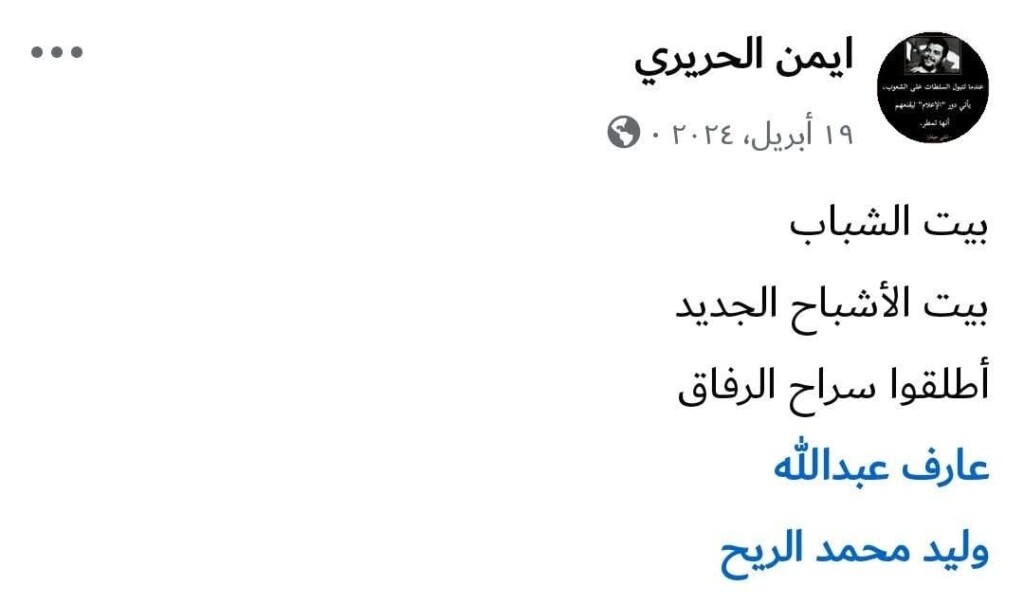
In the post, Hariri wrote:
“When the authorities panic over a mere feeling,
the ‘media’ has no role with them
except to inflame it.
The Youth House
The new Ghost House (Sudanese name for secret government ‘torture locations’)
Release the comrades
Aref Abdallah
Walid Mohamed Al Reeh”
‘A normal Facebook post’
Jaafar Khader, a civilian and political leader in El Gedaref state, told Radio Dabanga that the court punished Hariri for “a normal Facebook post” that criticised what he described as illegal practices by the security cell.
“The security cell arrests citizens using armed, masked men in behaviour that does not reflect the rule of law,” Khader said.
The security cell, formed after the outbreak of the war, includes members of the Sudanese Armed Forces, Military Intelligence, the General Intelligence Service, and the police. Rights groups have accused it of widespread violations.
Case reopened after acquittal
Khader said the court initially acquitted Hariri after the first judge concluded the post did not constitute a criminal offence. However, the security cell, acting as the complainant, appealed the ruling, prompting a retrial and the current conviction.
Lawyer Ramzi Yahya described the verdict as “a political ruling par excellence” and said it reflects a serious deterioration in Sudan’s human rights situation. “This case relates to a Facebook post protesting illegal arrests and measures,” he told Radio Dabanga.
‘Human rights collapse‘
Yahya said the ruling signals a broader “human rights collapse” that began after the 25 October 2021 coup and worsened following the outbreak of war in April 2023. He accused authorities of using the amended Cybercrimes Law to criminalise activists, social media users, and those opposing the war.
“These laws are being used to silence voices and restrict peaceful activism,” he said.
Khader linked the harsh sentence to the 2025 amendments to the Cybercrimes Law, which oblige judges to impose both imprisonment and fines. He said the law, first introduced in 2007, was designed to restrict freedom of expression rather than combat genuine cybercrime.
Calls for release
The El Gedaref Resistance Committees condemned the ruling as unjust and politically motivated, saying it aimed to intimidate activists and criminalise peaceful revolutionary action. They rejected the verdict as illegitimate and demanded Hariri’s immediate and unconditional release.
Revolutionary and civil forces said Hariri was arrested in April 2024 without clear legal grounds and subjected to repeated interrogation by unauthorised bodies, warning that his case reflects the growing politicisation of the judiciary.
Yahya called on Sudanese and international human rights organisations, including the UN Human Rights Council, to intervene urgently and support legal efforts to overturn the verdict.

 and then