




‘Presence vs absence’ at Berlin Conference, disputes over civilian representation, and exclusion of warring parties
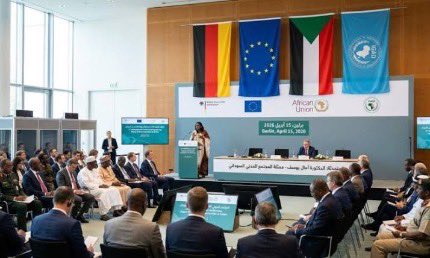
Preparatory Workshop for the Berlin Conference in Addis Ababa (File photo: Supplied)
By Suleiman Siri for Radio Dabanga
The Third International Conference on Sudan that commenced in the German capital, Berlin, this morning, is aimed at mobilising international support for peace efforts, delivering humanitarian aid and easing the worsening crisis. Some 40 political and civilian figures are taking part, while Sudan’s warring parties have been excluded. The one-day conference coincides with the third anniversary of the war that broke out on 15 April 2023 between the Sudanese Armed Forces and the Rapid Support Forces, along with allied groups on both sides. Efforts to reach a settlement have so far failed.
The announcement of the conference—organised by Germany, the European Union, the African Union, France, the United Kingdom, and the United States—has been accompanied by a counter media campaign and widespread anger over invitations and selection criteria. While some political and civilian groups welcomed the meeting, it has faced strong criticism from the governments based in Port Sudan and Nyala.
The “Tasees” administration did not object to the conference itself or its agenda, but criticised the invitation of figures it accused of fuelling the war, describing them as representatives of the Port Sudan government. That government had previously sought an invitation, according to the prime minister, but after failing to secure one, announced a boycott and launched parallel diplomatic efforts through its embassies abroad.
Prime Minister Kamil Idris confirmed this for the first time in remarks to visiting foreign journalists in Khartoum last Thursday, saying he had warned Germany’s foreign minister, Johann Wadephul, against ignoring his government.
Idris said the conference would fail without Sudan’s participation: “If the Berlin conference on 15 April does not include the government of Sudan, I can assure you, frankly and with full confidence, that it will be a complete failure.”
The government: present in absence?
However, the academic and political analyst El Nour Hamad takes a different view. He argued that claims by the Port Sudan government that it had been excluded were inaccurate, saying it had representatives attending on its behalf.
He told Radio Dabanga that these included Mohamed Sayed Ahmed, known as “El Jakoumi”, Democratic Bloc figure Mubarak Ardol, Umma Party leader Mubarak El Fadil, and others such as the lawyer Nabil Adib.
He described the government’s objections, voiced through its ambassador in Germany, as a “media campaign to mislead”.
He also criticised claims that the conference represents a broad spectrum of Sudanese civilian forces. He suggested that the Port Sudan authorities may have played a significant role in shaping the list of participants, possibly with support from unnamed regional actors backing the Muslim Brotherhood.
He linked this to earlier experiences in countries such as Egypt, saying such arrangements had historically worked against revolutionary movements and undermined democratic civilian transitions.
A contradiction with the “Quartet” approach
Hamad said he had hoped the conference would follow the line of the “Quartet mechanism” announced in September last year, which called for excluding Islamists, their affiliates and the military from power and wealth.
He expressed regret that this had not been realised, arguing that members of the Muslim Brotherhood were represented at the Berlin conference, despite having obstructed democratic transition efforts.
Based on this, he said he did not expect the conference to produce tangible results or lead to the formation of a civilian government. Instead, he suggested it might move towards reconciliation with Islamist groups and accept them as a political reality.
He also cast doubt on the prospects for mobilising humanitarian funding, warning that aid might not reach those in need if Islamist groups retained control of power.
He said the Port Sudan authorities could obstruct aid organisations and that relief supplies might be diverted into markets, describing such practices as consistent with methods used over 37 years of Muslim Brotherhood rule.
He concluded that the Berlin conference would amount to little more than a “media spectacle”, unlikely to have a real impact on developments in Sudan in the near term.
Between acceptance and rejection
By contrast, former foreign minister Ambassador Dr Ibrahim Taha Ayoub said the idea of the conference originated with the European Union, alongside other international bodies including the United Nations, the African Union, the Arab League, and the Intergovernmental Authority on Development (IGAD), as well as the United Kingdom.
He told Radio Dabanga the aim was to intensify diplomatic efforts to resolve the crisis affecting Sudan and its civilians, who, he said, had become victims of the war through no fault of their own.
He described the gathering of those opposed to the war as a last opportunity to restore peace, while noting that those who favour continuing the conflict view such efforts as foreign interference or a form of new colonialism aimed at undermining Islamist influence.
Ayoub said it was important that the Berlin meeting should lead to agreement on a political settlement acceptable to the parties, stressing that there can be no outright winner. He called for consensus on principles based on Sudan’s sovereignty, protection of citizens’ rights and agreement on transitional governance.
He also warned of international concerns about the conflict spreading to neighbouring countries and the Red Sea region.
Humanitarian issues
Ayoub said urgent priorities included strengthening humanitarian efforts, delivering food aid, and creating safe conditions for displaced people and refugees living in camps or in the open.
He added that the presence of international organisations reflected the use of both “soft and hard diplomacy”, which could help produce positive outcomes as intended by the host country and Sudan’s partners.
He said the countries behind the Berlin meeting include those forming the Quartet mechanism, and that the principles outlined in its September statement may guide the conference agenda.
He argued that the de facto government opposes the meeting because it was deliberately not invited, adding that Islamist groups, at its direction, were conducting public campaigns against it.
He added that the conference was intended to bring together advocates of peace, while excluding armed actors responsible for violence and fear among civilians.
Welcome, with reservations
Ambassador Dr El Shafi Ahmed Mohammed welcomed the conference, while expressing reservations. He said, in principle, any international effort to address humanitarian issues or armed conflict should be welcomed, provided it is genuine and serious.
He told Radio Dabanga that the conference could become complex and open to differing interpretations, noting that commentators often align with one side or another. He stressed the need for an objective assessment based on facts.
However, he questioned the seriousness of the sponsoring countries, noting that they have been involved in Sudan’s affairs since before the fall of the previous regime.
He said countries such as the United States, the United Kingdom, France, and Germany have long managed the Sudan file, whether through the Quartet or other initiatives.
Despite this, he argued, the crisis has grown more complex, eventually leading to war and widespread suffering, without tangible progress, even though those countries are aware of who initiated and funded the conflict.
A humanitarian tragedy
El Shafi said the humanitarian situation has reached critical levels in many parts of Sudan, particularly in Darfur and the city of El Fasher. He noted that despite a UN Security Council resolution calling for the lifting of the siege and the delivery of aid for more than a year and a half, it has not been implemented.
He accused those countries of acting as bystanders, and said some had specific agendas they sought to impose on Sudan, even if this risked worsening the crisis.
He suggested that calls to address the humanitarian situation often mask broader political aims, citing previous conferences in London, Paris, and the United States.
He also questioned the outcome of previous funding pledges, asking what had become of the announced aid, and said relief had not reached those in need.
He said he did not expect the Berlin conference to produce positive results, criticising the discussion of Sudan’s future without its representatives, and arguing that their absence indicates that organisers have a particular objective in mind.


 and then