




New Sudanese Declaration of Principles Forces charter ‘Towards Building a New Nation’
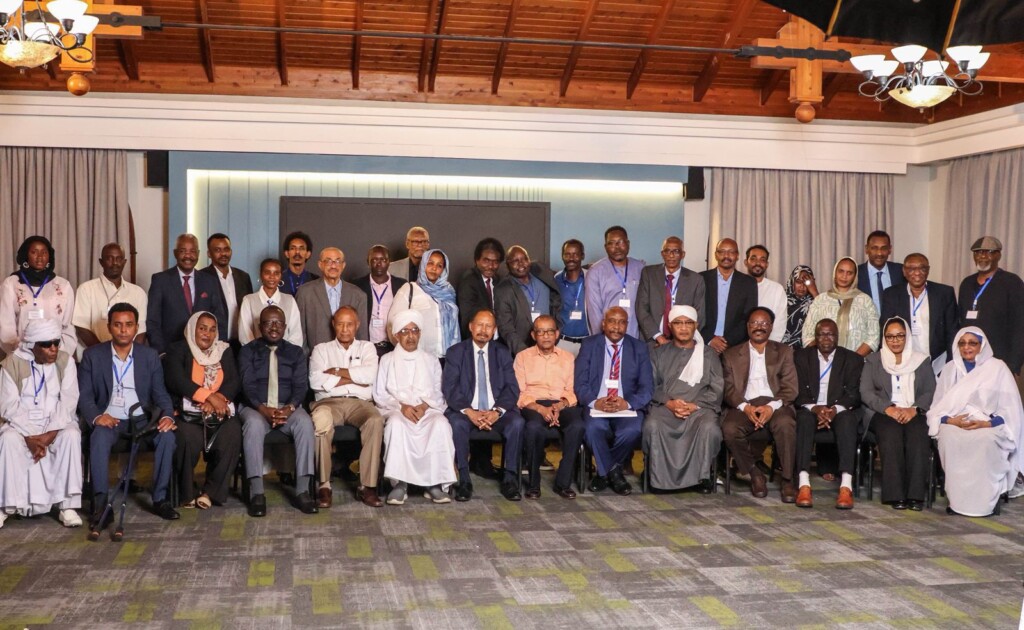
Delegates of the Sudanese Declaration of Principles Forces coalition in Nairobi last week (Photo: RD correspondent)
The Sudanese Declaration of Principles Forces coalition of leading Sudanese independent democratic civil society groups has announced the signing of a new political charter under the slogan ‘Towards Building a New Nation’ with the aim of “restoring the spirit of the Sudanese revolution and sustaining peace in the country,” they say.
The new Charter, seen my Radio Dabanga comes as an extension and development of the Declaration of Principles issued in Nairobi in 2025, seeking to unite national, civil, and social democratic forces as a fundamental step to end the senseless war that has been ongoing since mid-April 2023, protect civilians from violations, open safe corridors for humanitarian aid, and emphasises that “a comprehensive political solution is a historical duty that cannot be postponed”.
Initial responses are positive, however the National Umma Party has expressed its reservations regarding the controversial issue of separation of religion and state.
National vision
The charter stipulates a national vision that establishes a unified and democratic Sudanese state based on a decentralised federal system that separates religion and state and establishes equal citizenship as the basis for rights and duties. It also emphasises the need for the authority during the transitional period to be entirely civilian and without any participation from the military, with the rebuilding of the security and military system, including the army, police, and intelligence, according to professional and national foundations and international standards that reflect demographic diversity and are fully subject to civilian authority, while keeping them away from political work and economic activities.
Transitional justice
In the area of justice, the Charter calls for launching a comprehensive process of transitional justice and historical accountability, including handing over those wanted by the International Criminal Court and compensating the victims, in addition to dismantling the pillars of the June 30th regime and dismantling its empowerment after the October 2021 coup, banning the activities of the dissolved National Congress Party and its fronts, combating hate speech and racism, and adopting a policy of positive discrimination for the regions that suffered from wars and historical marginalisation in Darfur, Kordofan, the Blue Nile, the East and Northern State.
Economy and development
On the economic and social level, the Charter proposes a balanced development approach that favours the poor and ensures the Ministry of Finance’s authority over public funds, while launching a national plan for reconstruction and economic recovery. It also focuses on guaranteeing the rights of women, youth, people with disabilities, and children, providing free and high-quality services in the education and health sectors, reforming labor laws, and protecting the environment to address climate change and the social and psychological effects of war, thus mending the social fabric.
The permanent constitution
The charter proposes a clear mechanism for drafting a permanent constitution based on binding and irrevocable principles to protect the democratic civilian state. The signatory forces rely on peaceful means to achieve these goals, including building a unified civilian front against war, adhering to peaceful mass struggle, and rejecting any settlements that reinstate partnership with the military or war instigators. They also commit to activating regional and international diplomatic efforts to counter the rhetoric of war and support democratic transition. The charter concludes by affirming that Sudan is greater than its wars and that this covenant represents a practical step towards building a homeland that embraces everyone without exception.
NUP ‘reservations’
The National Umma Party expressed its reservations regarding the issue of separation of religion from state, indicating that “raising this sensitive controversial issue in this simplistic and direct manner is regrettable and does not serve the broad consensus that the country needs at this critical stage in its history”.
A delegation from the National Umma Party, headed by its Secretary-General, Dr. El Wathiq El Barir, participated in the meeting of the Declaration of Principles Forces, which was held last week. Representatives of the forces affiliated with the Civil Democratic Alliance for Revolutionary Forces (Somoud), headed by Abdullah Hamdok, the Baath Party, and the Sudan Liberation Movement, led by Abdelwahid, also participated.
The General Secretariat of the National Umma Party said that the party deals with its alliances with high credibility, and is “based on a deep vision that sees that issues of identity, the relationship of religion to the state, and other fateful issues are issues of complex societal, constitutional and historical dimensions, and that their natural place is the National Constitutional Conference that follows the end of the war, where they are agreed upon by all the people of Sudan without exclusion or imposing a prior will, instead of settling them through political charters that may lead to deepening divisions,” the NUM secretariat says.
However, the NUP statement endorsed the bulk what was stated in the charter “as a serious step and attempt to consolidate national visions”, and the party affirmed its” firm commitment and continued support for all national efforts seeking to end the war, restore the democratic civilian path, and build a broad civilian front that establishes the future of Sudan on the values of freedom, justice, and peace.”

 and then