





Germany: €1.5bn aid pledged in Berlin, but no Sudan ceasefire deal
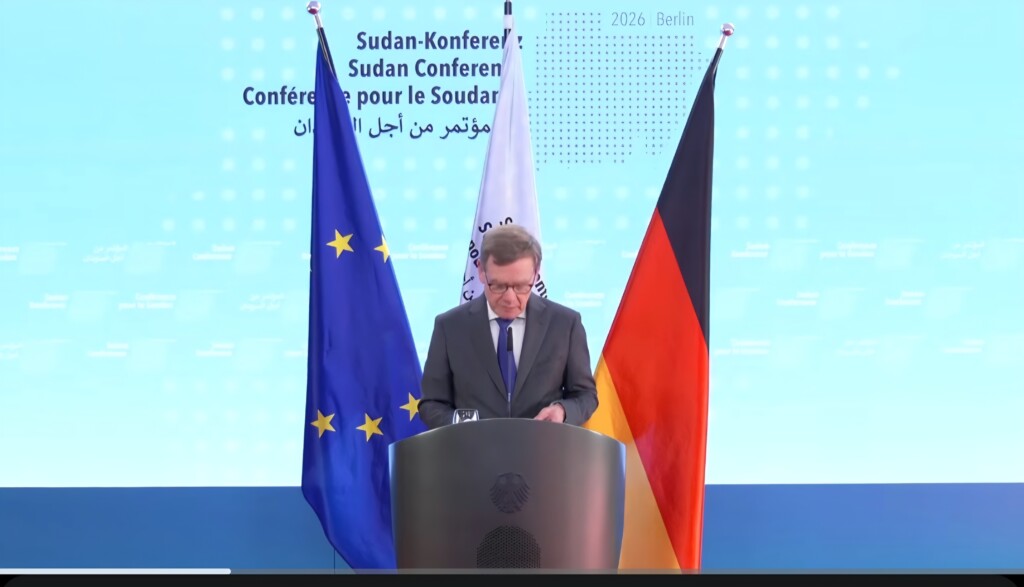
German Minister of State for Foreign Affairs, Serap Güler addressing reporters following the Berlin Conference on April 15, 2026 (Photo: German Foreign Ministry)
Germany’s Foreign Minister has confirmed the Third International Conference on Sudan, held in Berlin yesterday (May 15) failed to make progress towards securing a ceasefire in Sudan, despite international pledges of €1.5bn in humanitarian aid, and broad agreement among participants on the urgent need to end the fighting.
Speaking at a press conference on Thursday, the German Minister of State for Foreign Affairs, Serap Güler, said the gathering had not succeeded in achieving a truce or cessation of hostilities. Nonetheless, she stressed that foreign ministers and representatives from participating countries and organisations were united in calling for an immediate ceasefire and a pathway to peace.
The conference concluded on Wednesday with pledges totalling €1.5bn, alongside demands to halt hostilities, protect civilians, end external support for warring parties and allow humanitarian aid to reach those in need.
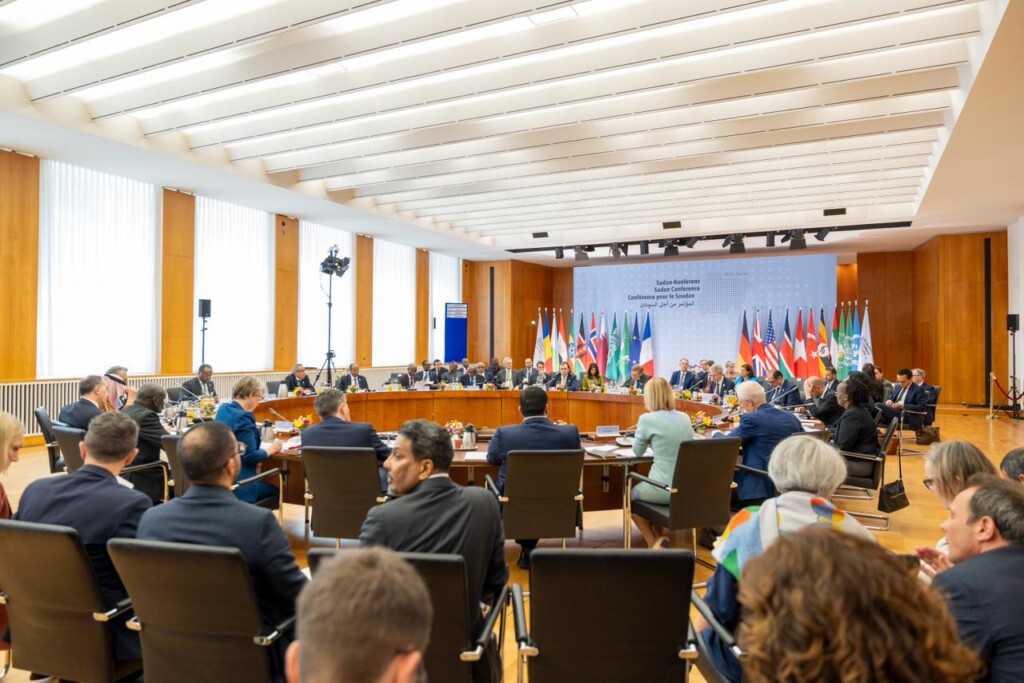
As previously reported by Radio Dabanga, in a joint statement, the organisers — Germany, the UK, France, the African Union, the European Union and the United Nations — said 55 countries had taken part, along with UN agencies, financial institutions and 38 Sudanese non-governmental organisations.
The meeting marked the third international conference on Sudan, following earlier gatherings in London and Paris, and came three years into a war that has triggered a profound humanitarian crisis.
Notably, the organisers did not invite the two main warring parties to the conflict, citing their failure to make meaningful progress towards peace or a ceasefire.
Major funding pledges
Güler said total commitments had reached €1.5bn. Germany pledged €232m in humanitarian assistance for Sudan and neighbouring countries, while the EU and its member states committed €811m.
The European Commission said more than €360m had been allocated, including over €215m for Sudan and more than €145m for neighbouring countries hosting refugees. At least 25% of humanitarian funding, it added, would go to local organisations, alongside the creation of a programme to protect aid workers.
Saudi Arabia also pledged $145m this year.
Güler said Germany would channel support through UN agencies, NGOs, and emergency response groups. “I told officials in Port Sudan that humanitarian aid must reach all areas, including those under the control of other parties,” she said.
She added that funds would be mobilised over the course of the year through existing mechanisms, noting a clear willingness among international actors to contribute.
Pressure on warring parties
Asked about concrete steps to end the war, Güler said the conference sent a clear message that the conflict in Sudan had not been forgotten despite other regional crises.
“The next steps include maintaining international pressure on the parties to the conflict,” she said, adding that the international community would continue to monitor developments closely.
She suggested the war had persisted in part because both sides believed they could continue without consequence. “That assumption is incorrect,” she said.
Civil society breakthrough
Güler described a parallel meeting of around 40 Sudanese civil society figures as one of the conference’s most significant achievements. Despite three years of divisions, participants agreed on a joint position, supported by efforts from a five-member facilitation group.
Civil society representatives issued a joint statement — which Güler described as the most impactful moment of the conference — declaring their readiness to assume a political role in a future transition. She said this signalled that a political solution remained possible, though she cautioned it was only a first step.
The EU’s special envoy for the Horn of Africa, Annette Weber, is expected to visit Port Sudan next week for further talks.
Mixed Sudanese reactions
Sudanese political figures offered differing assessments of the conference.
Siddiq Tawir, a Ba’ath party leader, described the Berlin meeting of political and civil forces as an important step, bringing together a broad spectrum of Sudanese actors for the first time. He said their joint appeal called for an immediate end to the war, serious measures to address the crisis and conditions for a Sudanese-led political process, alongside commitments to national unity, democratic civilian transition, and increased humanitarian support.
Mubarak Ardol, head of the Democratic Alliance for Social Justice, said the joint declaration by more than 40 Sudanese figures was a significant achievement despite the challenges involved. He noted that it called for ending the conflict and launching an inclusive political process leading to a civilian transitional government and eventual elections, while acknowledging shortcomings in representation.
Legal expert Saleh Mahmoud said the final declaration covered seven key areas, including ending the war, protecting civilians, facilitating aid, and pursuing justice. He added that the document was not final and would be shared with groups that did not attend. He also highlighted what he described as a unified international stance and renewed global attention on Sudan.
The Sumud coalition similarly described the document as an important step towards a unified civilian position to end the war. Its leader, Abdalla Hamdok, said the conference reflected genuine international political will to intensify efforts to bring the conflict to an end.
Government rejection
In contrast, Sudan’s prime minister, Kamil Idris, dismissed the Berlin conference, saying it did not represent the Sudanese government or people and that its outcomes were therefore irrelevant.
Speaking at a press conference in Khartoum on Wednesday, he criticised organisers for not inviting the government, calling the omission a “grave mistake” that signalled the conference’s likely failure.
He said Sudan’s government and people would not accept partial solutions, pointing to protests rejecting externally imposed proposals. Had the government been invited, he added, it would have participated and “set out the facts”.


 and then