





Ethiopia summons Sudan ambassador over drone attack allegations
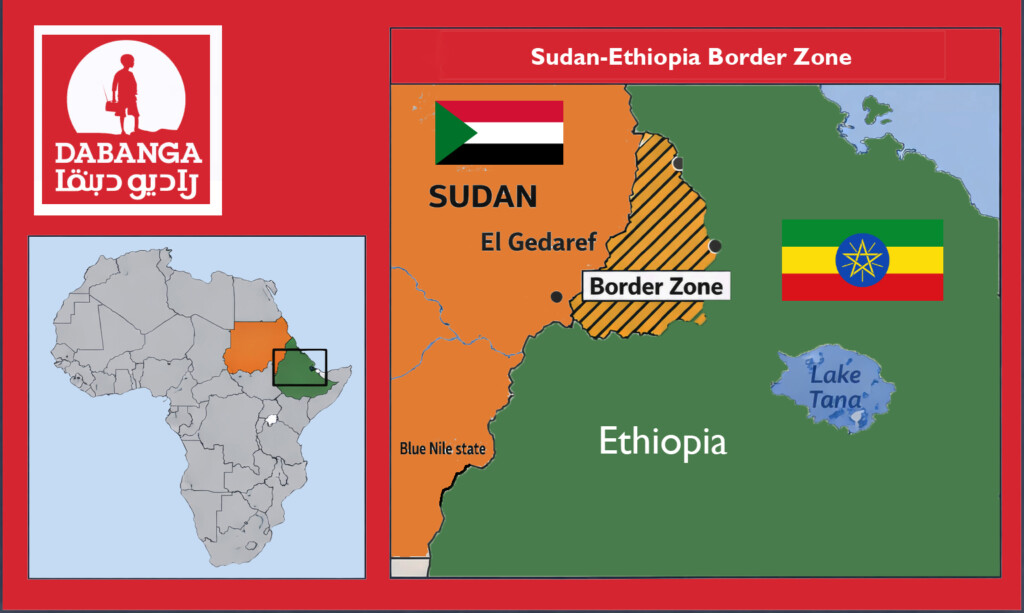
Sudan-Ethiopia Border Zone Map (RD)
Ethiopia’s Foreign Ministry has summoned Sudan’s ambassador to Addis Ababa following accusations by Khartoum that drone attacks on Sudanese territory were launched from Ethiopia. The move came after a statement by Sudan’s Foreign Ministry accusing Ethiopia of interference and alleging that drones entered Sudan from Ethiopian territory and struck targets inside the country.
According to Al Jazeera, an Ethiopian diplomatic source said the Foreign Ministry informed the Sudanese ambassador it “completely rejects” the accusations, describing them as false claims intended to cover up what Addis Ababa says is Sudan’s support for and recruitment of rebels from within Ethiopia. Ethiopia also reiterated its position of neutrality regarding the conflict in Sudan.
Mutual accusations
Khaled Mohamed Taha, a journalist and researcher on the Horn of Africa and the Red Sea, said tensions between Sudan and Ethiopia appear to have moved beyond media exchanges.
In an interview with Radio Dabanga, Taha said reports of drone strikes that caused displacement in Sudan’s Blue Nile state, along with alleged sightings of Ethiopian military units inside Gezira state, suggest the situation resembles an undeclared confrontation rather than a simple exchange of accusations.
Taha added that Ethiopia has accused Sudan of recruiting fighters from the Tigray region to participate in the Sudanese conflict, reflecting a shift from border tensions to the use of each country’s internal conflicts against the other.
International context
Taha said both countries appear to be adopting what he described as a strategy of “acknowledgment and postponement,” maintaining political escalation without formally declaring open confrontation while awaiting shifts in regional and international dynamics.
“What is happening cannot be separated from the broader regional environment,” he said, citing heightened tensions between the United States and Israel on one side and Iran on the other, which he said could create openings for regional powers seeking to reposition themselves.
Taha noted that Ethiopia, which sees itself as an emerging regional power with economic and military ambitions, may view the current period of geopolitical uncertainty as an opportunity to expand its influence, particularly along its borders and in Red Sea security dynamics.
Timing of Sudan’s statement
According to Taha, the timing of Sudan’s accusation of direct Ethiopian involvement in the war appears both defensive and pre-emptive, signalling that Sudan’s eastern border is not an open arena and that its airspace has become a red line amid the growing use of drones in regional conflicts.
He warned that any escalation between Sudan and Ethiopia could deepen uncertainty in the Red Sea region. Such tensions, he said, could increase the militarization of strategic corridors and heighten risks to maritime navigation and international trade.
Taha also said that rising tensions along Sudan’s eastern border could complicate efforts to resolve the war inside Sudan.
“Opening an eastern front would disperse military resources, complicate settlement efforts and give the conflict a deeper regional dimension,” he said, adding that this could prolong the war and tie it more closely to broader geopolitical competition in the Horn of Africa and the Red Sea.



 and then