




Denmark, UK, France back US proposal to expand Sudan arms embargo – China, Russia oppose
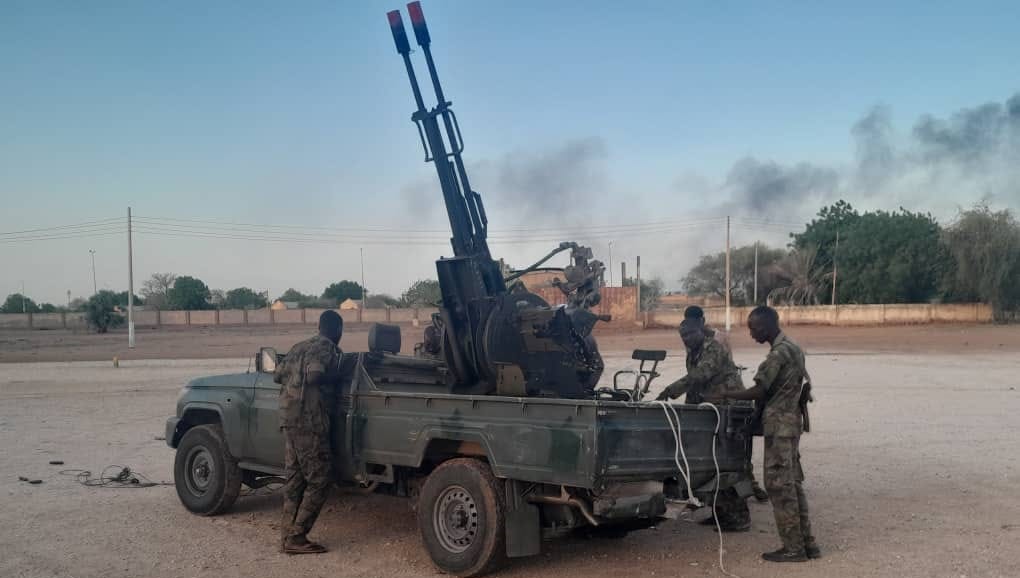
Sudanese Armed Forces soldiers in Khartoum (File photo: SAF media)
A US proposal to expand the arms embargo on Darfur to cover drones and the whole of Sudan has prompted widespread reactions among representatives of countries taking part in Monday’s UN Security Council session on Sudan. Representatives of Denmark, Britain, and France backed the US proposal, while China, Russia, and Sudan’s UN representative opposed it. Sudan’s army chief and head of the Sovereignty Council, Abdelfattah El Burhan, meanwhile, played down the potential impact of any additional sanctions or embargo on the country in a speech at a police graduation ceremony in Khartoum.
As reported previously by Radio Dabanga, the USA has proposed expanding the arms embargo currently imposed on Sudan’s Darfur region to cover the entire country, in an attempt to stem the flow of weapons and drones fuelling the war that has continued since April 2023.
Massad Boulos, the US president’s senior adviser for Arab and African affairs, told the UN Security Council session on Sudan on Monday that more than 12 countries were providing various forms of military support to the two warring parties, helping to prolong the conflict and increase civilian casualties.
The US proposals include clarifying that the arms embargo covers drones, their components, and related technologies, as well as strengthening the capacity of the panel of experts responsible for monitoring sanctions and increasing its cooperation with other UN sanctions teams and panels.
Call to extend ICC jurisdiction to all of Sudan
Denmark’s foreign minister, Lars Løkke Rasmussen, whose country holds the Security Council presidency for August, also called for the jurisdiction of the International Criminal Court to be extended to cover the whole of Sudan.
Speaking to the session, Rasmussen said the Security Council had a responsibility to stop the war, which he said was destabilising the entire region. He called for a humanitarian truce leading to a ceasefire, describing it as “the only way to achieve genuine protection for civilians”.
Russia’s representative to the Security Council, Vasily A Nebenzya, said his country opposed the US proposal to expand Security Council sanctions or the arms embargo on Sudan.
“Recently, we have heard worrying assessments of the expanding use of combat drones in the context of the Sudanese conflict, amid calls for a comprehensive ban on supplying the country with these systems and related technologies,” Nebenzya told the council. “We agree that attack drones pose a serious threat.”
Nebenzya said the Rapid Support Forces did not use drones merely in a random and indiscriminate manner, but often deployed them with the aim of causing the greatest possible damage to civilian infrastructure and civilian populations. By contrast, he said, the Sudanese Armed Forces sought to be precise when carrying out attacks.
“It is unacceptable to claim that both sides of the conflict bear equal responsibility for the consequences of weapons use,” he said, arguing that one side was spreading chaos and violence, while the other was essentially conducting an operation to neutralise those who were, in reality, rebels destroying the country.
‘Sanctions are borne by Sudanese citizens’
The Russian representative also expressed dissatisfaction with sanctions imposed on Sudan, pointing to an EU ban on imports of Sudanese gold imposed last July. He said Washington had also expanded its restrictions, including a ban on international financial institutions providing credit, or financial and technical assistance, to Sudan.
“We consider such measures unacceptable and hostile towards the country’s government,” he said. “At a time when the Sudanese economy is suffering from years of conflict, and the state needs resources more than ever to rehabilitate the health sector, water supplies, agriculture, and other essential infrastructure, this policy of economic strangulation raises serious questions.”
He stressed that ordinary Sudanese would ultimately bear the greatest burden of the consequences of the new restrictions.
“From the same perspective, we view any attempts to expand the existing UN Security Council sanctions regime against Sudan,” he said. “We are convinced that the way to alleviate the suffering of the Sudanese people does not lie in continuing to drain the Sudanese economy, but in ending hostilities, expanding humanitarian assistance, and supporting the country’s recovery efforts.”
China opposes external solutions
China’s representative praised steps taken by Sudan’s government to facilitate humanitarian operations, saying that sanctions were a means rather than an end in themselves.
He stressed that the Security Council should respect Sudan’s sovereignty and institutions, adding that China did not support imposing external solutions on the country.
Khartoum rejects expansion
Sudan’s representative to the UN, El Harith Idris, rejected the expansion of the arms embargo beyond its current scope during the Security Council deliberations.
He said the draft resolution would effectively equate the army with the Rapid Support Forces and undermine Sudan’s sovereignty. Idris called on the Security Council instead to renew the existing measures while strengthening their enforcement against those violating the arms embargo, and to subject external networks supplying weapons and drones to greater scrutiny.
He said the government was committed to protecting its citizens to the greatest extent possible, having established a national mechanism for civilian protection and worked to facilitate the return of displaced people. By the end of June, he said, 5.8 million voluntary returns had been recorded.
Idris said the government remained committed to international humanitarian law and international human rights law, and that security forces were redeploying as control over territory was restored.
‘The people will not break’
In Khartoum, army chief and Sovereignty Council head Gen Abdelfattah El Burhan said talk of possible sanctions against the country would have no effect and would not weaken Sudan’s resolve.
Speaking on Monday at a graduation ceremony for the 22nd intake of police officers at the Police Sciences and Law College in Khartoum, El Burhan said: “Our lives and our destiny are in God’s hands.”
He urged Sudanese not to pay attention to what he described as claims by “enemies and those with ulterior motives” about the imposition of a no-fly zone over the country.
“Our message to those staying in hotels abroad and applauding sanctions to subjugate the Sudanese people is that the people will not break, and collapse and disappointment will befall you,” he said.
He added that those people would not be able to rule the Sudanese people again.
Editor’s note: This article was translated from Arabic with the assistance of artificial intelligence, and subsequently reviewed and adapted by a human editor before publication.


 and then