





‘Atrocities persist in El Fasher one year after RSF takeover’
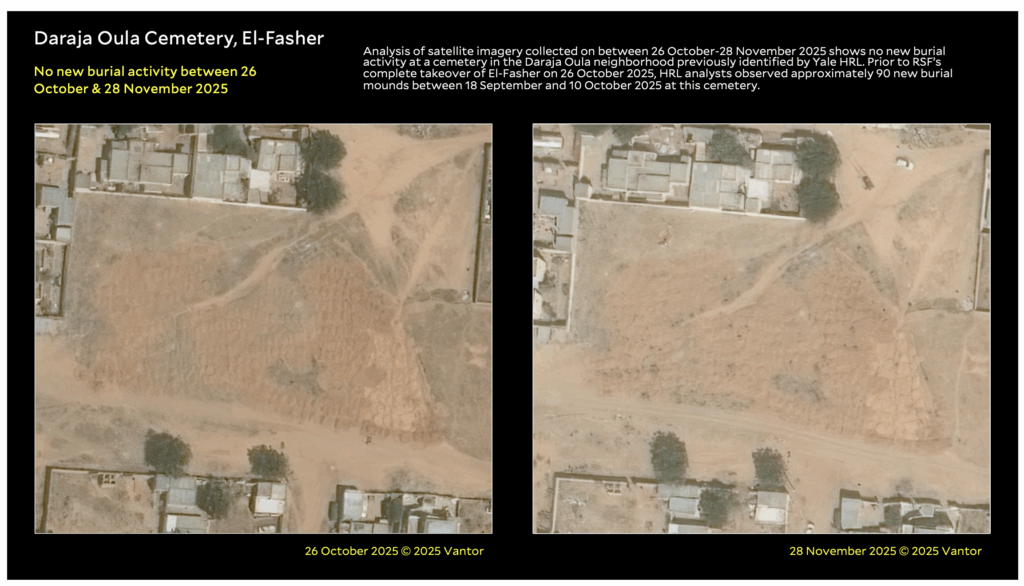
Satellite imagery in Daraja Oula Cemetery, El Fasher, shows no new burials between 26 October and 28 November 2025, despite around 90 burial mounds recorded there in the weeks before the RSF takeover (Photo: Yale HRL / Vantor)
Amnesty International says civilians face arbitrary detention, torture and restricted humanitarian access, as international coalition calls for accountability over atrocities in North Darfur.
Civilians in El Fasher, the capital of North Darfur, continue to face arbitrary detention, torture, unlawful killings and restricted humanitarian access one year after the paramilitary Rapid Support Forces (RSF) seized the city, Amnesty International said on Friday.
In a statement by Amnesty International, published ahead of the first anniversary of the takeover on 26 October 2025, the human rights organisation said schools had been turned into detention centres, residents faced constant surveillance and children remained at risk of malnutrition.
Amnesty interviewed 25 civilians, including 19 residents and six humanitarian workers, in August and September 2026. Of the 19 residents interviewed, 17 said they had been detained by the RSF, often for months.
“The RSF’s claims that El Fasher is safe for civilians to return to after the horrific massacres that took place one year ago could not be further from the truth,” said Agnès Callamard, Amnesty International’s Secretary General.
“A pervasive pall of fear hangs over El Fasher today. Men and women live under constant RSF surveillance, and with the ongoing threat of detention, torture and killing,” she added.
Survivors described beatings, unlawful killings and severe shortages of food and water in detention. Amnesty also documented forced labour, including making detainees collect bodies and rubble or cook and clean for RSF members without pay.
The organisation said fewer than 70,000 people remained in El Fasher, compared with a pre-war population of more than one million. Humanitarian workers also warned of rising malnutrition risks amid limited aid access and a poor harvest season.
The RSF had not responded to Amnesty’s findings by the time of publication, the organisation said.
‘Int’l coalition urges respect for UN sanctions and embargo’
The Coalition on Atrocity Prevention and Justice for Sudan marked the anniversary by calling for accountability for crimes committed in and around El Fasher.
In a statement by the coalition today, whose members include the United Kingdom, France, Germany, Canada and the European Union, said findings by the UN Independent International Fact-Finding Mission for Sudan had exposed the scale of violations of international humanitarian law and abuses of international human rights law.
It said civilians had suffered mass killings, ethnically motivated killings, summary executions, torture, disappearances, forced recruitment, arbitrary detention and widespread sexual and gender-based violence.
“One year after El Fasher, our message is clear: the victims will not be forgotten, survivors will be heard, and we will continue to pursue accountability for those responsible,” the coalition said.
The coalition called on all parties to protect civilians and ensure safe, rapid and unimpeded humanitarian access. It also urged states to stop arming, financing or otherwise enabling the war, and to respect UN sanctions, including the arms embargo on Darfur.
‘North Darfur gov calls for accountability’
North Darfur Governor Hafiz Mohamed Bakhit alleged that the RSF committed 320 cases of gang rape at El Fasher University and said 140 mass graves had been established around the city.
He described the destruction of homes, hospitals, schools and displacement camps, alongside killings targeting civilians on ethnic grounds, as war crimes and genocide.
Survivors and refugees in eastern Chad described losing family members and enduring harsh living conditions, calling for an end to the war, accountability for violations and the safe return of displaced civilians.
Abu Hassan, a survivor of the fall of El Fasher, described October 26 as a catastrophic day that would never be erased from memory.
He recalled women, children and elderly people fleeing the city in fear, many of whom ended up in camps and shelters lacking basic necessities.
He said displaced people continued to suffer, urging the warring parties to end the fighting, pursue peace and ensure civilians could return to their homes as soon as possible.
“What have we gained from this war so far, other than death, destruction, displacement and hatred?” he asked.



 and then