




Adlan Yousif: the Sudanese sculptor turning ‘iron of tragedy’ into global portraits of resilience
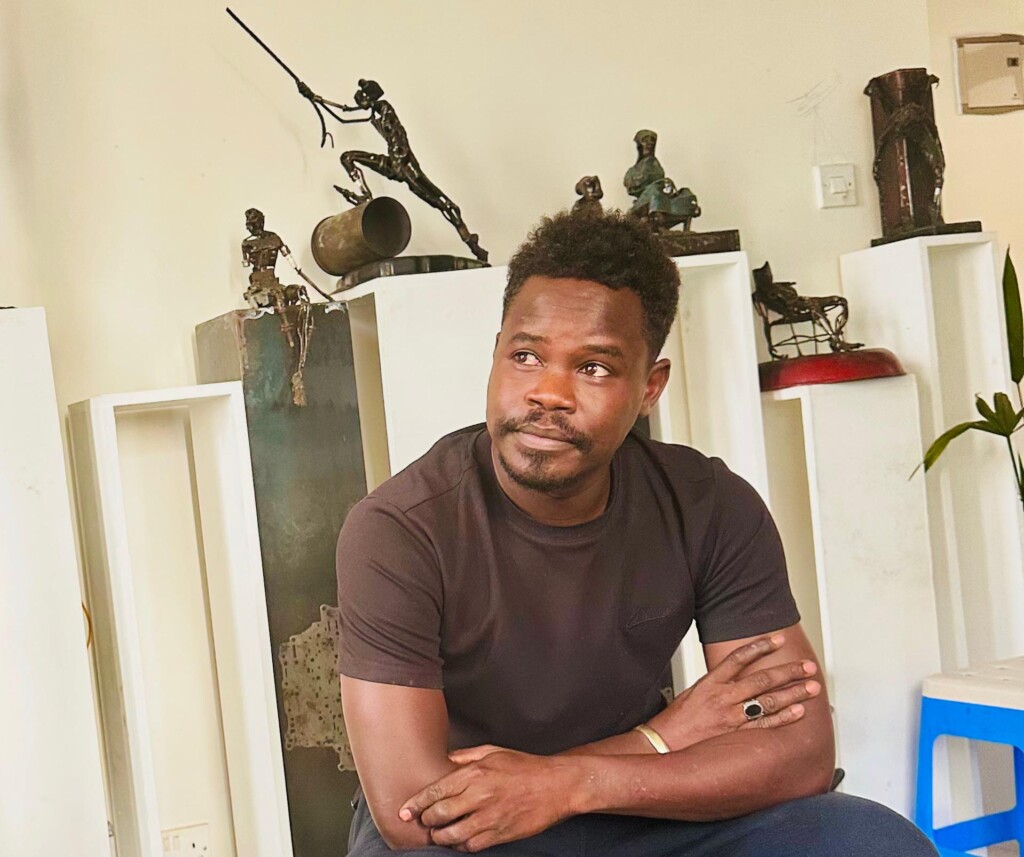
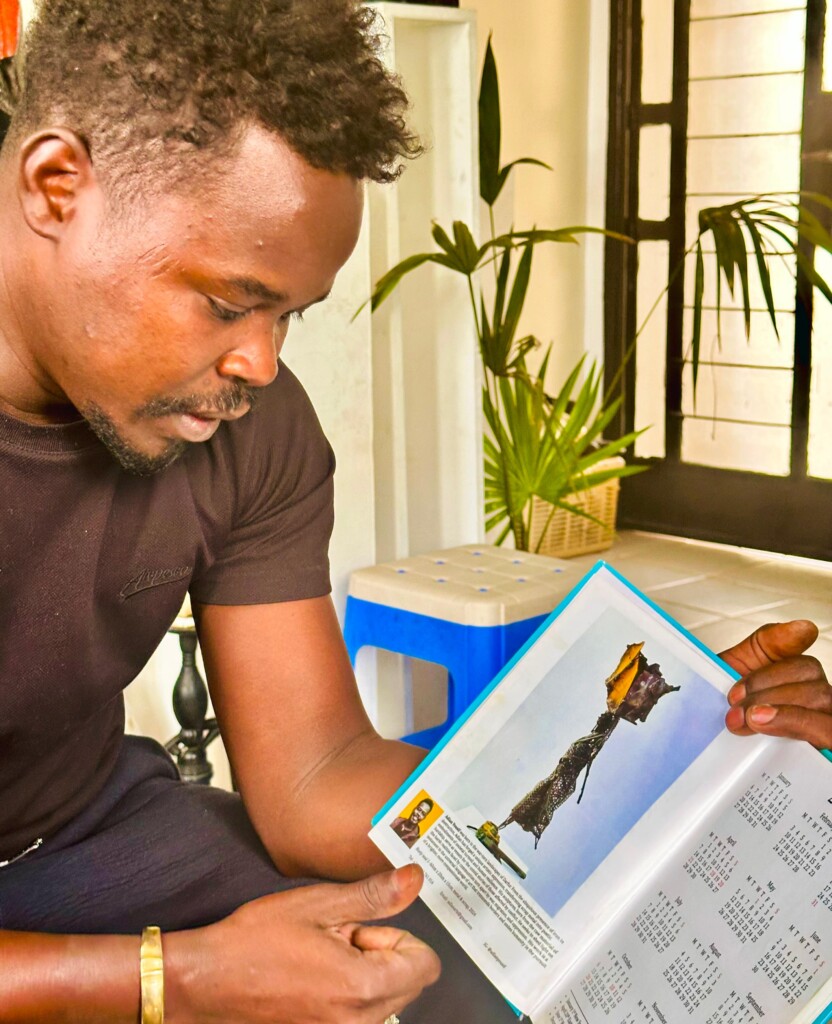
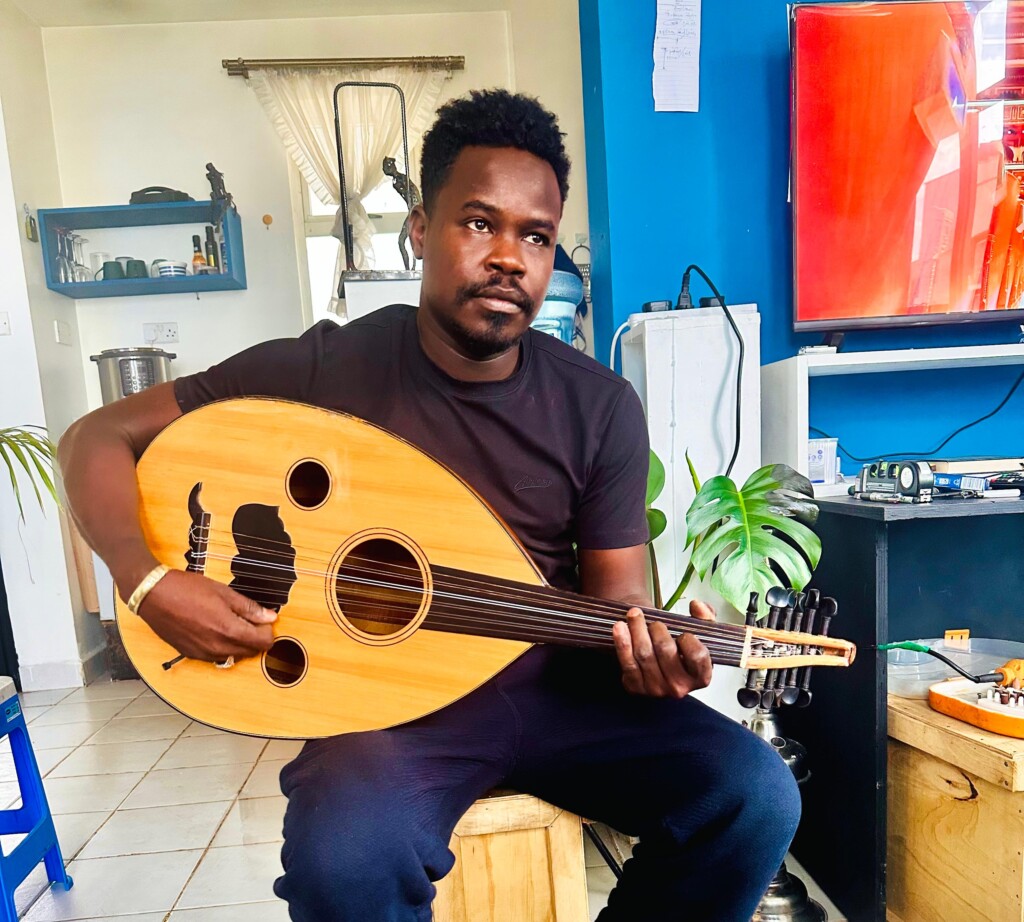
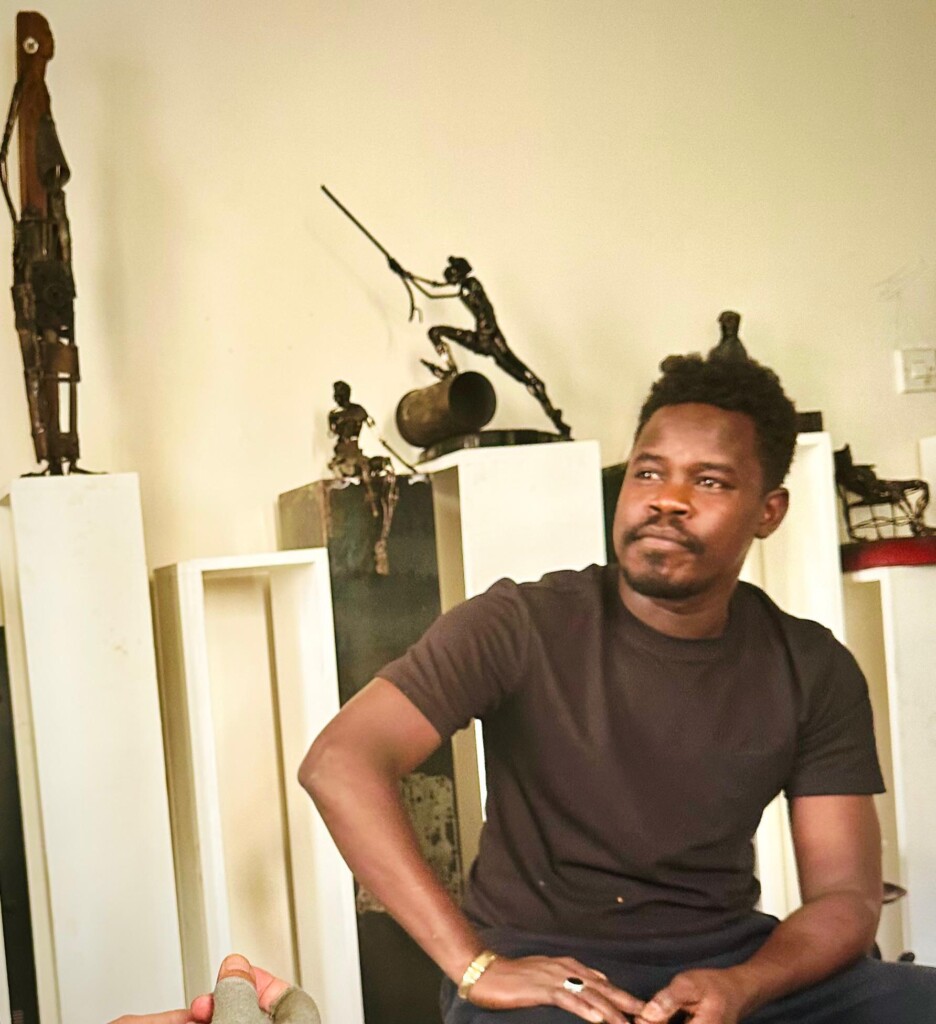
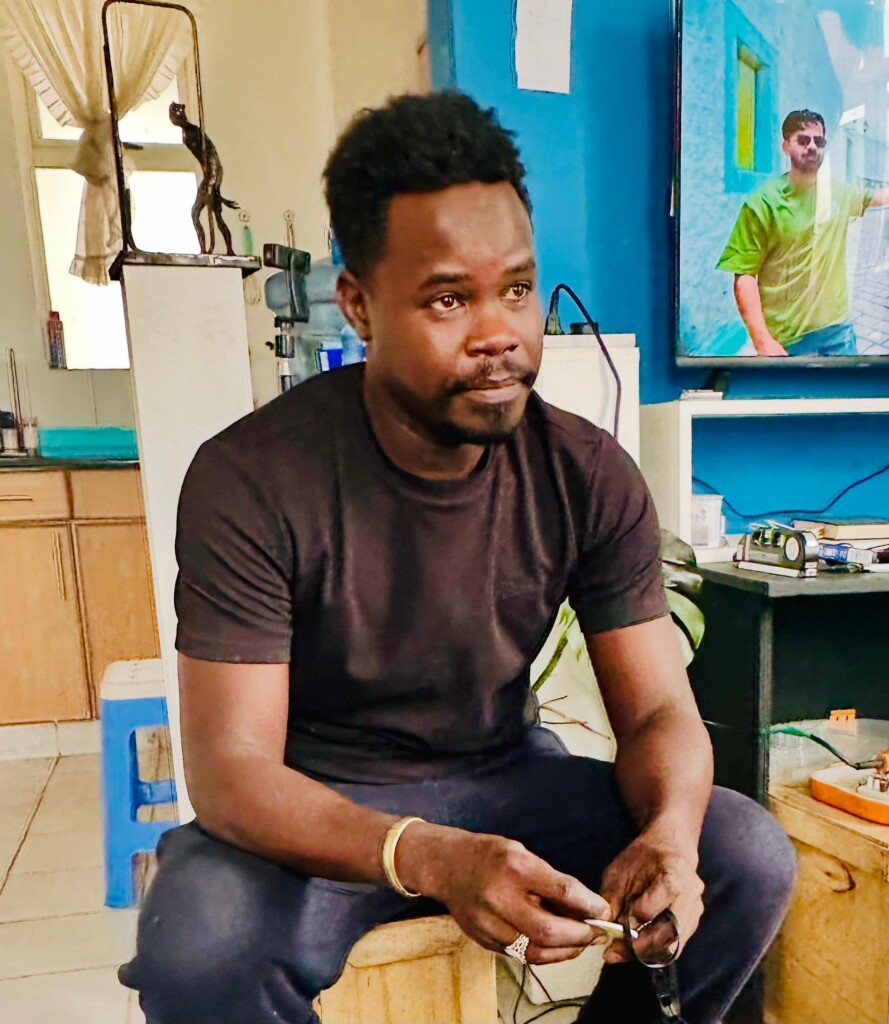
Sudanese artist and sculptor, Adlan Yousif, during an interview with Radio Dabanga at his home in Nairobi (Photo: RD)
From the wreckage of war, Sudanese artist and sculptor Adlan Yousif salvages scrap metal and transforms it into works of art that carry memories of pain and tell stories of displacement, loss, and resilience. In his sculptures and paintings, metal becomes a witness to a war that has left deep scars on people and the land, while his work seeks to bring aesthetic and human value to the ruins, carrying messages of peace.
Yousif tells Radio Dabanga, in an interview at his home in the Kenyan capital, Nairobi, that his artistic practice has taken shape around personal and collective memories burdened by war. Its roots lie in his childhood in Darfur, where he lived through the events of 2003 and 2004, moving between Kabkabiya and El Fasher.
There, he witnessed destruction and suffering, and saw how green spaces were transformed into near-desert landscapes under the weight of hunger and siege. Those scenes never left his memory. Instead, they became part of his artistic identity and the starting point for works that express Sudan’s tragedy, not as a series of passing events, but as an enduring human experience that leaves its mark on individuals and communities.
From scrap metal to the memory of war
Yousif chooses scrap metal as the principal material for his sculptures. It is, he says, a remnant of war, once used to kill and displace people.
Speaking to Radio Dabanga at his home in Nairobi, he explains that material bearing the marks of violence and destruction can be transformed into a means of expressing tragedy and calling for peace.
“Scrap metal is a military material that was used to kill and displace people,” he says, reflecting on whether it can be transformed into something of aesthetic value that tells the story of what happened and helps people understand the causes of wars and how to avoid them.
Yousif does not seek to conceal the material’s harshness or erase its history. Instead, he draws on its solid, uncompromising presence to express the fragility of human life in the face of violence.
In this way, the remnants of war become a visual language that recalls what people have lost and opens up space for reflection on the meaning of survival and the possibility of rebuilding.
The pain in Adlan Yousif’s sculptures
The death of Yousif’s mother in November 2025 was not simply a personal loss. It marked a painful turning point in his artistic journey, leaving a clear imprint on his sculptures and other works.
He tells Radio Dabanga that losing his mother led him to stop working for nearly two months. When he returned to art, he carried with him the memory of his mother and the pain of her absence.
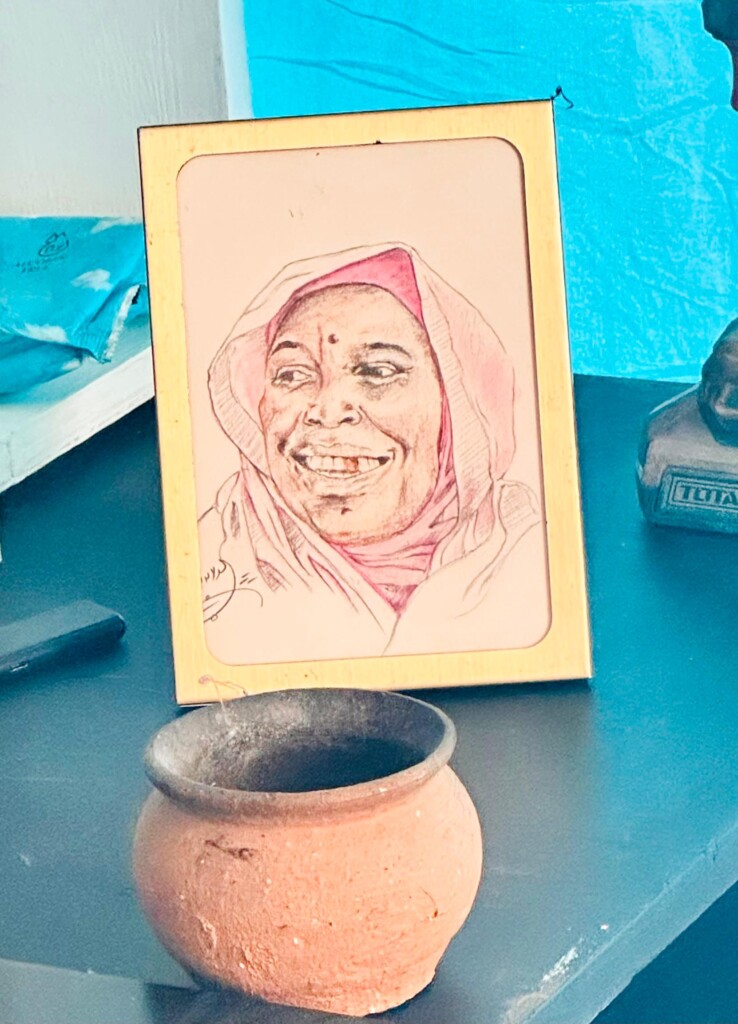
His work became a space in which to recall her image and document the stories of mothers whose lives have been touched by war.
The image of the mother in his paintings extends beyond his own experience, becoming a symbol of Sudanese women and the loss and suffering they endure, particularly in El Fasher.
Through his modelling of clay and his evocation of the female form and the figure of the mother, Yousif seeks to give women who have died a presence that transcends death and oblivion. He also seeks to affirm that the mothers who lost their lives in the war deserved a safe life and the peace they were never given the chance to enjoy. In this way, his mother’s presence in his memory becomes a human thread running through his work, with sculpture serving as a means of preserving faces and stories.
‘Deprivation’: a lone child in a landscape of loss
Yousif recalls his first solo exhibition, Deprivation, which placed the experience of loss and displacement at the heart of his work.
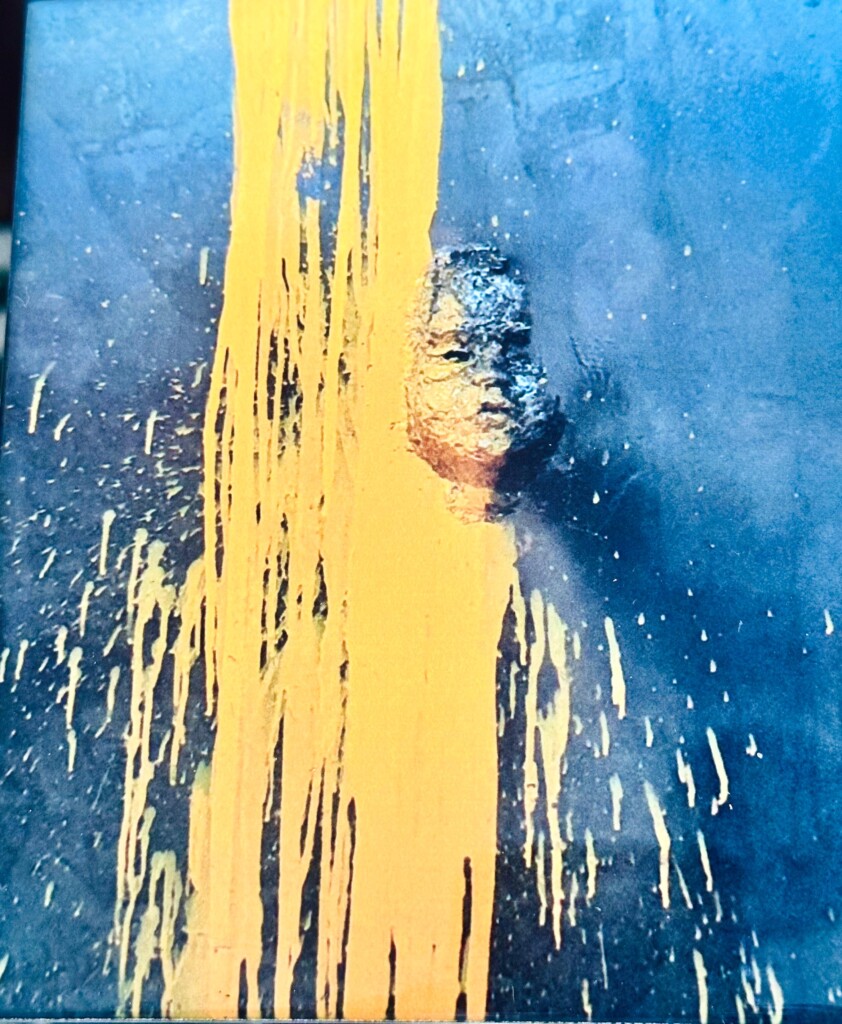
One of the exhibition’s most striking pieces is a large painting dominated by an expanse of yellow. Yousif explains that the colour represents desertification, drought, and deprivation.
At its centre is the face of a single child, set against the vastness of yellow: an image of a human being left alone in a world stripped of the conditions necessary for life.
Through this visual contrast between the vast landscape and the solitary face, Yousif evokes the suffering of civilians, particularly children, amid forced displacement, hunger and killing.
But the title Deprivation carries more than a general meaning. It also refers to a deeply personal experience that the artist himself endured.
He lost his mother during the war, as well as relatives, neighbours, and loved ones in El Fasher, in western Sudan, while he was far away from them.
Since then, he has continued to paint her, saying that she is always present.
In the repeated appearance of his mother, painting becomes a way of resisting absence and attempting to preserve a bond that war cannot sever.
Embodying women’s resilience in the face of war
Sudanese women occupy a prominent place in Yousif’s artistic practice. He sees them as symbols of generosity and resilience in the face of war and violations.
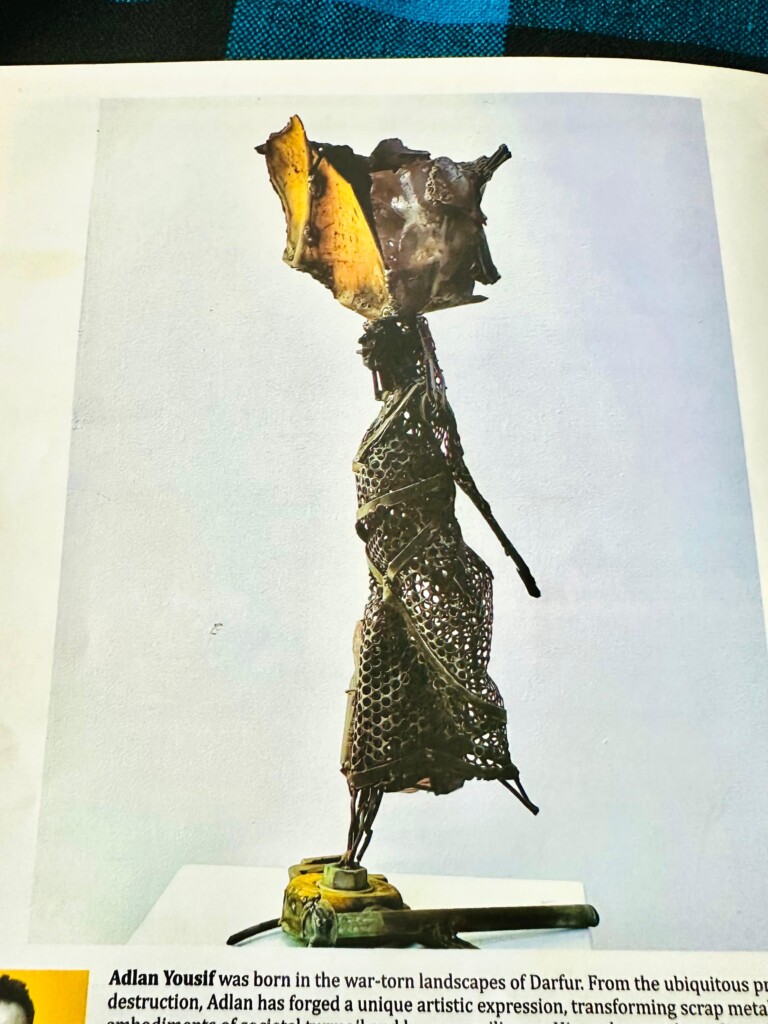
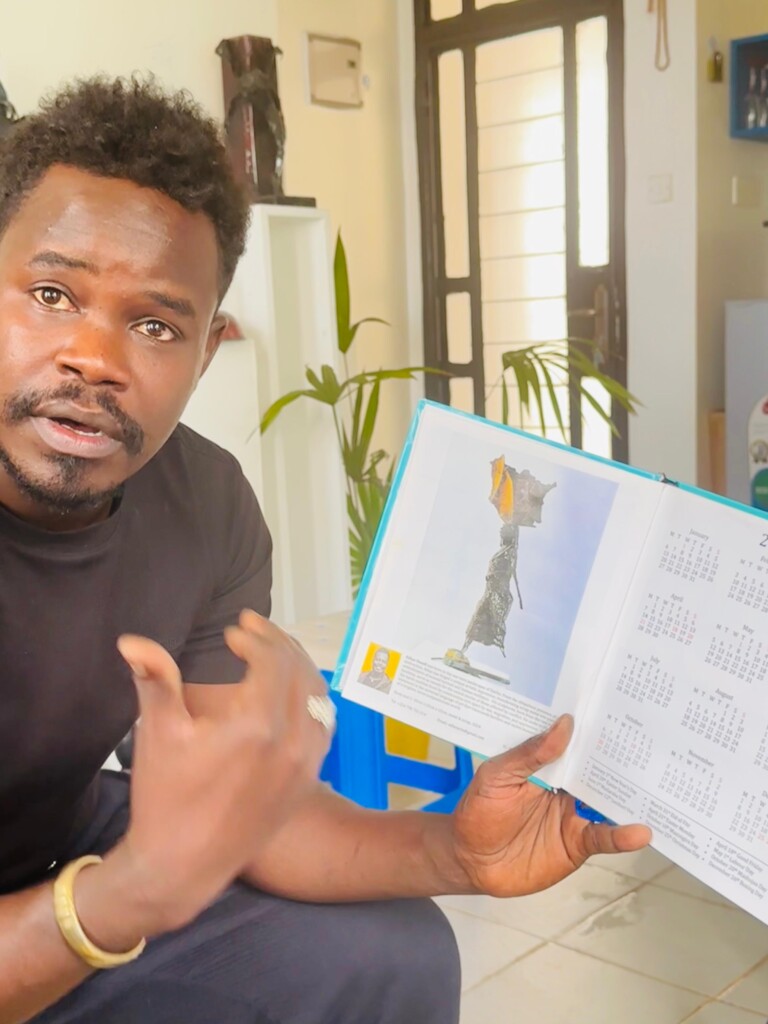
One of his most notable works is a sculpture of a woman carrying burdens on her head, despite having lost a leg and an arm.
The work portrays a woman physically exhausted by war, yet still able to give and continue living.
The sculpture is permanently displayed at the Nairobi National Museum and also appeared in the 2025 edition of the Kenya calendar.
Its meaning extends beyond physical injury, pointing to the burdens borne by Sudanese women during the war and the violations they face, including sexual violence, while continuing to care for their families and communities.
Yousif gives women a central place in the story of the war, not simply as victims, but as a force capable of enduring and continuing to live despite the pain.
He also responded to an incident that shook the conscience of the Sudanese people.
In September 2025, a shocking video circulated on social media showing a Sudanese girl, Qisma Ali Omar, hanging from a tree, bound with ropes and subjected to brutal torture that led to her death. The perpetrators were reported to be members of the Rapid Support Forces wearing their uniforms, in Zalingei, in central Darfur.
According to reports and news platforms, the accusation against her was that she had sent a voice message.
Yousif created a sculpture expressing the tragedy, drawing public attention to the horrific violations documented in the work.
Art as a voice for peace
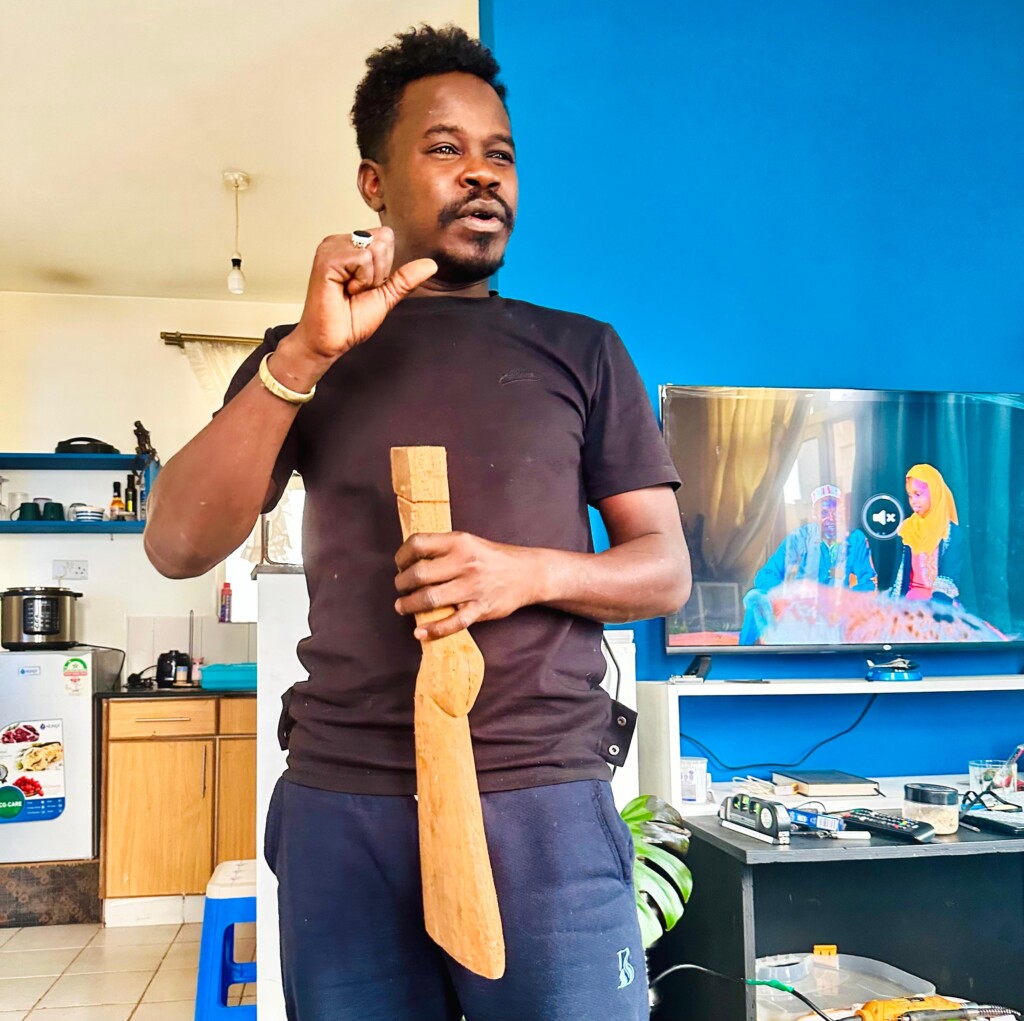
Yousif has created numerous artworks in opposition to war. One project carries a clear symbolic meaning: a piece that can be dismantled and reassembled, initially resembling the buttstock of a rifle before transforming into a microphone.
He calls it The Buttstock.
The work, he explains, embodies the idea of turning instruments of war into tools for dialogue and peaceful expression. Its message is that weapons should give way to words, and that the voice of art can replace the sound of bullets.
Yousif tells Radio Dabanga that his talents are not confined to sculpture and painting. He is a multi-talented artist who plays eight musical instruments, including the oud and the organ.
His parents supported his talents from childhood, and he sometimes uses music as a soundtrack for his documentary films.
He believes that art, in all its forms, is a human language capable of transcending borders, uniting peoples and helping to build a more humane society.
Yousif advises families to support their children’s artistic talents from an early age. He believes that art gives them a means of expressing themselves, allows them to say what words sometimes cannot, and enables them to contribute to building a more beautiful and peaceful world.
Taking Sudan’s memory to the world
Yousif’s artworks have been exhibited in the United States, Canada, Australia, Asia, and Europe.
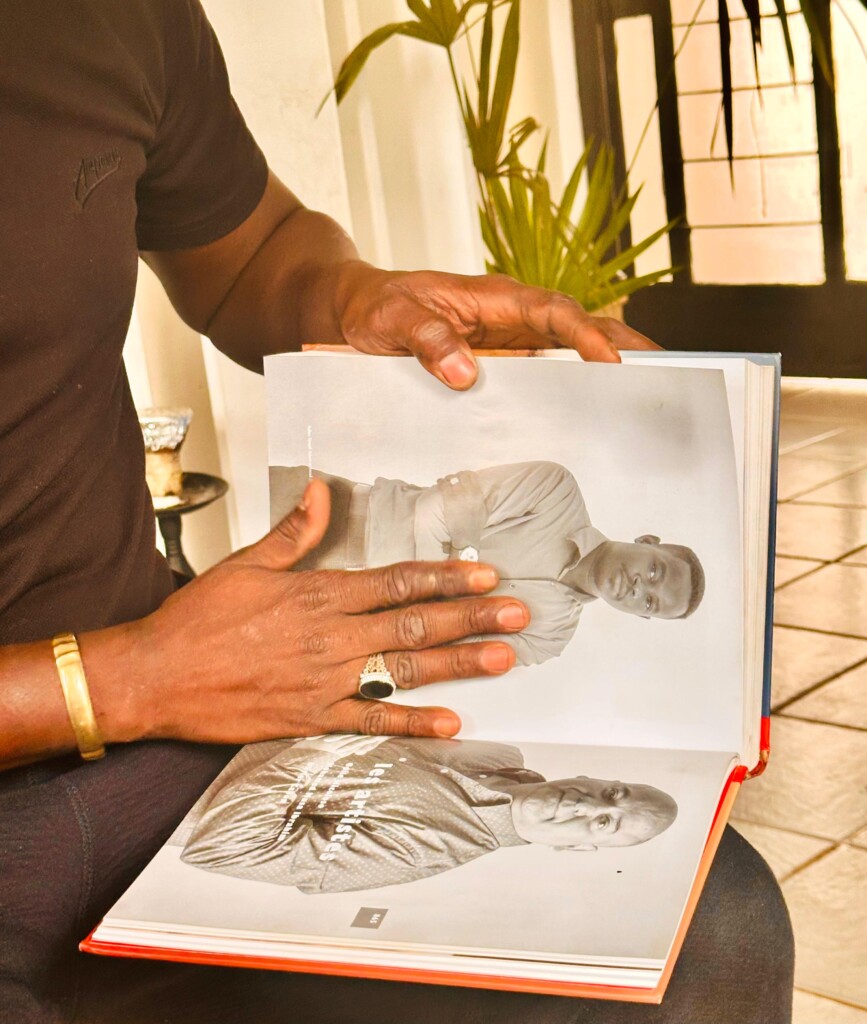
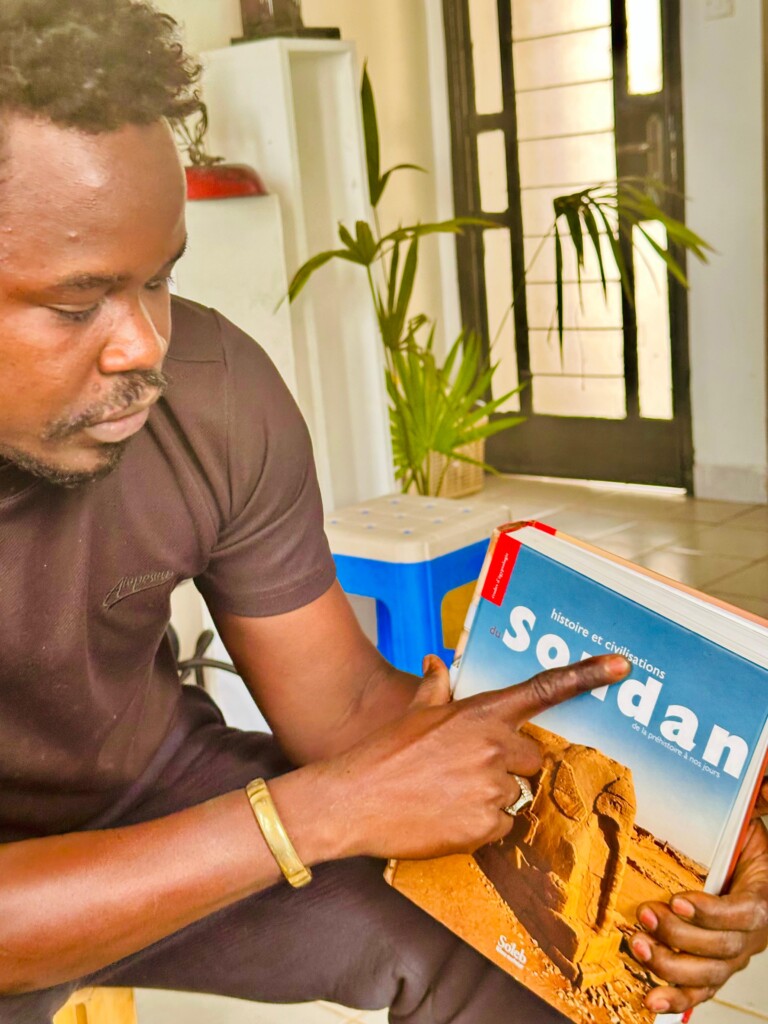
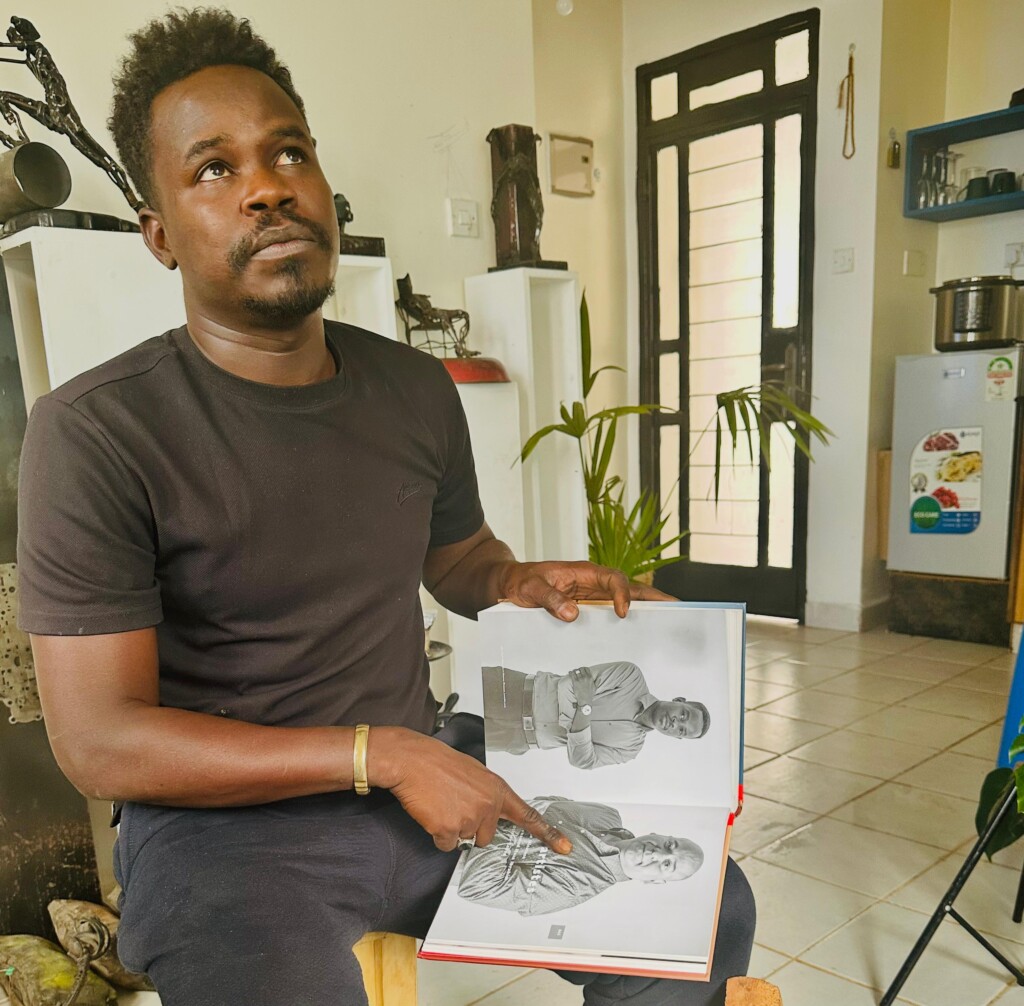
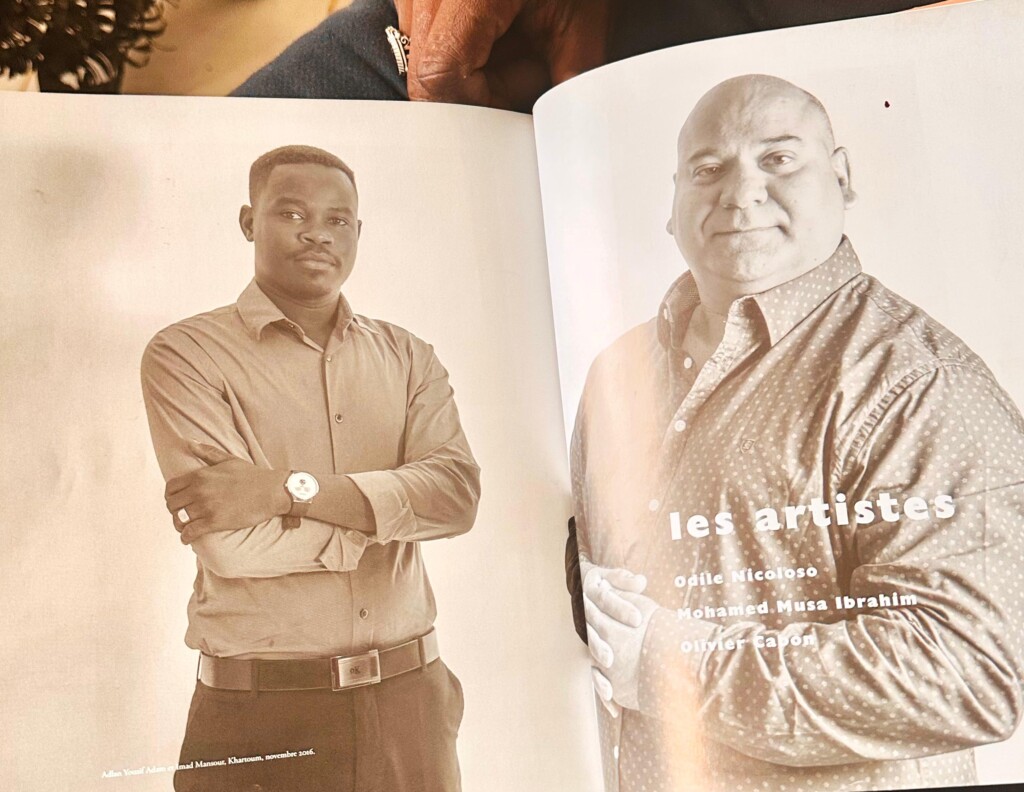
His name and photograph also appeared in a French book entitled History and Civilisations of Sudan, in which he was included among the pioneers of contemporary visual art in Sudan.
Despite the international reach of his work, Yousif notes that he has faced difficulties travelling to attend his exhibitions because of problems with his identity documents.
The artist believes that art cannot be separated from the struggle to convey the truth about what is happening in Sudan.
Every sculpture and every painting carries a fragment of the memory of war, giving viewers the opportunity to see the tragedy from a human perspective that goes beyond figures and news reports.
Between exiles
The exhibition Between Exiles, held in Nairobi in July last year, was one of the defining moments in Yousif’s career. His homeland remains at the heart of his concerns.
Through his work, he revisits the changes that forced departure brings to people’s lives and to their relationships with their past and their surroundings.
Yousif does not treat exile as a move from one country to another. Instead, he sees it as an extended experience of loss and estrangement, in which memories of a place intertwine with images of a new life, and the search for identity becomes part of the suffering of displacement.
This perspective stems from the artist’s own experience and from his observations of the disintegration of individual and collective lives caused by war.
In his interview with Radio Dabanga, Yousif says the experience of forced travel has changed his relationship with art, drawing him closer to memory and to the images it holds of family, friends, and places from which he was suddenly cut off.
Between what he left behind and what he discovered in places of exile, he found new material for his art. Feelings of longing and loss become visual expressions of a complex human experience.
He believes that circumstances imposed on people against their will can, despite their harshness, become a stimulus for artistic experimentation and production, rather than a reason to stop working and surrender.
A reading of Adlan Yousif’s work
The work of Sudanese artist and sculptor Adlan Yousif is built around a stark material paradox. He selects scrap metal from the remnants of war – a material that, he says, was used to kill and displace people – and reshapes it into sculptures that carry memories of displacement, loss, and resilience.
He does not seek to conceal the material’s harshness or erase its history. Instead, he makes its solidity a language that speaks of the fragility of life in the face of violence.
In doing so, he stands within a recognised international tradition of sculpture.
One prominent figure in this tradition is the Spanish sculptor Julio González (1876–1942), who made his first welded-iron sculptures in 1927. González chose iron in protest against its use in military equipment and, according to accounts of his words, hoped that the metal would cease to be an instrument of killing and instead be shaped by an artist’s peaceful hand.
In Mozambique, the sculptor Cristóvão Canhavato, known as Kester (born in 1966), created Throne of Weapons in 2001 from weapons decommissioned after the civil war that ended in 1992. The work was acquired by the British Museum in 2002.
Four artists from the Transforming Arms into Tools project were subsequently commissioned to create Tree of Life in 2004.
A direct personal story
Yousif shares with these artists the practice of transforming an instrument of death into an image of life. What distinguishes his work, however, is its direct personal motivation: a childhood in Darfur burdened by war, the loss of his mother and family in El Fasher, and the recurring presence of the mother and woman in his work.
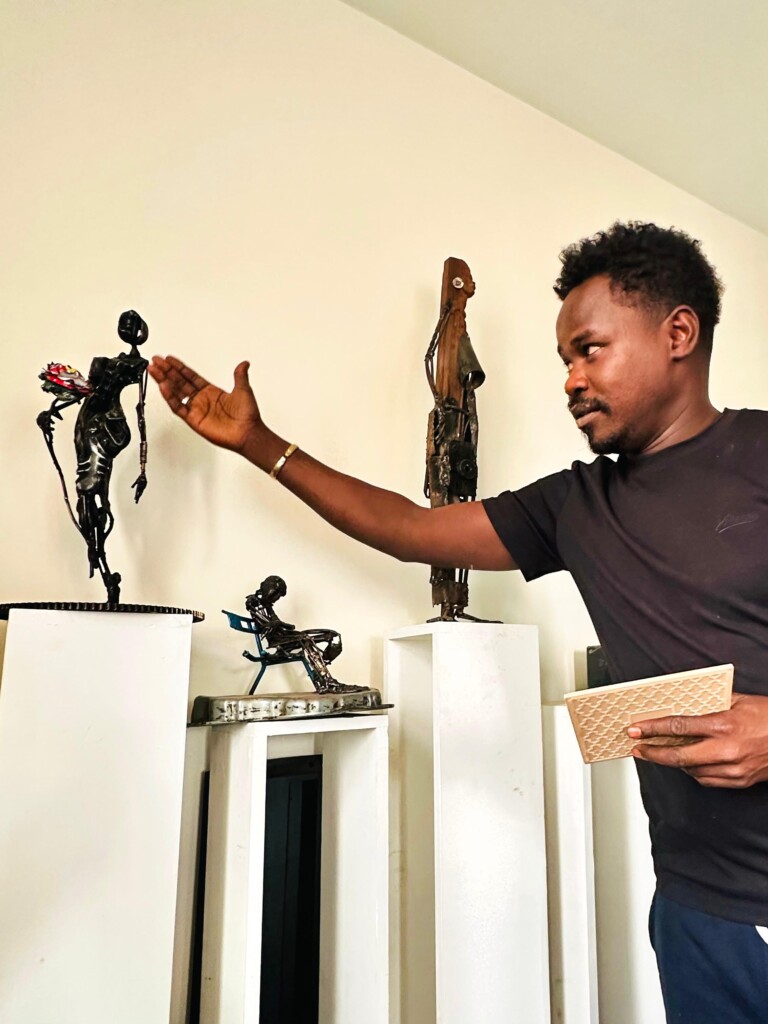
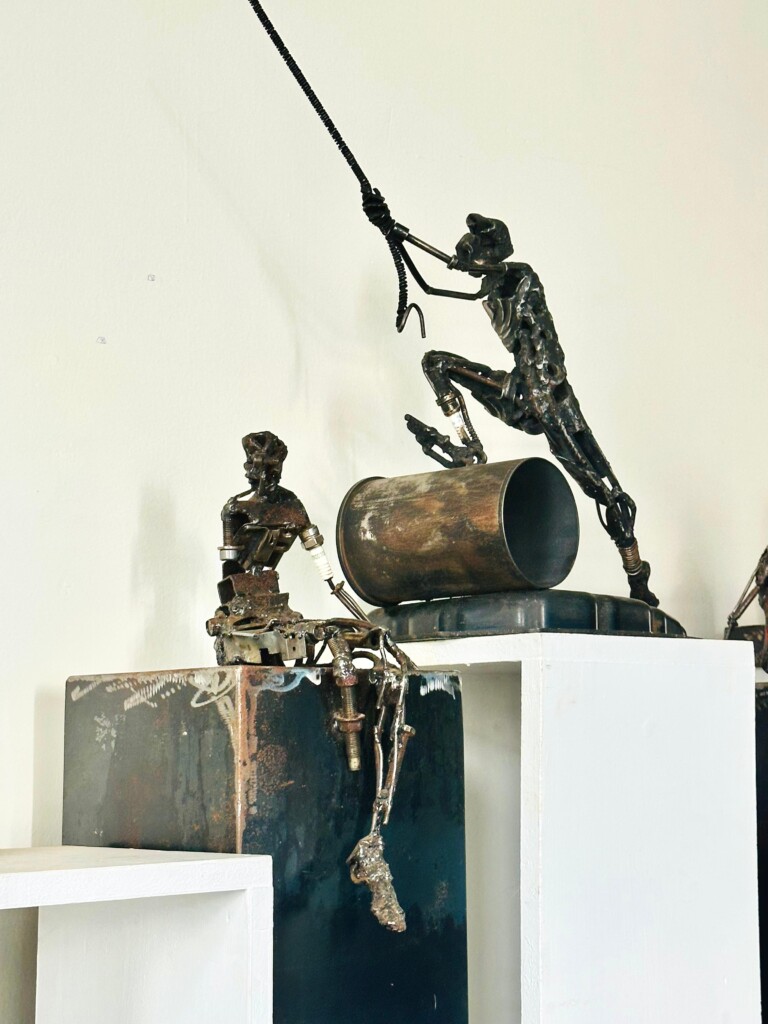
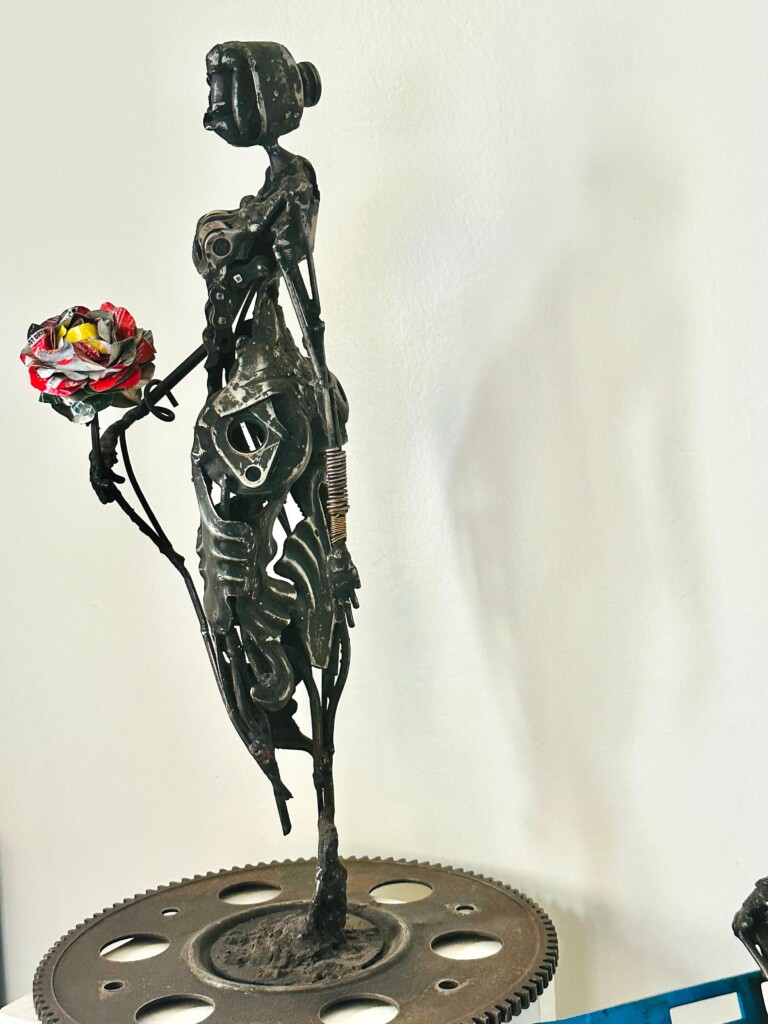
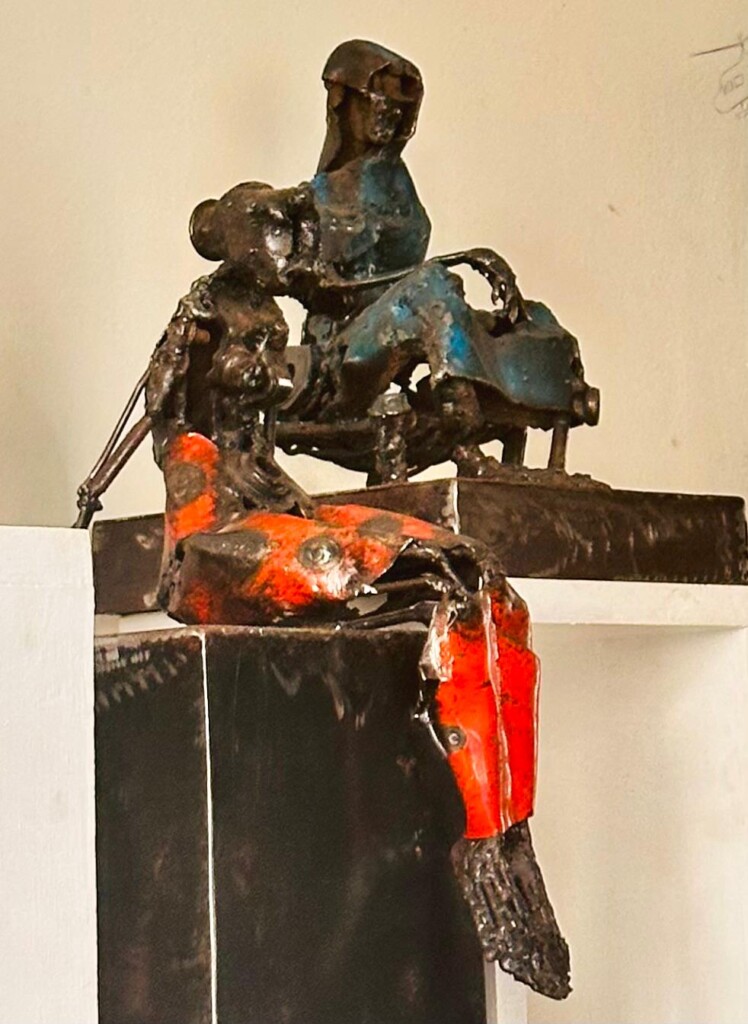
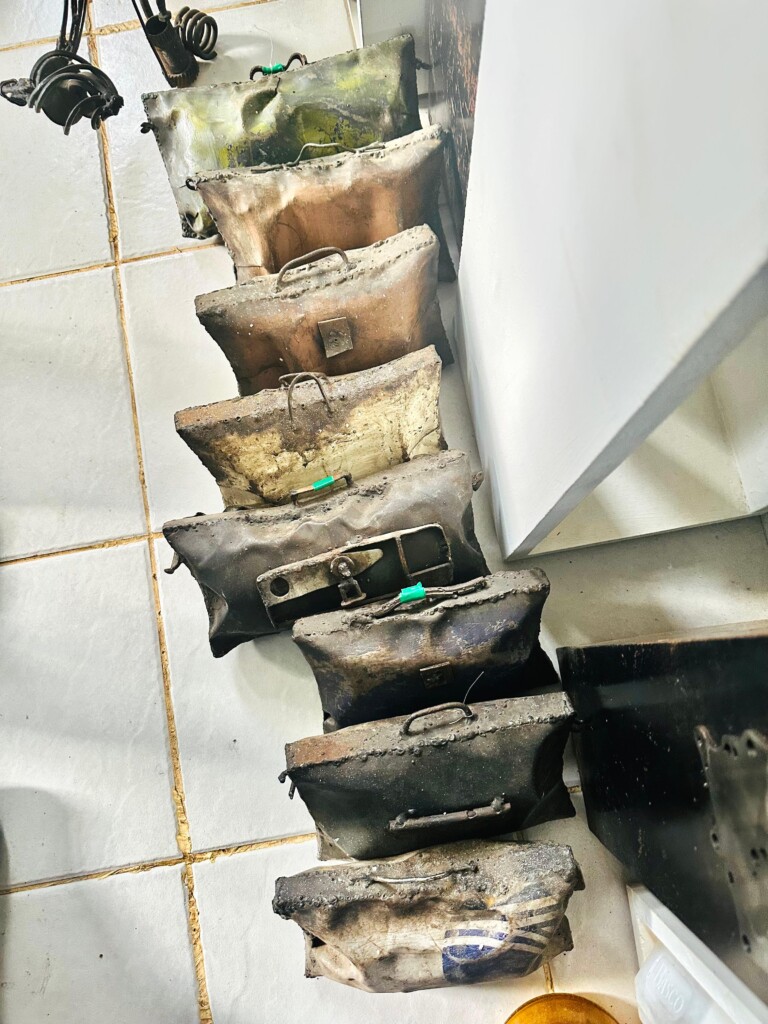
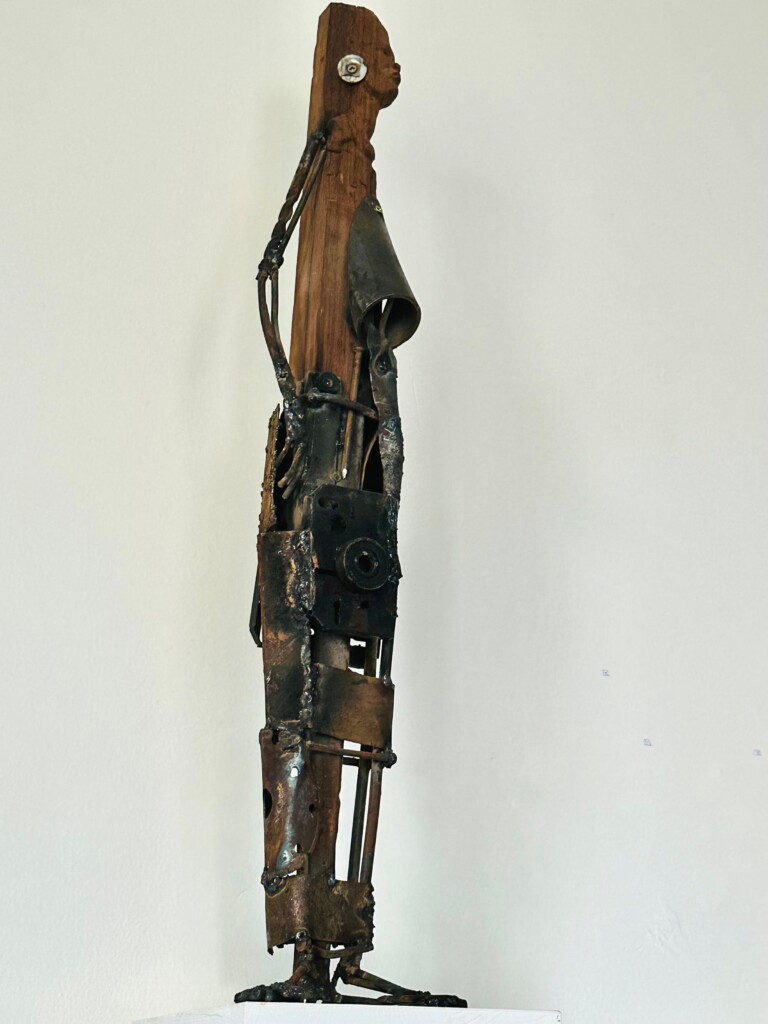
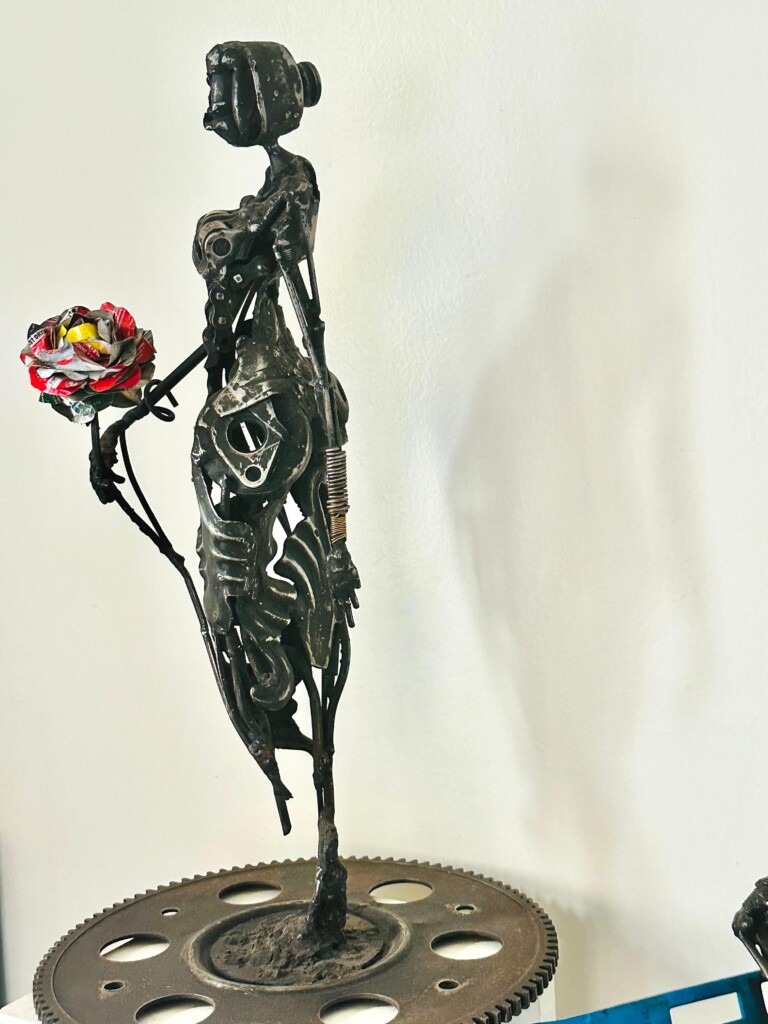
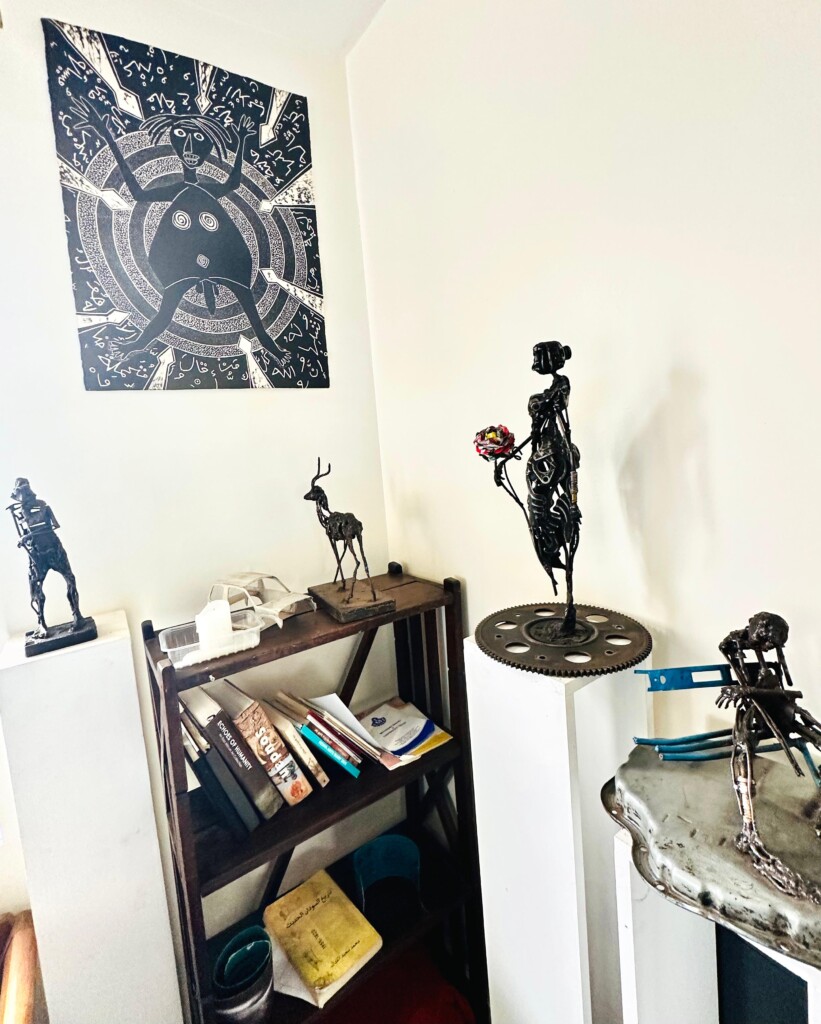
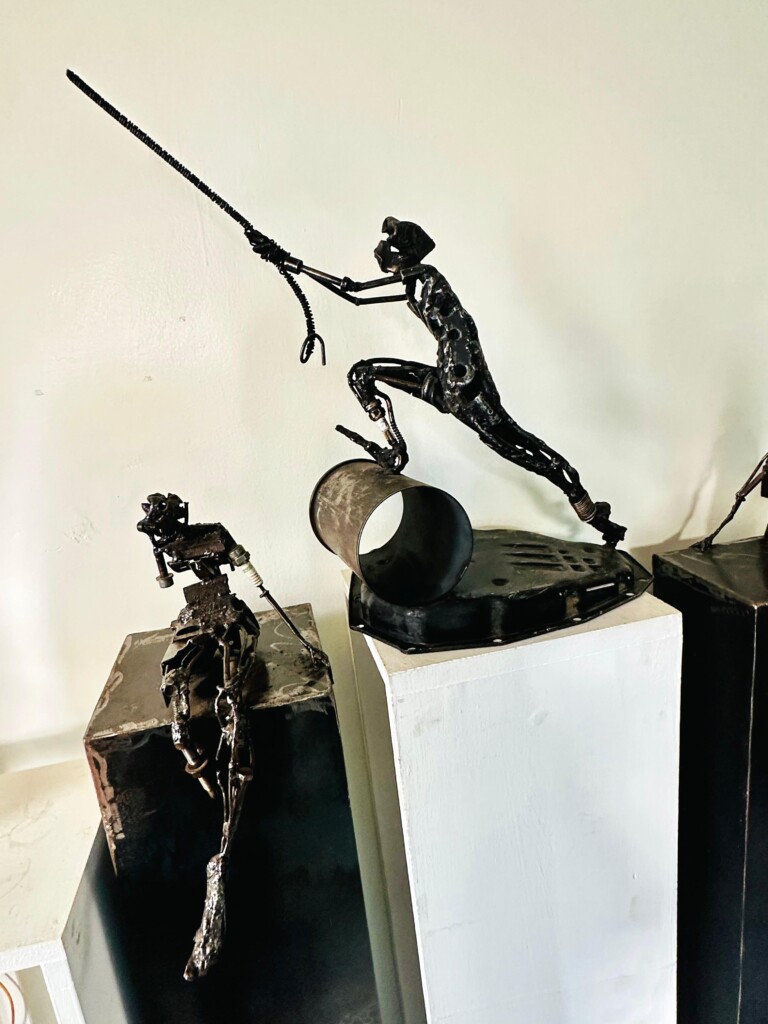
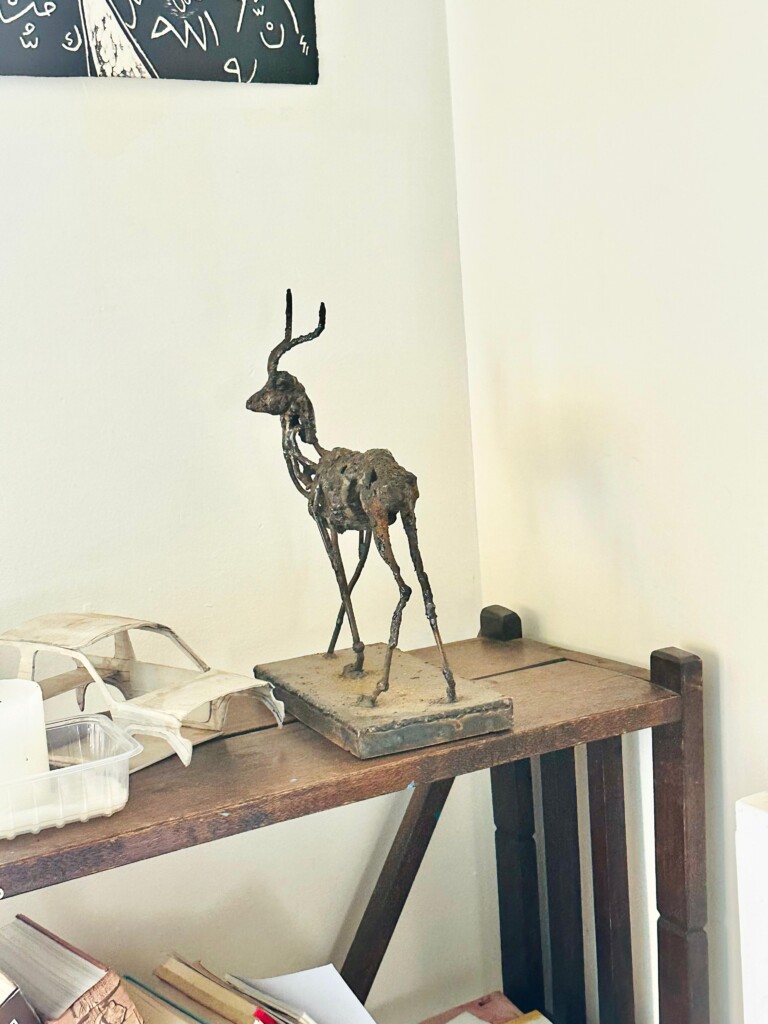
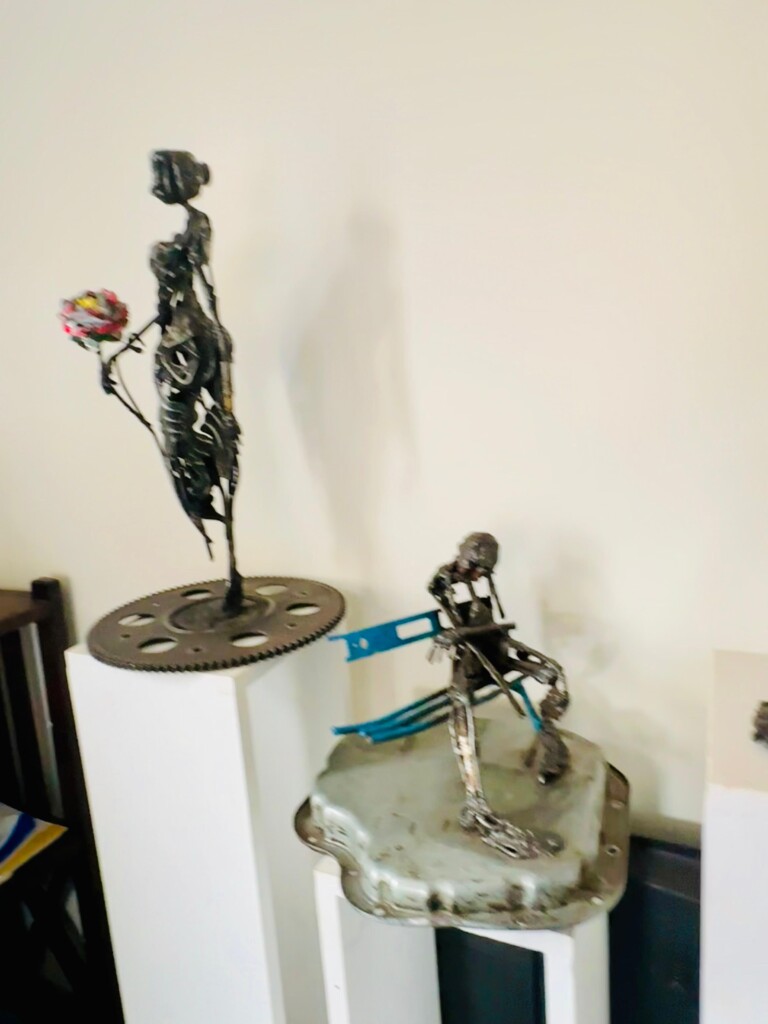
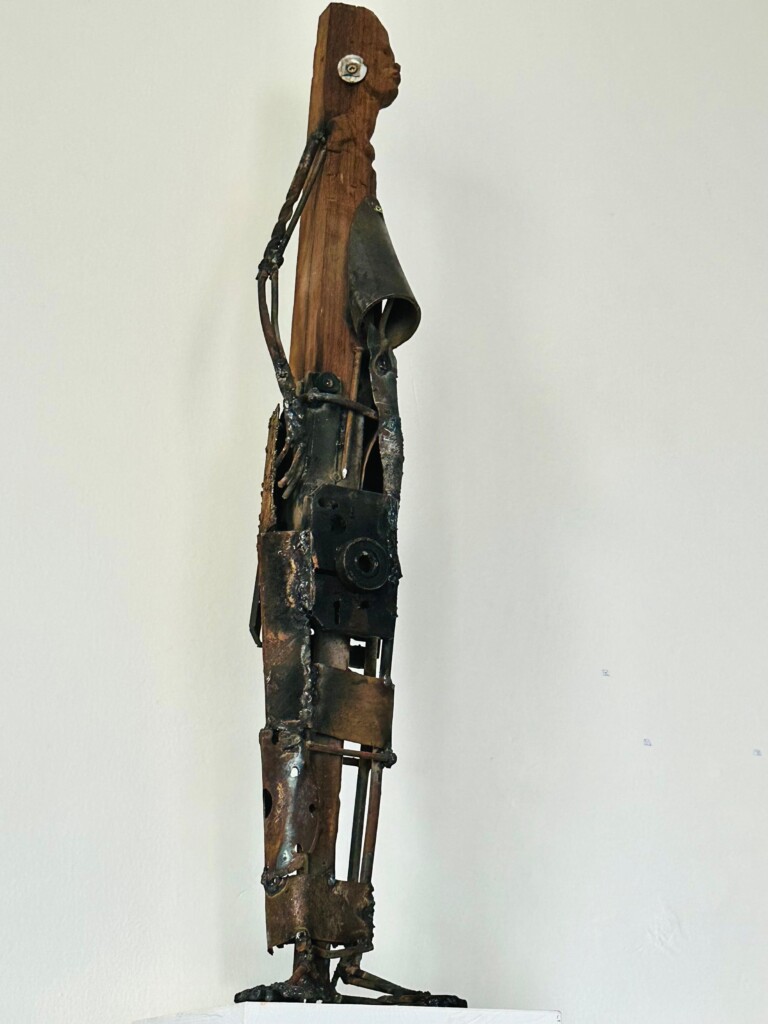
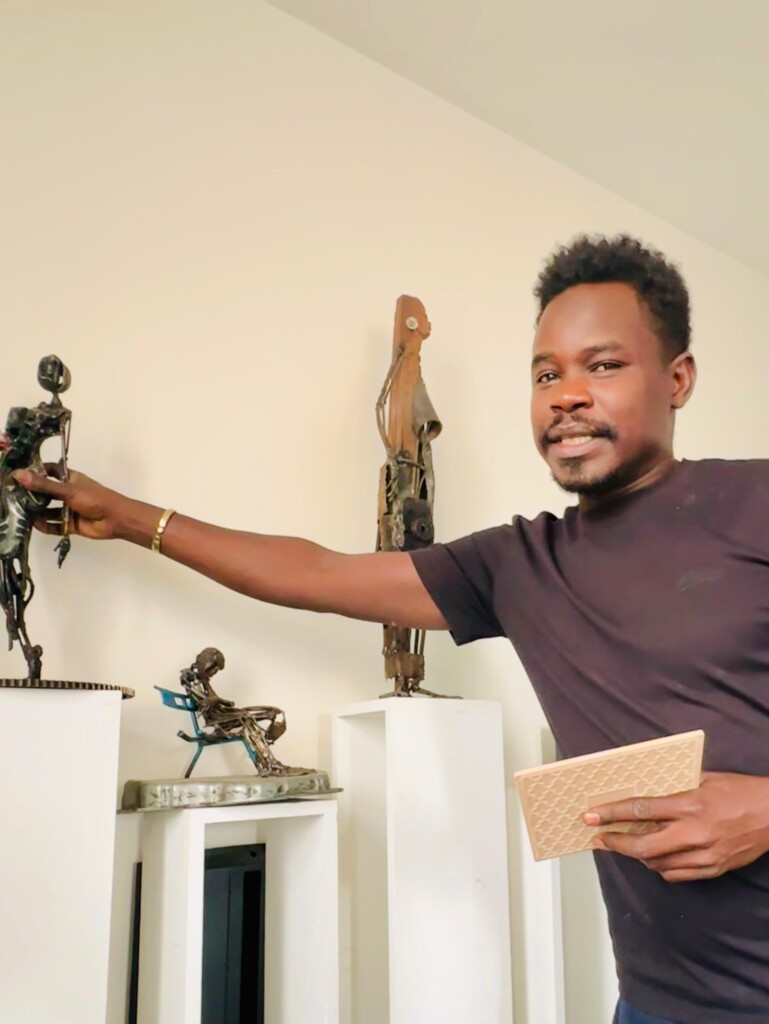
His sculptural scenes are assembled from springs, nails, spark plugs, pipes, and hinges. The welds remain clearly visible, while the bodies are deliberately incomplete, expressing fragmentation in both the material and the lived experience.
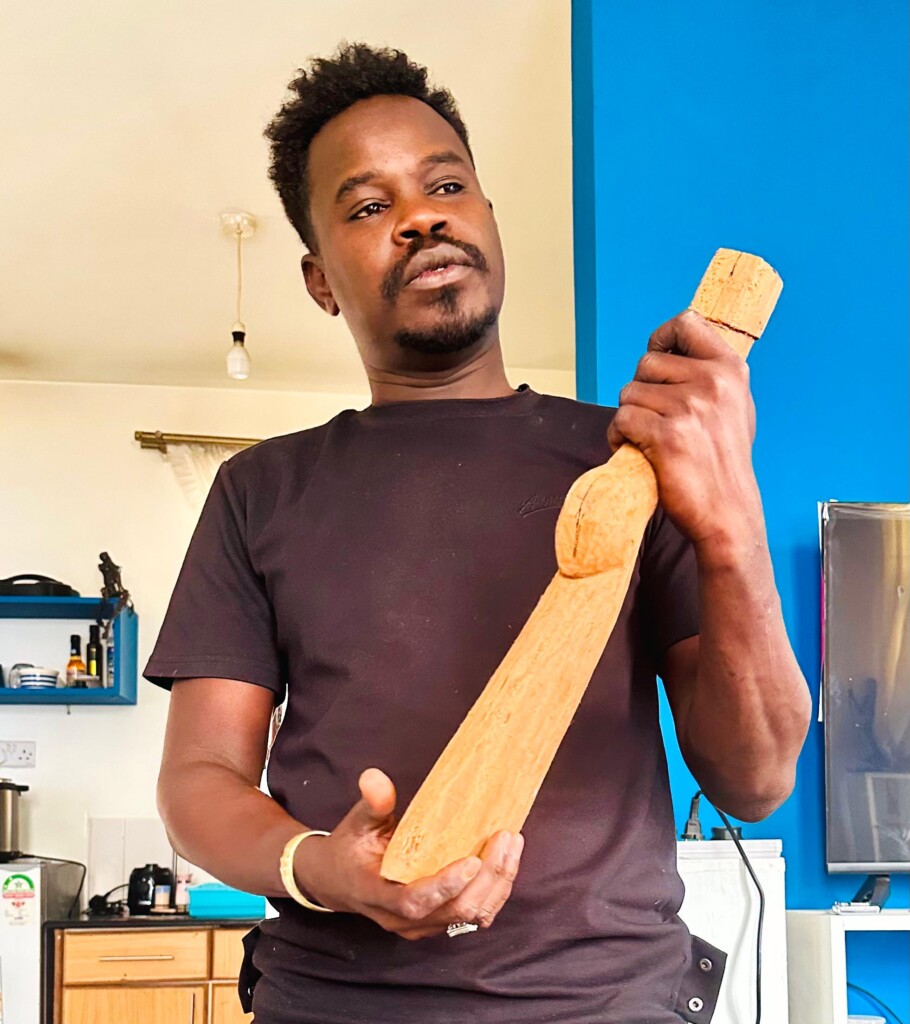
Yousif’s work also combines wood and metal in long, slender forms that recall the elongated bodies of Swiss sculptor Alberto Giacometti (1901–1966), known for his elongated, abstract figures of the late 1940s.
The red and blue colours on the seated woman, and the flower apparently made from coloured metal cans, soften the darkness of the metal. Tenderness and loss sit side by side within the very material of war.
The work can be understood as a form of material memory, in which iron does not merely represent war but carries its traces.
Scrap metal is thus transformed from the waste of violence into an emotional document that preserves faces and stories, and calls for peace.


 and then