





Broad reaction to El Burhan’s call for dialogue inside Sudan and reports of presidential amnesty
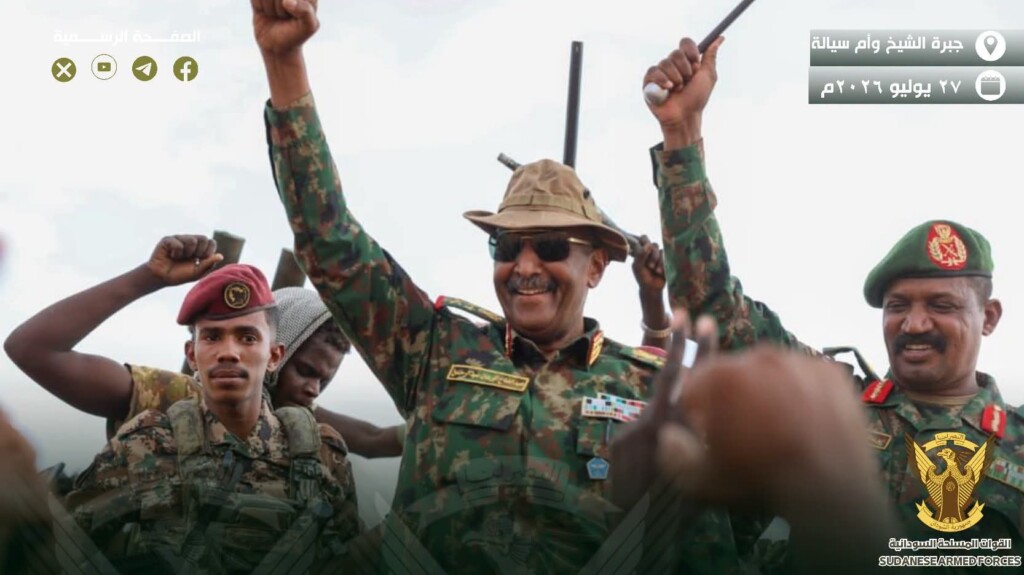
Sudan Armed Forces Commander-in-Chief Lt Gen Abdelfattah El Burhan visits troops in Um Sayala and Jabra El Sheikh, North Kordofan State, following recent military advances in the area (Photo: Sudan Armed Forces)
A call by Sudanese Armed Forces (SAF) chief and head of the Sovereignty Council, Gen Abdelfattah El Burhan, for dialogue inside Sudan, coupled with reports of a forthcoming presidential amnesty, has prompted widespread reaction among political forces, civil-society organisations, and the Sudanese public.
Kamal Omar, political secretary of the Popular Congress Party, said his party supported an internal dialogue to avoid the experience of previous negotiations held abroad. But he said its purpose must be to end the war, and that the Founding Alliance (Tasees) could not be excluded because it is one of the parties to the conflict. The complex circumstances created by the war, he argued, meant that the first objective of any dialogue must be to stop the fighting.
Omar told Radio Dabanga that his party would not take part in any political process that did not guarantee an end to the war and was not inclusive of all parties, with the exception of the dissolved National Congress Party.
Reactions have continued to report that Burhan may grant a presidential amnesty, dropping charges and sentences against leaders of Somoud and political activists in an effort to create the conditions for the proposed dialogue inside Sudan.
Lawyer and human-rights activist Hanan Hassan said she categorically and in principle rejected any political settlements or amnesty decisions that might be issued to drop the charges and accusations against her. She stressed that she rejected any pardon or amnesty from the current authorities.
Hassan told Radio Dabanga that she remained committed to returning to Sudan under civilian rule and an independent judiciary, in order to prosecute all those involved in fabricating the accusations against her and to secure her acquittal through law and justice rather than political concessions.
Omar El Digair, chairman of the Sudanese Congress Party, likewise categorically rejected reports of a presidential amnesty for leaders of civilian forces, describing them as a distortion that perpetuated the narrative that peaceful political activity is criminal.
Digair warned against embracing calls for dialogue that coincide with military escalation and rejection of ceasefires. The fundamental criterion for taking part in any political process, he said, must be that ending the war is at the top of its agenda, that it is linked to the humanitarian and security tracks, and that it avoids legitimising the status quo.
In the same vein, the Somoud Alliance said in a statement that initiatives calling for amnesty for civilian forces had turned the facts on their head. The measures taken against them, it said, were political in origin and had no basis to begin with.
The statement added: “Our position in Somoud is clear: we support justice and accountability for all — holding to account those who started the war, those who profited from it, and everyone who committed crimes against innocent people, and handing over those wanted to the International Criminal Court.”
The statement stressed that justice was the foundation of any lasting peace. It said this was a task that should be undertaken by independent and impartial judicial institutions, rather than being turned into a political tool in the hands of parties lacking legitimacy.


 and then