




Sudan govt reiterates rejection of the Berlin Conference – pro-army voices call out ‘selectivity’
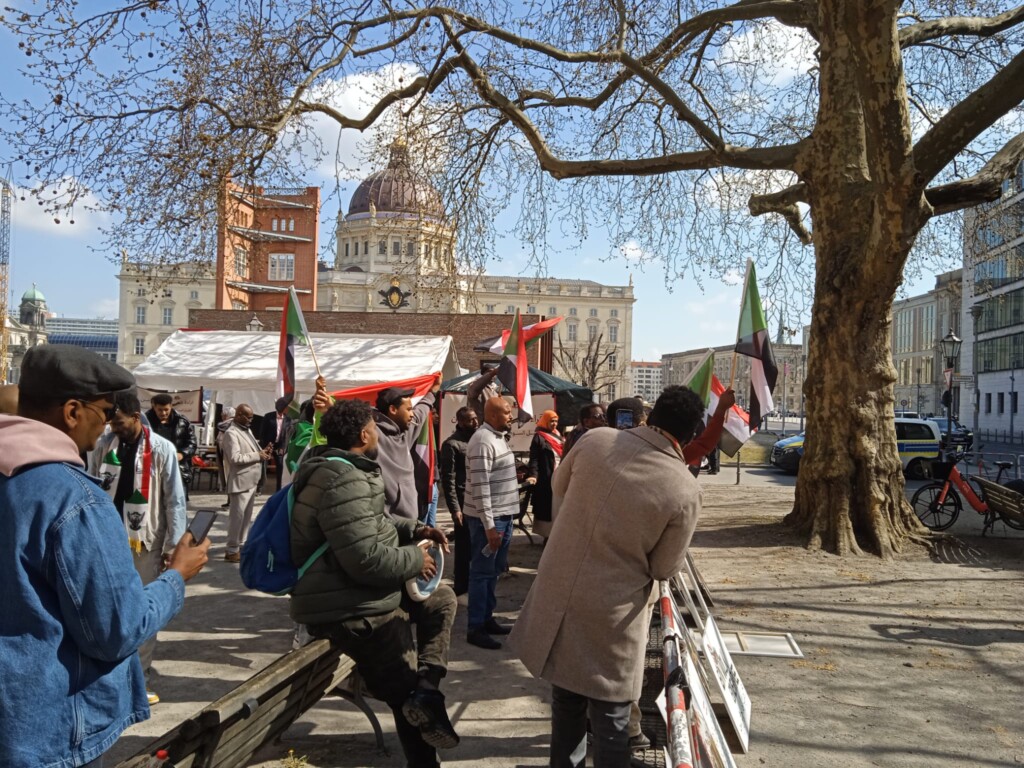
Supporters of the Sudanese Armed Forces (SAF) demonstrate in front of the German Foreign Ministry today, to condemn the Berlin Conference (Photo: Radio Dabanga)
The Sudanese government has reiterated its strong rejection of the Third International Conference on Sudan commenced in Berlin today, stating that the move “represents a disregard for the country’s sovereignty” and “a consecration” of what it described as the approach of colonial tutelage.
In a statement seen by Radio Dabanga, the Sudanese Ministry of Foreign Affairs, said that holding the conference without consultation or coordination with the Sudanese government reflects a deliberate disregard for national visions, stressing that any discussion related to Sudanese affairs must be conducted with the participation of the state and its official institutions.
The statement stressed that Sudan is the first and last stakeholder in its internal issues, rejecting what it considered attempts by international parties to bypass the legitimate government or deal with false neutrality between the state and the Rapid Support Forces (RSF). Khartoum criticised what it said was an inaccurate portrayal of the war in Sudan, warning that such approaches do not lead to peace or stability, but rather promote polarisation and open the door to state fragmentation. The Berlin conference is an extension of previous conferences in Paris and London, accusing these initiatives of undermining the principles of international law and the sovereignty of states, and providing political cover to armed groups.
The Sudanese government affirmed its commitment to work towards peace, noting that it submitted an initiative before the UN Security Council in December 2025, and expressed its readiness to deal with any serious and impartial international efforts that respect the country’s sovereignty and territorial integrity. It warned that any initiative that is not in line with these principles will be rejected and unacceptable.
‘Imbalance of participation standards’
A group of 25 entities and parties supporting the armed forces criticised what he described as the imbalance in the criteria for selecting participants, the lack of transparency and the adoption of selectivity in issuing invitations, pointing to what he called “the overwhelming representation of forces identified with the RSF in exchange for the widespread exclusion of the national forces supporting the Sudanese state institutions”, which he considered a disturbance of balance and a challenge to the neutrality of the organisation.
The statement, signed by the Justice and Equality Movement, the Supreme Council for Beja Glasses, and the National Movement, also accused the deliberate exclusion of key actors by refusing and stipulating that certain leaders should not participate, which is considered blatant interference in Sudanese affairs in exchange for unconditional representation of the allies of what it terms the RSF Militia.
The statement said that the preparation of the agenda of the conference without consultation with Sudanese stakeholders reflects external interference and empties the process of its national ownership.
He also criticised what he described as the subjective integration of the political track and the security and humanitarian tracks in line with the vision of the RSF and its allies from the political forces.
The statement warned of what it called the urgency of forming committees and structures without Sudanese consensus, which threatens to exclude national forces, undermine the comprehensiveness of the political process, and contradict the principles of national sovereignty and the Sudanese-Sudanese solution.
He declared his rejection of what he described as the unacceptable use of the humanitarian file as a tool of political pressure rather than a neutral response to the needs of citizens.
On the other hand, Sudanese supporters of the armed forces began organising protests in front of the headquarters of the German Foreign Ministry to condemn the Berlin conference. Participants in the protests came from a number of European countries.
Official memorandum
As previously reported by Radio Dabanga, in a previous statement, the Sudanese government in Khartoum rejected the convening of the conference, without its participation, approval, and consultation on all arrangements, and submitted an official memorandum to that effect to the German Foreign Ministry on April 10, emphasising that “the tutelage approach reflected in the Berlin Conference might prompt Sudan to reconsider its dealings with the countries organising and sponsoring the conference, based on the principle of reciprocity…”

 and then