




Sudan conference kicks off in Berlin – hopes to raise over $1 billion
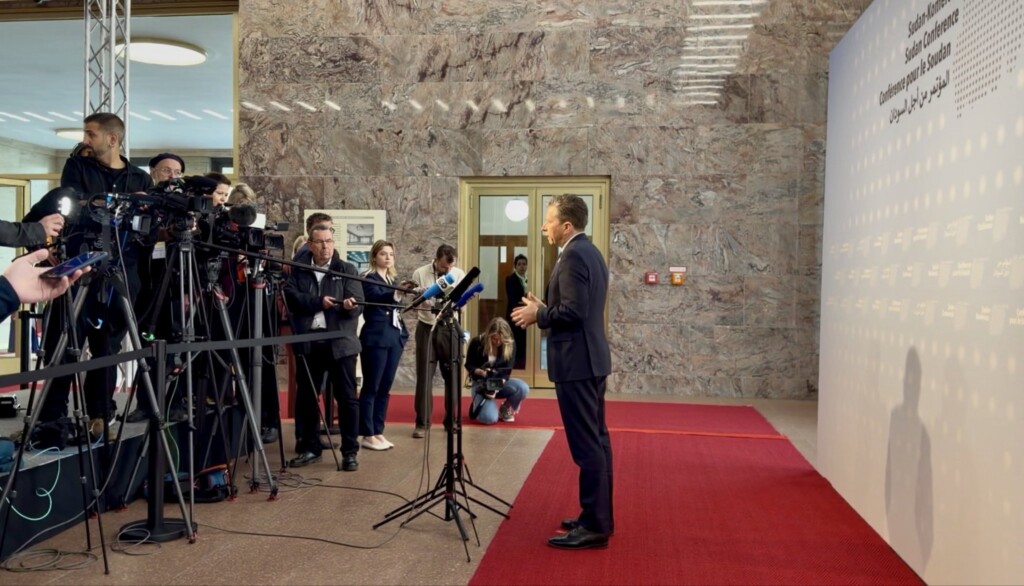
United Nations Under-Secretary-General Tom Fletcher addresses reporters in Berlin today (Photo: Supplied)
The Third International Conference on Sudan commenced in Berlin today, amid hopes among Sudanese observers that the international community will meet its humanitarian commitments to the country. The United Nations’ special envoy for Sudan, Pekka Haavisto, said the conference was a crucial step in supporting the delivery of humanitarian aid and bringing an end to the war. He described the meeting as an “excellent opportunity” to call for a humanitarian truce that would allow aid workers to reach affected civilians. He stressed the need to protect civilians and to limit the use of heavy and dangerous weapons, including drones, on front lines.
He added that the conflict has exacerbated a major humanitarian crisis, marked by widespread displacement and severe shortages of food and basic services. The Berlin conference, he said, provides an international platform to coordinate humanitarian efforts and encourage the parties to commit to peaceful solutions and cooperate with the United Nations to ensure the delivery of urgent aid and reduce civilian suffering across Sudan.
Working through UN mechanisms
Speaking at the conference, Massad Boulos, adviser to the US president for Arab and African affairs, said the main focus was on finding solutions and working through UN mechanisms. He said a proposed truce should lead to a permanent ceasefire, describing a humanitarian truce as the main pillar for delivering aid to civilians. He added that the United States was not siding with any party and was concerned only with the humanitarian situation.
The failure of the international community
Britain’s foreign secretary said the international community had failed Sudan and called for a coordinated effort to halt the flow of weapons, stressing the need to exert pressure on the warring parties.
Keeping attention on Sudan
Germany’s development ministry announced that it would provide an additional €20m ($23.6m) to Sudan this year, ahead of a conference aimed at raising more than $1bn in funding commitments.
Johann Wadephul told Deutschlandfunk radio that the aim of the conference was to keep attention on Sudan amid the wars in Ukraine and Iran, whose effects are felt more acutely by European governments, as US interest in humanitarian aid declines.
Not a quick fix
“This is not a quick fix, but maintaining international attention on the humanitarian situation in Sudan is a significant contribution to ending the war,” he said. He added that Germany was in contact with both warring parties, but neither was attending the conference, as no ceasefire had been agreed.
Ahead of the meeting, Germany’s development ministry said it would increase aid to Sudan by €20m this year, after providing €155.4m at the end of last year. Wadephul said Germany aimed to raise at least $1bn in pledges. He added that ensuring people do not face hunger is not only a moral obligation but also in Germany’s interest, in order to avoid large migration flows similar to those seen from the Middle East in 2015 and 2016.
Italy participates
In the same context, Antonio Tajani is taking part in the conference, which marks the third anniversary of the outbreak of war in Sudan.
Italy’s foreign ministry said he would speak at the humanitarian session alongside representatives of EU member states and other donors. As in previous meetings in Paris and London, the conference aims to mobilise funding for the humanitarian response. Representatives of UN agencies, regional and international organisations, NGOs and civil society are also attending.
Since November last year, Tajani has launched the “Italy for Sudan” initiative, modelled on the “Food for Gaza” initiative, with the participation of the “Italian system”. It is based on three pillars: providing life-saving assistance to displaced people; supporting refugees, host communities and receiving countries; and facilitating voluntary returns under safe conditions. In 2026, the initiative allocated 132 tonnes of humanitarian goods, along with €5m to the FAO to support agricultural capacity projects and €1m to the International Federation of Red Cross and Red Crescent Societies to provide water, shelter and medical assistance.


 and then