





Sudan war paralyses gum arabic market in El Obeid as production falls and exports stall
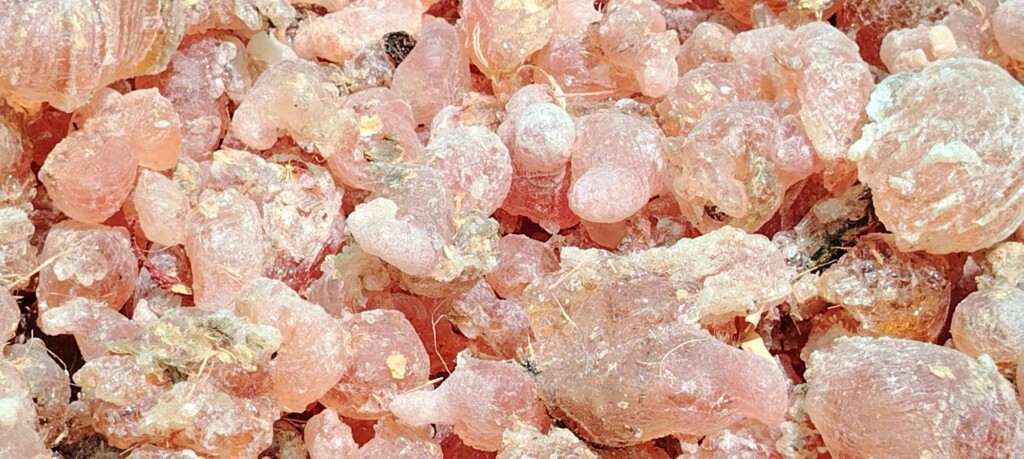
Raw Gum Arabic harvest in Blue Nile this month (Photo: Blue Nile Regional Government)
By Amin Ramadan for Radio Dabanga
The expansion of Sudan’s war and the takeover of key production areas by the Rapid Support Forces have brought the gum arabic market in El Obeid to a near standstill, traders say, threatening one of the country’s most important export commodities*.
As the harvest season begins in traditional producing regions, fighting and insecurity have disrupted supply chains, particularly in West Kordofan, long known for producing hashab and talha gum. El Obeid, historically one of Sudan’s main trading and export hubs for gum arabic, has been severely affected.
According to official figures, Sudan exported between 100,000 and 150,000 tonnes of gum arabic annually in stable years before the war erupted in April 2023, with Europe — especially France and Germany — alongside the United States and India, among its key markets. During the 2023–2024 season, exports fell to around 48,000 tonnes, roughly 40% of pre-war levels.
Military control and economic suffocation
Ali Jano, a gum arabic trader and exporter at the El Obeid commodities exchange in North Kordofan, told Radio Dabanga that RSF control of western production states had effectively choked supplies.
He said that the movement of gum from RSF-held areas to those under army control had been blocked, sharply reducing volumes reaching El Obeid. Prices have also fallen amid weak demand and limited purchasing power. The price of a quintal of hashab gum, once about SDG 60,000, has dropped to around SDG 47,000, he said.
Most of the major companies that previously purchased and exported large quantities ceased operations after the outbreak of war, further weakening production and market activity. Hashab gum has become scarce in El Obeid, while talha gum has almost disappeared from the market.
Jano said large quantities remain stockpiled in production areas of West Kordofan but cannot be transported safely due to insecurity and checkpoints. Many producers have opted not to harvest this season because of low prices and the absence of economic incentives, raising fears of further decline in the sector.
He also pointed to the impact of roadblocks and checkpoints set up by RSF forces, which have prevented local traders and producers from moving gum to army-controlled markets, deepening internal market stagnation.
Looting delivers further blow
Jano described the looting of the gum arabic market in En Nahud following an RSF attack on the town in early May 2025 as one of the sector’s most damaging episodes since the war began.
He said more than 1,000 tonnes of gum arabic stored by companies and long-standing traders were stolen. For some businesses, the looted stock represented their entire working capital, forcing them to exit the market immediately.
The incident, he said, dealt a severe blow not only to En Nahud but to the wider regional trade, undermining confidence in the business environment, reducing available supply and worsening liquidity problems for traders and producers.
Alternative export routes falter
Some traders attempted to reroute exports through South Sudan, Chad and the Central African Republic. However, Jano said these efforts largely failed.
Exporting via the Juba–Nairobi–Mombasa corridor proved prohibitively expensive due to customs duties and transport costs, while exports through Chad were constrained by weak local purchasing power.
He added that the limited quantities currently reaching El Obeid — often via informal routes — amount to only two or three truckloads at a time, insufficient to meet commercial demand.
Jano warned that unless production areas are secured and trade routes reopened, Sudan risks losing its historic position as one of the world’s leading producers and exporters of gum arabic.
Price collapse and producer exodus
Jano said sharp price disparities between production areas and major markets have undermined the economic viability of harvesting.
In some producing areas, the price of a quintal of hashab gum ranges between 100,000 and SDG 150,000, compared with around SDG 600,000 in other markets. Talha gum has fetched as little as SDG 10,000 per quintal in production zones, compared with SDG 120,000–130,000 in export markets.
As a result, many producers have abandoned gum collection in favour of riskier activities such as informal gold mining. In parts of North and West Kordofan, production has nearly ceased. Some producers have resorted to cutting down acacia trees — the source of gum arabic — for charcoal, a trend Jano described as alarming for the long-term sustainability of the resource.
The impact has extended beyond producers to traders and exporting companies. Large export contracts, typically requiring between 50,000 and 100,000 tonnes, have become impossible to fulfil due to supply shortages, forcing some firms out of the market entirely. Lower-quality grades now struggle to find buyers amid unstable global demand and supply uncertainty.
Wider economic and social impact
Given gum arabic’s global and domestic importance, Jano said the downturn has cost thousands of jobs across the value chain, from collection and transport to storage, marketing and export.
He warned that the collapse of production in rural areas reliant on gum as a primary source of income has exacerbated social vulnerability, pushing more people towards unstable or hazardous livelihoods.
Large-scale displacement to neighbouring countries, including South Sudan, Ethiopia and Chad, has further disrupted the social and economic networks underpinning the trade. Weak border controls have halted formal exports and opened the door to smuggling.
“The crisis in gum arabic is no longer just about prices,” Jano said. “It has become a structural crisis threatening a historic strategic resource.”
Calls for reform and protection
Agricultural engineer Ahmed Al-Ajab Mohamed Al-Safi, a gum arabic activist, said producers across the gum belt stretching from west of El Obeid to East Darfur are facing deteriorating conditions due to displacement and insecurity, leaving large quantities unharvested.
He said many farmers have fled to urban camps, leaving naturally produced gum in forests uncollected. Al-Safi also criticised what he described as entrenched local and international “lobbies” controlling pricing and export volumes, arguing that producers are forced to sell at prices that do not cover basic living costs.
He called for stronger protections for producers and greater transparency in pricing, and urged the international community to recognise the issue as both an economic and rights-based concern.
Blue Nile launches harvest
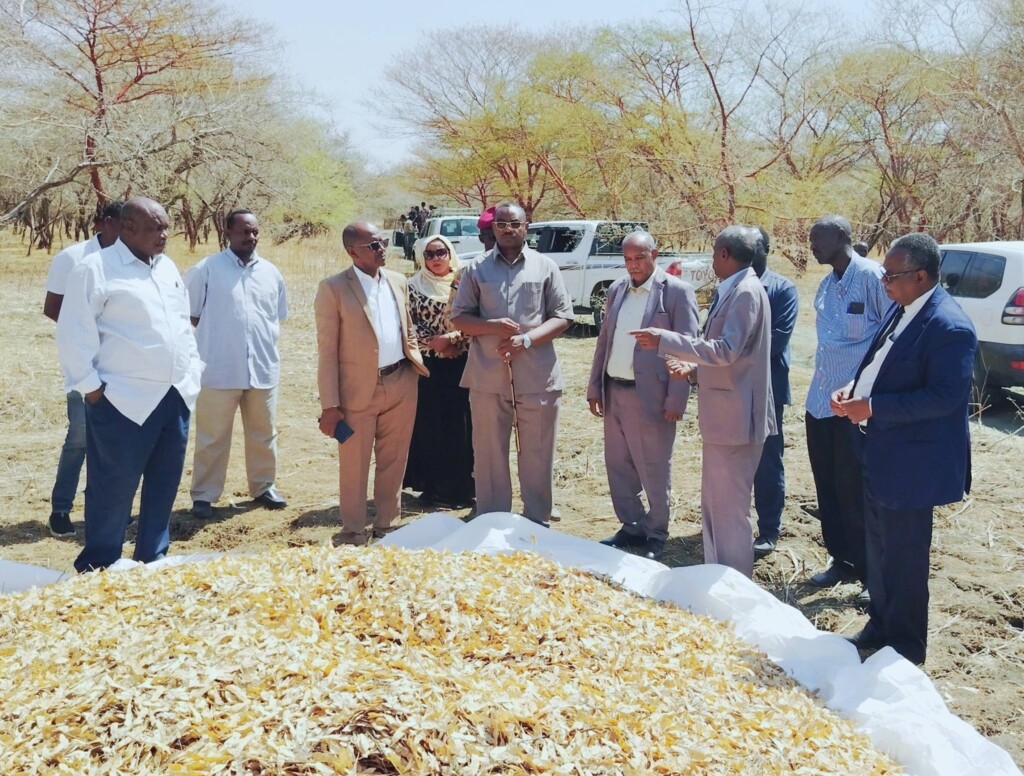
In contrast, authorities in the Blue Nile region this week launched the new gum arabic harvest season in Khor Dunia forest, attended by regional and federal officials.
They highlighted the crop’s economic importance and pledged to expand cultivation and related industries. Officials said Blue Nile aims to contribute around 11,000 tonnes of natural gums this season.
The regional agriculture and forestry minister outlined plans to expand forest cover by 1.6 million feddans and to implement seed-harvesting projects for gum-producing trees. The head of the National Forestry Corporation said Khor Dunia forest, covering 152,000 feddans, is the largest federal producer of gum arabic and related gums, with plans to produce 100 tonnes of seeds to support reforestation and green belt projects.
Despite such initiatives, traders warn that without security, stable trade routes and restored market confidence, Sudan’s gum arabic sector — long a pillar of its rural economy — will struggle to recover.
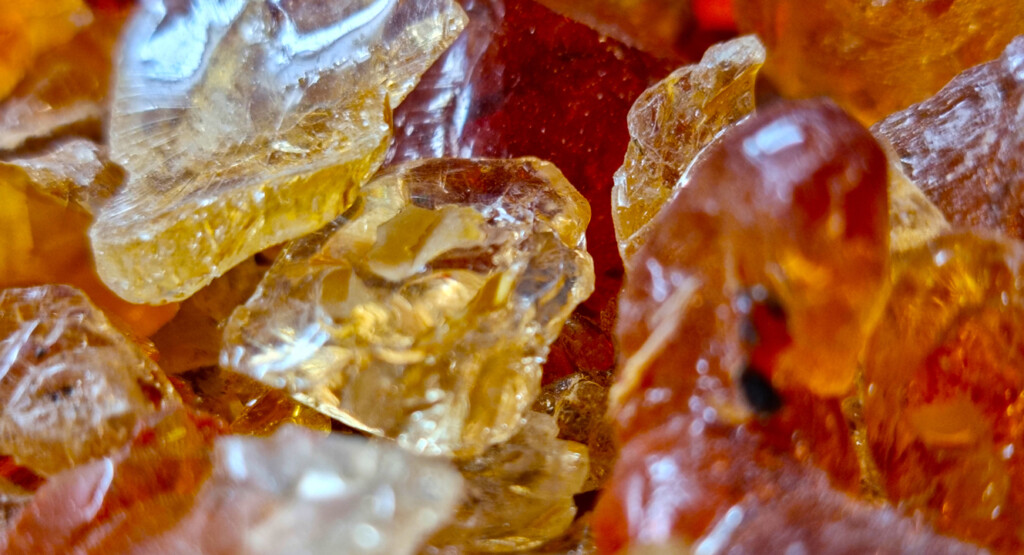
*Gum arabic is an emulsifier and a stabiliser made from resin from the acacia Senegal tree. Apart from shoe polish and ink, the food industry uses the stabiliser in chocolate and sweets, and, most importantly, in soft drinks, as it binds the sugar to the drink.
Sudan is the world’s foremost producer at an estimated 100,000-150,000 tonnes a year. Sudan, Chad, and Nigeria, produce 95 per cent of gum Arabic exported to the world market.
The gum Arabic belt covers about one fifth of the country. North Kordofan and North Darfur are the largest producers, followed by the states of Blue Nile, White Nile, and El Gedaref.


 and then