





Khartoum airport reopens – ‘new phase in managing Sudan’s crisis’
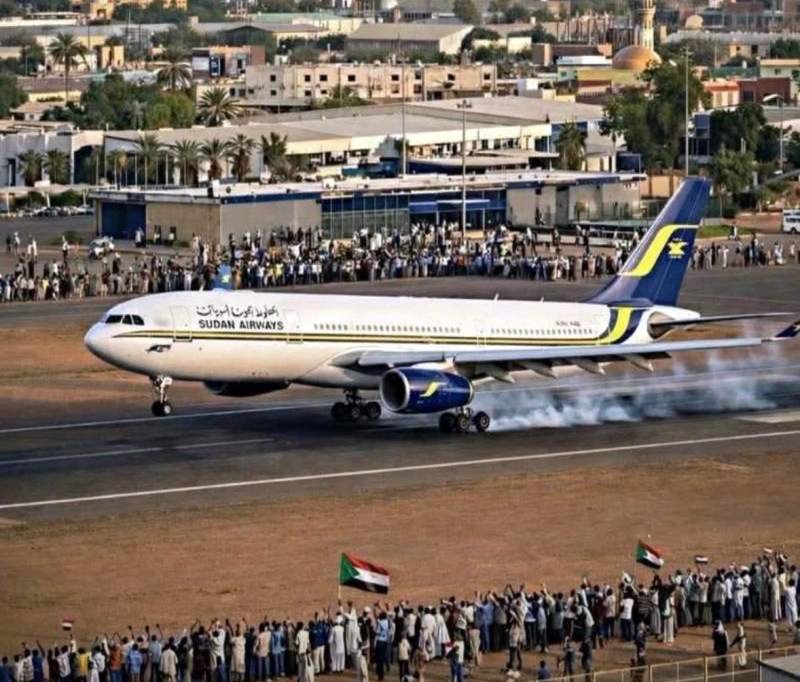
Aircarft lands Khartoum Airport (File photo: Supplied)
Report by Suleiman Siri for Radio Dabanga
Aviation expert and former Director of Sudan’s Civil Aviation Authority, Ibrahim Adlan, confirms that arrangements are under way to implement a humanitarian truce plan centred on the United Nations’ use of Khartoum Airport as a main humanitarian hub, warning that reliance on foreign crews to run regional airports could undermine the effort.
Speaking to Radio Dabanga, Adlan said recent developments at Khartoum Airport should not be viewed as a purely logistical step or a temporary humanitarian exception, but as the beginning of a new phase in managing Sudan’s crisis.
He described Khartoum Airport as the first sovereign institution to resume operations, noting that the landing of a civilian commercial aircraft amid an undeclared war carries major political and operational significance.
According to Adlan, civil aviation operates under strict standards requiring effective security neutralisation, coordinated airspace arrangements, and tacit acceptance by the parties to the conflict. He said the Rapid Support Forces’ decision not to respond hostilely to the airport’s reopening — despite having the capability to disrupt it — while drones continue to operate elsewhere suggests an undeclared understanding to keep Khartoum Airport neutral.
‘The real question is no longer who has legitimacy, but who can restore state functions, at what cost to sovereignty and in whose interest…’
He added that this interpretation is supported by the United Nations’ request to use the airport for humanitarian purposes, which he described as a sovereign and persuasive step that redefines the airport as a neutral facility under soft international oversight.
“In this sense, Khartoum Airport becomes the first sovereign institution to resume work outside competing claims of legitimacy, marking the start of Khartoum’s transition from a war city to an administrative centre,” he said.
International precedents
Adlan said the approach mirrors international models used in the Balkans in 1998 and at Kabul Airport in 2001, where airport operations resumed despite the absence of a fully functioning state, serving as a relief corridor and point of contact with the outside world.
“The principle in these cases is the same: when it is impossible to agree on who governs, agreement is reached on what must function,” he said.
‘Sovereignty is not measured by slogans, but by who holds the keys to the skies…’
He stressed that Khartoum Airport cannot operate in isolation and requires a network of alternative airports, emergency diversion points, and a functioning humanitarian distribution system. In Sudan, he said, this would include El Fasher, El Geneina and Nyala, with Khartoum as the central hub and Darfur’s airports acting as operational extensions.
Three management scenarios
Adlan said the key question concerns who will manage air navigation and airspace control, which he described as revealing the true intent of the plan. He outlined three possible scenarios.
The first would leave Sudanese Civil Aviation as the sole authorised authority for airspace and navigation management, as recognised by the International Civil Aviation Organization and international law. He said qualified staff and experience are available, but challenges include institutional fragmentation, lack of protection, and damaged infrastructure. With international protection, emergency funding, and independent technical management, he said, this would be the least costly and most sustainable option.
The second scenario — which he described as the most likely — is joint management. Under this model, Sudanese Civil Aviation retains legal authority while international teams provide technical support, monitor safety compliance and temporarily run certain functions. He said this “shadow management” model has been applied in the Balkans, Afghanistan, and Iraq.
The third scenario would involve importing fully foreign crews. Adlan warned this is the riskiest option and is usually used only as a short-term measure in cases of total institutional collapse. He said it could weaken remaining professional sovereignty, sideline national staff, and create long-term dependency. In Darfur in particular, he warned, excluding local personnel would likely lead to failure because local knowledge of terrain and security conditions cannot be imported.
Limited and cautious reopening
Adlan said any reopening of Darfur’s airports would likely be gradual and limited, potentially restricted to daytime operations and partial services rather than full monitoring, with an international support presence in the early stages. He stressed that success depends on involving Sudanese civil aviation personnel rather than replacing them.
He concluded that the airport reopening does not represent a political victory or final settlement, but a shift from war management to crisis management. Khartoum Airport, he said, is the first gateway, and its operation raises broader questions about control of the national airport network and airspace.
“The real question is no longer who has legitimacy, but who can restore state functions, at what cost to sovereignty and in whose interest,” he said. “Sovereignty is not measured by slogans, but by who holds the keys to the skies.”



 and then