





UNSC to hold closed consultations on Sudan
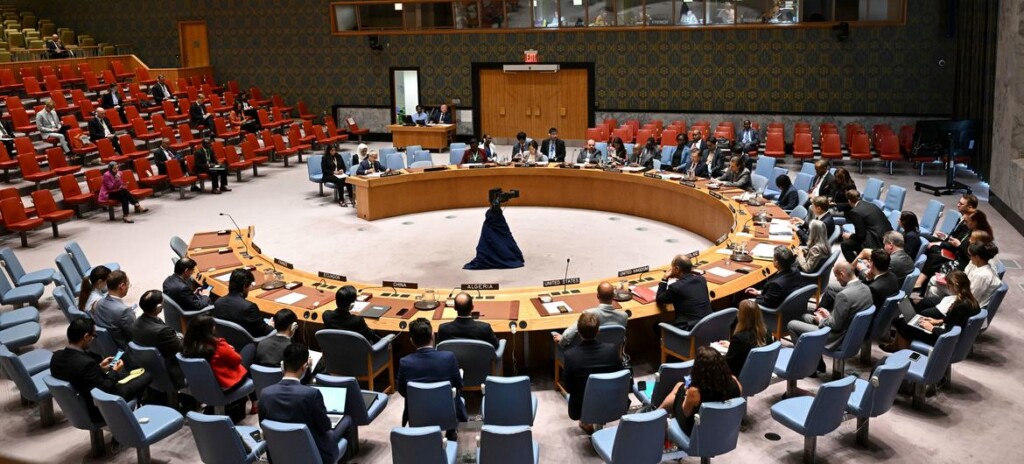
UNSC in session (File photo: UN/Evan Schneider)
The United Nations Security Council (UNSC) is due to hold closed consultations today on the situation in Sudan, amid renewed warnings of worsening famine conditions and escalating conflict across Darfur and Kordofan.
Briefings are expected from Edem Wosornu, Director of the Operations and Advocacy Division at the UN Office for the Coordination of Humanitarian Affairs (OCHA), and Matthew Hollingworth, Assistant Executive Director for Programme Operations at the World Food Programme (WFP).
The meeting was requested by the United Kingdom, the Council’s penholder on Sudan, together with Bahrain and Denmark, which serve as co-chairs on conflict and hunger issues. The request follows the latest Integrated Food Security Phase Classification (IPC) alert on Sudan issued on 5 February.
The alert raised serious concerns over deteriorating humanitarian conditions across Greater Darfur and Greater Kordofan. It follows a November 2025 IPC report that identified famine-like conditions in several conflict-affected areas, including El Fasher, the capital of North Darfur, and Kadugli, the capital of South Kordofan.
Severe acute malnutrition in Umbro and Karnoi
The latest IPC alert reports that famine thresholds for acute malnutrition have been exceeded in two additional areas of North Darfur — Umbro and Karnoi — indicating a heightened risk of excess mortality and raising fears that neighbouring areas could slide into similarly catastrophic conditions.
According to the alert, Rapid Support Forces units have advanced in the vicinity of Umbro and Karnoi, forcing thousands of civilians to flee urban centres into rural areas or towards the Chadian border.
Most residents displaced from El Fasher
In El Fasher, the alert states that most civilians have either fled the city or died since late October 2025, when the Rapid Support Forces launched an offensive and seized large sections of the city, leaving fewer than 100,000 people trapped. By the end of 2025, the total number of internally displaced people from El Fasher was estimated at around 1.22 million.
The IPC warns that the humanitarian situation along the El Fasher–Tina corridor towards Chad is expected to deteriorate further in the absence of an immediate cessation of hostilities and a large-scale humanitarian response. Avoidable deaths are already occurring and are likely to rise without urgent action. Security conditions are also worsening in South Darfur state, particularly in and around Nyala, where civilian casualties continue to be reported.
Kordofan emerges as a major conflict hotspot
In recent months, Kordofan has become a principal theatre of conflict. The IPC warns that escalating fighting is likely to increase the number of people facing severe hunger and acute malnutrition, with a corresponding rise in hunger-related deaths.
Famine conditions were identified in Kadugli in November 2025, while severe conditions were projected for Dilling and parts of the western Nuba Mountains. Both Kadugli and Dilling had been under prolonged siege by Rapid Support Forces units until recently, when the Sudanese Armed Forces reportedly broke the blockade and reopened supply routes.
The security situation in Blue Nile state is also deteriorating, with recent reports of renewed clashes and mobilisation by armed groups in the southern and western parts of the state, heightening fears of broader instability along the border with Ethiopia and South Sudan.
Limited progress in aid delivery
The United Nations has reported some recent progress in delivering humanitarian assistance to parts of Sudan, including areas in and around Darfur. However, deliveries remain extremely limited due to insecurity and ongoing negotiations with armed groups. Access is largely irregular, restricting the ability of humanitarian organisations to provide sustained and predictable support.
The IPC alert notes that inconsistent access to El Fasher is constraining aid deliveries to surrounding areas such as Tawila, which hosts more than 650,000 internally displaced people, and Dabba, where aid agencies are struggling to meet the needs of new arrivals.
On 26 December 2025, a UN team led by Sudan Humanitarian Coordinator Denise Brown conducted an assessment mission to El Fasher — the first UN visit since the city was besieged by the Rapid Support Forces in May 2024. Following the visit, Brown described El Fasher as a “crime scene” and estimated that thousands may have been killed. A joint inter-agency mission including UNICEF, WFP, UNHCR and OCHA visited the city again on 13 January.
Aid access remains heavily restricted
According to the 5 February IPC alert, humanitarian access across Sudan remains severely constrained by insecurity, unexploded ordnance, movement restrictions, checkpoint delays, administrative impediments, informal fees, and operational interference. Access is described as especially fragile and increasingly limited across Greater Darfur and Greater Kordofan, with most of the remaining population in El Fasher difficult to reach.
Deadly attacks on civilians and civilian infrastructure — including humanitarian personnel, assets, and convoys — continue. On 6 February, a WFP convoy in North Kordofan state was struck by drones while travelling from Kosti to deliver life-saving food assistance to displaced families near El Obeid, the state capital and a strategic hub linking Greater Darfur to Khartoum. At least one person was killed, others were injured, and food supplies intended for humanitarian response were destroyed.
El Obeid remains a contested battleground and is subject to repeated drone strikes. The incident followed another drone attack earlier in the week near a WFP facility in Yabus, Blue Nile state, which injured a staff member.
Renewed calls for ceasefire and funding
Several Council members are expected to renew calls for an immediate ceasefire and to remind the parties to the conflict of their obligations under Security Council Resolution 2417 of 24 May 2018, which condemns the use of starvation of civilians as a method of warfare and the unlawful denial of humanitarian access. The resolution calls on all parties to armed conflict to comply with international humanitarian law, protect civilians, and safeguard objects necessary for food production and distribution.
Briefers are likely to urge the international community to scale up its humanitarian response in line with the urgency and scale of the crisis. As of the time of writing, only 5.8% of the $2.9 billion required for Sudan’s 2026 Humanitarian Needs and Response Plan has been funded. The 2025 plan, which required $4.16 billion, reached only 38.6% funding.
On 3 February, the United States hosted a high-level Sudan donor conference in Washington, DC, bringing together more than 20 international partners to mobilise additional support. Donors pledged approximately $1.5 billion, including $200 million from the United States — already committed as part of its $2 billion pledge to OCHA-managed pooled funds. During the conference, media reports quoted Massad Boulos, Senior Adviser for Arab, and African Affairs in the United States, as saying that members of the Quad mechanism — Egypt, Saudi Arabia, the United Arab Emirates, and the United States — had agreed on a draft peace framework aimed at securing a humanitarian truce and opening safe corridors for relief operations. The document is expected to be submitted to the Security Council once formally adopted.

 and then