






Davos 2026: UN refugee commissioner fears that Sudan war could spread to neighbouring countries
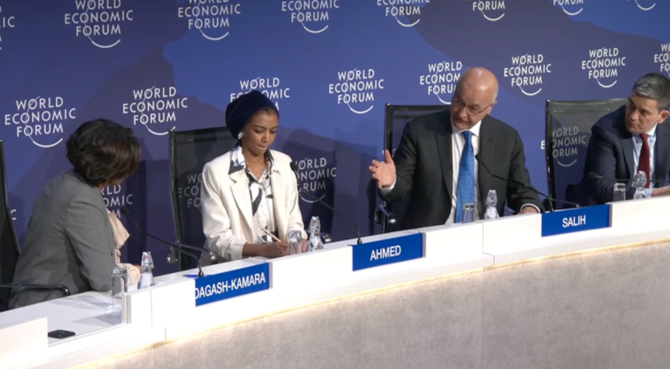
Session on Sudan at the Davos Forum - January 21, 2026 - Social Media
The UN High Commissioner for Refugees, Barham Salih, has warned that the ongoing war in Sudan will not be contained within its borders, and calls on the international community to take action to end the conflict. He added: “This conflict could have been avoided or contained in its early stages if a unified international effort had been made.”
Speaking at a session on Sudan at the World Economic Forum in Davos in Switzerland yesterday, Salih said that during his visit to Chad and Kenya he noticed gaps in protection, and that the available humanitarian aid was neither sufficient nor close to what was needed.
He pointed out that the amount provided is 10 litres of water per person per day, which is far from what is needed in emergencies, and that one in three families need shelter. He added that healthcare, psychological, and mental health services cover no more than 20 percent of those in need.
‘Aid alone cannot resolve this suffering; the solution lies in ending the war…’ – UN High Commissioner for Refugees, Barham Salih
Atrocities
The commissioner said that those he met in Abéché, Farchana, and Adré spoke of atrocities including rape and murder. He stressed that aid alone cannot resolve this suffering; the solution lies in ending the war.
He called on the international community to take action to support the political process to end the war, and stressed the need for international and regional efforts to end the conflict, as well as calling for securing aid for those who need it.
Regarding Chad, the high commissioner said that the government is pursuing policies to integrate and engage refugees, allowing them to obtain documents and providing job opportunities, in order to integrate displaced communities into the national economy within a comprehensive approach, stressing the need to focus on mechanisms that allow for the integration of refugees.
The largest humanitarian crisis
David Miliband, president of the International Rescue Committee, said that Sudan represents the largest humanitarian crisis in the world since the committee began documenting such crises.
He added that what is happening in Sudan is a civil war of a special kind, with interventions from neighbouring countries and countries in the Middle East.
He said that civilians bear the brunt of the conflict, and that survivors from El Fasher tell harrowing stories.
‘The conflict is not static and that the battle lines are constantly shifting…’ – David Miliband, president of the International Rescue Committee
Battle lines move
Miliband noted that the conflict is not static and that the battle lines are constantly shifting, pointing to the ongoing war in Darfur despite the fall of El Fasher.
He expressed concern about the situation in Kordofan and near Sudan’s southern border, warning of besieged towns, which could lead to future atrocities. He said that what is happening in Sudan will not be confined to Sudan alone.
He pointed out that Sudan has suffered from international neglect, especially since the civilian government assumed its duties in 2020 and 2021, when it did not receive sufficient support from the international community, indicating that Sudan had an opportunity to move forward after 2019.
He argues that the war in Sudan is linked to impunity, and that the only way to address this is through the use of force. He pointed to the profits reaped by those involved in the war, thus necessitating a counterforce. He called for the punishment of those participating in and benefiting from the war, not only within Sudan but also abroad.
He also called for a leading role for the United Nations at both the political and humanitarian levels, especially in the area of humanitarian response.
Emergency rooms targeted
Hanin Saleh, representative of the emergency rooms in Sudan, said that the rooms are working to fill gaps on the ground, and have 26,000 volunteers, noting that they face problems related to human resources, protection and famine, which even the volunteers themselves suffer from.
She said that emergency rooms are facing arrest, kidnapping, and killing by warring parties.
She also pointed to the weak role of the UNHCR in Egypt and Chad, stating that the response is “very limited and far too late”.

 and then