





Sudanese refugee children haunted by traumas of war
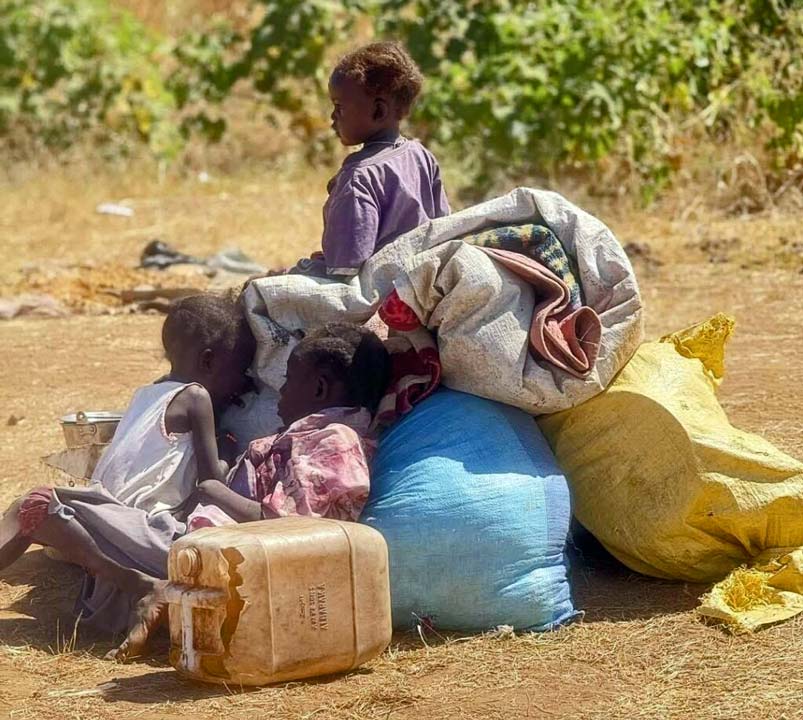
Desperation and devastation – exhausted children displaced from El Fasher rest en route to Tawila (Photo: RD correspondent)
By Abdelmoneim Madibu for Radio Dabanga
During the days of the Ugandan general elections, the sight of security planes flying over the capital, Kampala, was not a passing event for many Sudanese refugee children and women, but rather a direct trigger for recalling the traumas of the war that have not yet healed. As the sounds of warplanes echoed across the city’s skies for three consecutive days, some Sudanese children and women relived the scenes they had experienced during the bombing of their cities. For them, the presence of those planes over Kampala was not a source of safety, but rather a source of fear and renewed trauma. Children would run for cover whenever they heard the engine, and women would react with panic to scenes that brought back feelings of helplessness and apprehension, a clear reflection of the profound psychological impact of the war.
This report by Radio Dabanga examines the psychological dimensions of the Ugandan election experience – which took place last week – on Sudanese refugees in Kampala, and how the aircraft engines brought back symptoms of war trauma in children and women despite their escape to another country.
Mohammed Yassin, a Sudanese refugee living in Kampala, recounts the difficult days his three children experienced during the Ugandan general elections due to the frequent overflights of aircraft in the city’s skies.
Yassin tells Radio Dabanga that the sounds of the planes were enough to bring his children back to the state of shock and terror they had previously experienced in the city of Nyala in South Darfur, when they witnessed the aerial bombardment that targeted the city during the first months of 2024.
He adds, “Whenever the plane flies over our house, the children run away to look for a place to hide, in a state of extreme fear, thinking that the plane will drop bombs.”
He stated that he had to reassure the children each time, explaining that those planes were not warplanes and did not pose a danger, but the scene would be repeated the next day in the same way. He continued, “The situation continued in this manner for the three days that the flights continued.”
Yassin pointed out that their presence as parents with the children inside the house helped to alleviate the fear, but he noted that what happened reflects the deep and ongoing impact of the war on the children’s psyche.
He added, “We left Sudan in search of safety and to keep our children away from the atmosphere of war and its dangers, but the trauma remained present and resurfaces with any scene or sound that brings back memories of the bombing and conflict.”
A refugee living in Kampala told Radio Dabanga about a scene that reflects the varying impact of psychological trauma within a single family as a result of planes flying over Kampala during the days of the Ugandan general elections.
The refugee, who preferred to remain anonymous, said, “While the plane was flying low over the neighbourhood where she lives, the children continued to play normally, without showing any signs of fear or anxiety. However, the scene was completely different for her neighbour, the children’s mother, who comes from the city of Omdurman.”
Speaking to Radio Dabanga, she indicated that as soon as the mother heard the sound of the plane, she rushed out in a state of extreme confusion, running through the neighbourhood in a state of obvious shock, so much so that she was unaware of her usual appearance as a veiled woman. She was moving back and forth in a state of panic, trying to get her children out of the area, believing they were in imminent danger.
But the children, unlike their mother, refused to leave the play area and ignored her repeated attempts. The refugee added, “It was clear that the fear wasn’t with the children, but with the mother herself, who appeared visibly terrified.”
These scenes reflect the cumulative impact of the aerial bombardment experiences lived by Sudanese people, especially women and children, and how auditory and visual stimuli, such as the sound of airplanes, can recreate psychological trauma even after reaching a place that is supposed to be safe.
In a related context, Dr. Ibtisam Mahmoud Ahmed, a psychology consultant, and leader of the Behavioural Change Revolution initiative, recounts a shocking incident she experienced in one of Cairo’s streets, reflecting the profound psychological impact that continues to haunt Sudanese children fleeing the war.
She says she was walking down the road when she was surprised by the loud sound of motorcycles resembling gunfire, which prompted two Sudanese children who were with their mother to scream hysterically, repeating, “The Rapid Support Forces have come.”
Dr. Ibtisam told Radio Dabanga that the two children fell to the ground and clung to their mother in a state of extreme panic, while the mother appeared to be in a state of complete shock.
She adds that she rushed to hug them and reassure them that they were in Egypt and that there was no threat, before taking the family to the nearest store until the children calmed down and gradually regained consciousness.
She noted that after speaking with the mother, it became clear to her that the family had arrived in Egypt only about a month earlier, after the two children had witnessed harsh acts of violence in Al-Jazirah State, including the slaughter of their grandfather in front of their eyes.
She explains that this experience accounts for their violent reaction to any sudden noise and confirms that they are suffering from clear symptoms of post-traumatic stress disorder.
Commenting on the return of fear and panic among some Sudanese children and women in Kampala following the flight of the Ugandan election security plane, Dr. Ibtisam Mahmoud Ahmed says that this reflects the depth of the psychological trauma associated with the experiences of war.
She explains that war is one of the worst man-made disasters, and that its psychological impact varies from person to person depending on individual experience and psychological readiness.
Dr. Ibtisam points out that any traumatic experience a person goes through is first recorded through the senses, then processed in thought, before it moves to the emotions and is later reflected in behaviour, whether psychological or motor.
She adds, “When a painful experience is associated with feelings of fear or pain, any similar stimulus in the future—such as the sounds of airplanes or explosions—may bring back those same feelings, in what is scientifically known as (classical conditioning).”
She noted that many war survivors suffer from post-traumatic stress disorder (PTSD), which can manifest as sudden panic attacks or intrusive flashbacks of traumatic memories when exposed to similar triggers. She emphasized that this condition requires professional psychological intervention, particularly given the lack of systematic assessment, treatment, and psychological support following conflicts.
At the same time, she warned that ignoring psychological trauma could lead to the development of more serious mental disorders, such as depression or psychosis, particularly in children, women, and people with psychological fragility or previous traumatic experiences in childhood.
She emphasized the importance of providing psychosocial support services to refugees through trained teams who listen to those affected, assess their cases, and refer those needing specialized treatment.
She noted that these cases are not isolated but rather common among many Sudanese children in host countries, due to the lack of specialized psychosocial support programs.
Dr. Ibtisam believes that the continued suffering of refugees from panic attacks upon hearing the sounds of airplanes, years after their displacement, is a serious indicator of the lack of mental health services. She warned that ignoring these traumas and failing to treat them professionally could have long-lasting effects on an entire generation of children and could lead to a societal catastrophe after the war ends, characterized by escalating violence and social unrest.



 and then