





Yale Humanitarian Research Lab: ‘Possible siege preparations around North Kordofan capital, El Obeid’
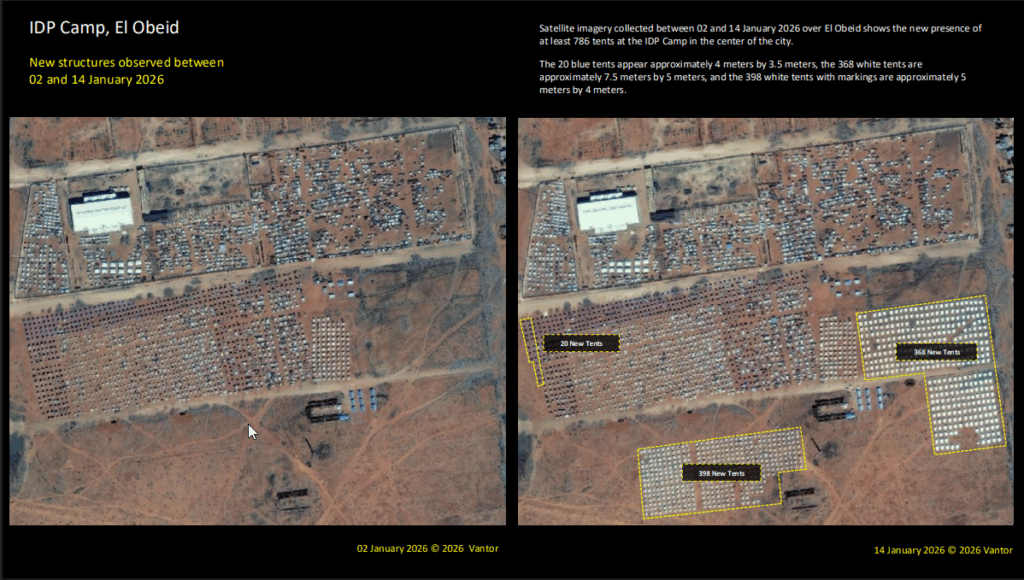
Increase in tents at shelters in El Obeid - January 2026 - Yale University Laboratory
The Humanitarian Research Lab at Yale University in the USA has identified activity suggesting preparations by the Sudanese Armed Forces and allied groups for a potential siege of the North Kordofan capital of El Obeid, according to an analysis of satellite imagery.
The lab reported the construction of new earthworks and embankments along key exit routes from the city, as well as around several pieces of critical infrastructure. It declined to provide further operational details at this stage, citing concerns related to civilian safety and human security.
The Kordofan region is currently witnessing intense fighting. El Obeid, which remains under the control of the Sudanese Armed Forces, is one of the three principal cities in the region. While the city faces the risk of siege in North Kordofan, the cities of Kadugli and Delanj are already under siege in the Nuba Mountains of South Kordofan.
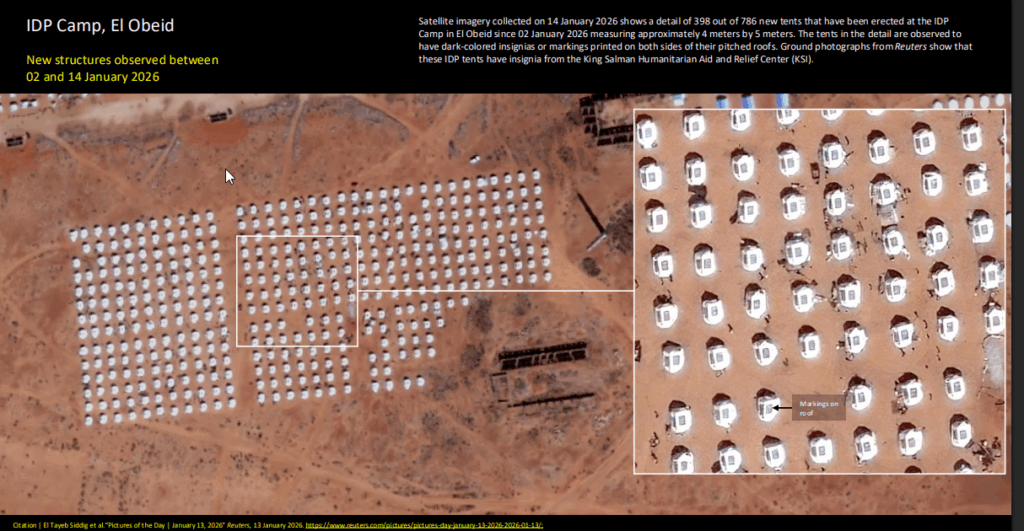
Rise in displacement and shelter construction
The Yale Humanitarian Research Lab, based at the Yale School of Public Health, has also documented a significant increase in temporary shelters typically used by internally displaced people in El Obeid.
Satellite imagery captured between 2 and 14 January 2026 shows the expansion of a displacement camp located to the north-central area of the city. The camp contains an estimated 800 tents, characterised by three uniform sizes, shapes and colours.
According to the International Organization for Migration (IOM), 42,780 people were displaced across North Kordofan between 25 October and 30 December 2025.
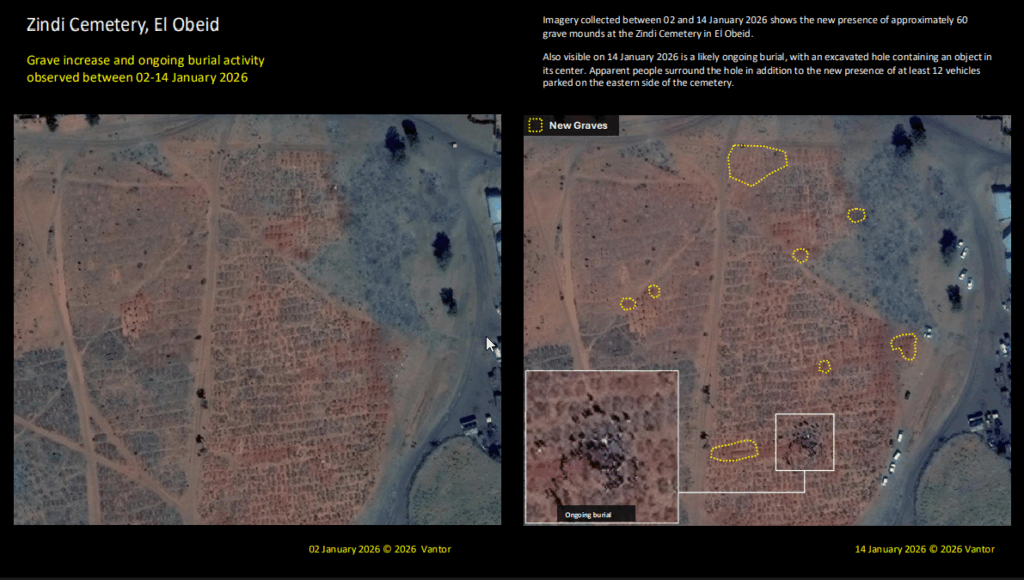
Increase in burials recorded
At least three displacement incidents were documented in North Kordofan between 21 and 30 December 2025. El Obeid continues to serve as a key transit point along displacement routes for civilians fleeing areas further south in the region.
The research lab also identified approximately 100 new burial mounds in El Obeid’s cemeteries. This represents an estimated increase of around 60 additional graves, alongside ongoing burial activity visible in satellite imagery.
The report suggests that current military operations may increasingly rely on aerial bombardment, particularly through the use of drones, with critical infrastructure and civilian areas likely to be targeted.
The assessment was prepared by the Yale Human Security Lab through cross-verification of open-source information, including social media content, local news reports, multimedia materials and other documentation, as well as remote-sensing data such as satellite imagery and thermal sensor analysis.



 and then