




The tragedy of the Sudan war as reflected in the numbers for 2025
Sudanile / Sudan Media Forum
What is left for the Sudanese citizen to pay for the accursed war between the army and the Rapid Support Forces (RSF)? His life, his morals, his children’s education, his health, his displacement within his country or his dispersal in exile?
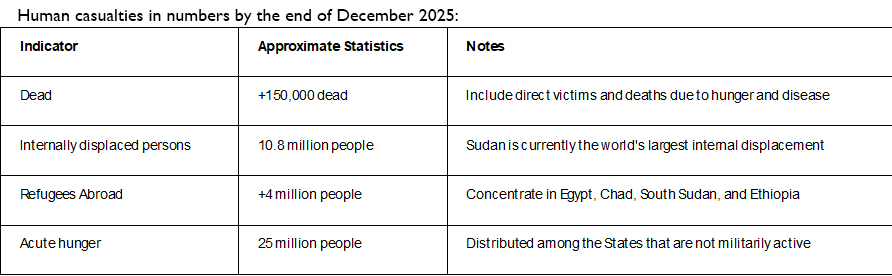
There are days left to say goodbye to 2025, the worst year of this war, which is the world’s largest crisis in terms of the number of deaths, hunger and displacement, through the language of the numbers that we will provide in this report:
The harvest of the Sudanese war within a year
Statistics of victims and fatalities:
The total number of deaths since the beginning of the war in April 2023 until December 2025 reached nearly 150,000 deaths (according to the estimates of the US envoy and international organizations), with the difficulty of counting the numbers accurately due to the media blackout and the collapse of health facilities, and the number of civilian deaths in the first half of 2025 from January to June 2025 reached nearly 4 thousand people, including 191 children, as documented by the United Nations High Commissioner for Human Rights, and the most affected areas were the northern state Darfur (especially El Fasher) followed by the Kordofan region and then Khartoum State.
The world’s largest displacement and asylum
Since the outbreak of the war, Sudan has witnessed the largest case of marriage and asylum in the world, as the number of internally displaced people has reached 12 million people, and the number of refugees to neighboring houses has reached more than 4 million people, most of whom are located in Egypt, Chad, South Sudan, Ethiopia and Uganda.
Famine
Some 26 million people face acute levels of hunger, with a state of famine officially declared in some camps for displaced people (such as Zamzam camp in Darfur).
Types of Documented Violations Against Civilians
The United Nations has documented the killing of thousands of civilians during the attacks of the Rapid Support Forces (RSF), most notably the attack on the Zamzam camp for displaced people in April 2025, as well as mass graves, where official and international reports revealed the discovery of approximately 965 mass graves in the states of Gezira, Darfur (El Geneina and Ardamta) and Kordofan, and it is believed that they contain the bodies of liquidated prisoners and citizens who were forcibly disappeared.
The use of rape as a weapon of war, where women and girls have been subjected to “horrific and wide-ranging” sexual abuse. The UN estimates that more than 12 million people in Sudan are at risk of gender-based violence.
Abduction and slavery: Cases of “sexual slavery” and abduction of women and girls (including minors) have been recorded in Darfur and Khartoum, with cases of suicide among survivors documented due to stigma and severe mental disorders.
– Ethnic cleansing and systematic targeting
Ethnic violence: In 2025, the conflict has taken on an increasingly ethnic character, targeting specific tribes in Darfur states.
Attacks on villages: Human Rights Watch and the Human Rights Office have documented attacks by the Rapid Support Forces (RSF) and allied militias on villages in North Darfur and al-Jazeera based on the ethnic identity of the population.
Enforced disappearances and arbitrary detention
Using hunger as a weapon by denying humanitarian aid, fuel and water access to besieged cities (such as El Fasher and Kadugli), resulting in hundreds of deaths due to acute malnutrition.
– Looting of resources: The systematic looting of food stores belonging to international organizations and citizens’ agricultural crops continued, accelerating the famine in five key regions.
– Direct targeting of hospitals and health facilities, as more than 671 incidents of assault on medical personnel and health facilities have been recorded since the beginning of the conflict.
Detention and torture of civilians, especially teachers and volunteers in “emergency rooms” inside the detention centers of both sides of the conflict, with reports of extrajudicial field executions.
Service and health breakdown
Health: In the field of health, 80% of hospitals in conflict zones are completely out of service.
Outbreaks of epidemics and diseases: The year 2025 was the year of epidemics and diseases, as the cholera epidemic broke out in 152 localities in all states, recording more than 123,000 cases and about 3,500 deaths by December 2025. The dengue epidemic also broke out in most of Sudan’s states, especially Khartoum and Gezira state, and led to hundreds of deaths.
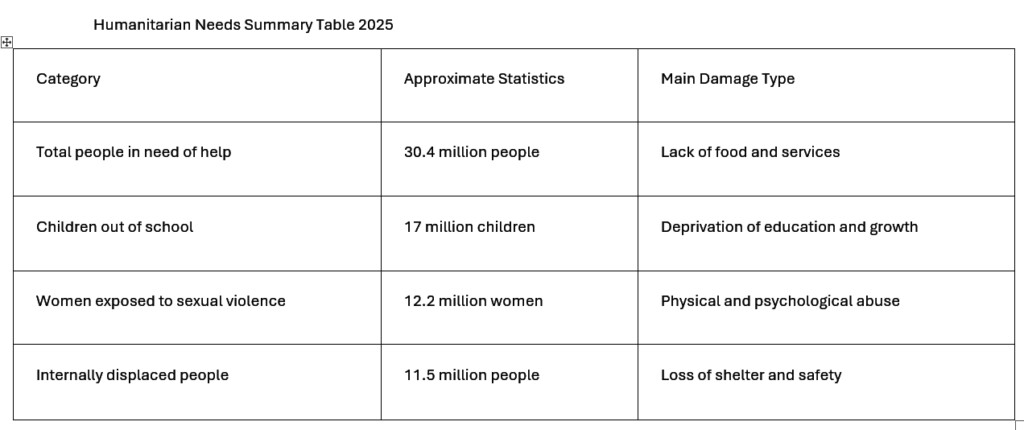
Education: The field of education is the real disaster of this war, especially as it relates to the future of the country and the loss of an entire generation, as the number of students who are out of school has reached more than 17 million children for the second year in a row.
Infrastructure: The country’s infrastructure has completely destroyed the state’s service institutions, including ministries, factories, bridges, and major electrical transformers, leading to almost total economic paralysis.
Victim Focus Highlights in 2025
Zamzam camp (Darfur): A bloody attack in April 2025 killed more than 1,000 civilians in just three days.
Gezira State: The last quarter of 2025 witnessed “waves of revenge” that resulted in hundreds of deaths and injuries in the villages of the island’s countryside.
Khartoum: It remained at the top of the list of deaths due to mutual artillery shelling and drone strikes.
Consequences of violations against women in Sudan by the end of 2025:
Sexual violence as a “weapon of war”
Imminent danger: The United Nations (June 2025) estimated that more than 12 million people in Sudan are at risk of sexual violence, using it as a tool to “defeat communities from within” and force them to displace or surrender.
Documented statistics: The Sudanese National Commission of Inquiry has identified 1,392 confirmed cases of sexual violence as of mid-year, including gang rape, sexual slavery, and forced pregnancy.
Systematic rape: A report by the Office of the High Commissioner for Human Rights (OHCHR) (December 2025) documented horrific cases of rape during the fall of IDP camps (such as Zamzam camp), where women and girls were targeted as they fled the fighting.
Social and psychological effects (stigma and suicide)
Suicide: International organizations have recorded painful suicides among young girls and rape survivors as a result of societal “stigma” and the lack of specialized psychological support.
Forced displacement: Women and girls account for more than 50 per cent of the displaced, and face additional risks in overcrowded shelters that lack privacy and protection.
Groups most affected by the war in Sudan
The following are the groups most affected by the war, supported by documented figures until the end of 2025:
Children
They are the most vulnerable and affected by this war, as they face hunger, disease, and ignorance, as in the field of education, we find that there are 17 million children out of school for the third year in a row, which threatens to completely collapse the educational future of an entire generation.
In health, some 4.9 million children under the age of five are acutely malnourished, of whom hundreds of thousands are at imminent risk of death from famine.
At the level of displacement, more than half of the displaced people in Sudan (about 6 million) are children, and most of them live in camps that lack the basic necessities of life.
At the level of violations, children were not spared from these violations, as they were killed and forcibly recruited by both sides of the war, and the violations against them increased 10 times this year compared to previous years.
Women and girls
Women and girls have been subjected to serious violations in the form of sexual violence, and the number of women exposed to gender-based violence has risen to 12.2 million (an increase of 80% from 2024).
Women’s reproductive health has also been compromised, with 80% of hospitals in conflict zones failing, pregnant women at risk of dying from lack of care, with maternal mortality rates rising alarmingly.
Thousands of women have also lost their sole breadwinner to their families due to the loss of husbands, exposing them to economic and security exploitation.
Displaced people and refugees
Displaced people and refugees have also paid a heavy price, with 12 million internally displaced persons (IDPs) missing the most basic necessities of life, such as health, food, and medicine, most of whom live in camps and camps. As for the refugees outside Sudan, they are not the best of the displaced inside Sudan, as most of them are struggling to adjust their situation in the countries in which they live and to provide a livelihood for themselves and their families.
Medical staff and aid workers
The conflict directly targeted the service system:
Victims: More than 110 aid workers were killed, injured and abducted in 2025 while trying to deliver aid.
Facilities: Health facilities have been subjected to more than 600 attacks, with most of them out of service and medical staff arrested or killed.
The Great War Catastrophe: The Collapse of Sudan’s Education Sector
There is no doubt that the biggest casualty of the Sudanese war is the collapse of the education sector, which will cast a shadow on the future of an entire generation that has been deprived of education at all levels of education, leading to a sharp increase in cases of child labor, child marriage, and forced conscription.
The following are the breakdowns of the damage caused to the students:
Basic and Intermediate Education:
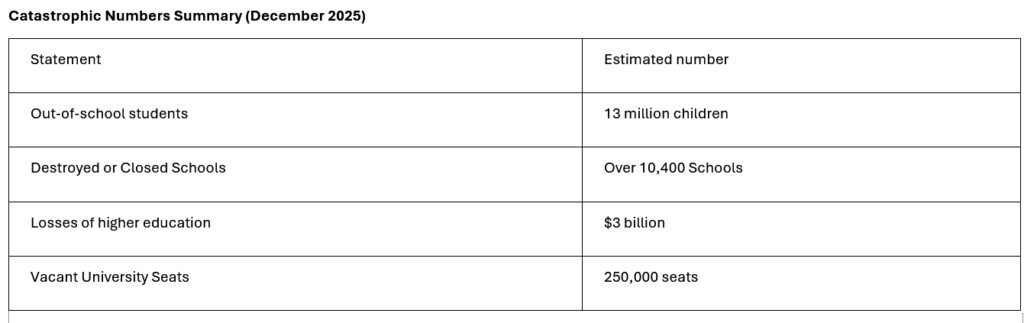
There are around 17 million school-age children in Sudan, of whom 13 million are out of school at the end of 2025.
About 7 million of them are officially enrolled but unable to go to school due to fighting or displacement, while 6 million have not been able to register at all.
In the River Nile State (as an example of safe zones), only 56,057 students sat for the intermediate certificate exams, a small number compared to population density and displacement.
Secondary Education (Sudanese Certificate):
More than one million students are at risk of transitioning into adulthood without a high school diploma, depriving them of access to universities or the qualified job market.
Of the 337,484 students who registered for the exams, only 226,730 were able to actually sit for them (67%).
Higher and University Education:
Studies have been discontinued in most public and private universities (more than 100 universities).
There is a huge gap in university admissions, with 250,000 university seats remaining vacant this year due to the inability of students to apply or access exam centers.
Second: Damage to Educational Institutions
Educational institutions have been transformed from houses of learning into conflict arenas or temporary shelters:
Destruction of facilities: More than 10,400 schools were completely or partially damaged. Reports indicate that 55% of schools in Sudan are completely closed.
Militarization of schools: Approximately one in 10 schools are used as shelters for displaced people or as military barracks and weapons depots by parties to the conflict.
Higher Education Losses: The direct material losses to the higher education sector have been estimated at US$3 billion as a result of looting, burning, and destruction of historic laboratories and libraries (such as the University of Khartoum and Omdurman Islamic University).
Third: Damage to the Educational Staff
Teachers: More than 240,000 teachers have been living without regular salaries since the beginning of the conflict, with the exception of some states (River Nile, Red Sea, and Northern) that pay partial salaries.
Migration: Sudan has lost about 20% of university professors and teaching staff who migrated out of the country or were displaced to pursue marginal occupations to make a living.
This article relied on reports from:
United Nations (OCHA): Updates on the humanitarian situation in Sudan (October – December 2025)
UNHCR: Two Years of Conflict Impact Report – 2025 Update
ACLED: Armed Conflict Site and Event Data (December 2025 Update)
Human Rights Watch (HRW): World Report 2025 on Sudan’s Violations
ReliefWeb: Field and Health Situation Reports (December 2025)
Human Rights Watch World Report 2025 (Sudan): Documenting War Crimes and Ethnic Abuses
United Nations Office for the Coordination of Humanitarian Affairs (OCHA): Displacement and Famine Statistics (December 2025)
ACLED (Armed Conflict Site Data Project): Tracking Military Sites and Death Toll
UN Human Rights Office (OHCHR): Reports on ethnic violence and the use of drones against civilians in 2025
Amani Africa: Political and field analyses on the fall of El Fasher and the future of the conflict
Armed Conflict Site Data Project (ACLED): Sudan Conflict Index – December 2025 Report
UN Human Rights Office (OHCHR): Report “Patterns of Violations and the Toll of Civilian Casualties in Sudan” (December 2025)
ReliefWeb: Situation Report No. 27 on Conflict and Cholera (3 December 2025)
Yale HRL: Monitoring Massacres and Military Activity via Satellite 2025
Sudanese Doctors’ Association (SABA): Statistics of human losses in field hospitals
UN Report Geneva (June 2025): “Horrific testimonies of women who have been raped and abducted”
UN Human Rights Office (OHCHR): “Patterns of Violations in Zamzam Camp” Report (December 2025)
Human Rights Watch Global Report 2025: Sudan’s Division on Gender-Based Violence
United Nations Population Fund (UNFPA): Response to Gender-Based Violence in Sudan Report (October 2025)
SIHA Network: More than Numbers Report on the Situation of Women and Girls (December 2025).
This article is published by Sudanil. It serves as a monitoring of the crimes that accompanied the events of 2025. The article, which relied on the reports of the relevant authorities, shows us staggering figures of direct and indirect violations committed against civilians, especially children and women, as well as the destruction of infrastructure and the low standards of life.
 and then