





Sudan war: Int’l pressure grows as fears mount over escalation in El Obeid
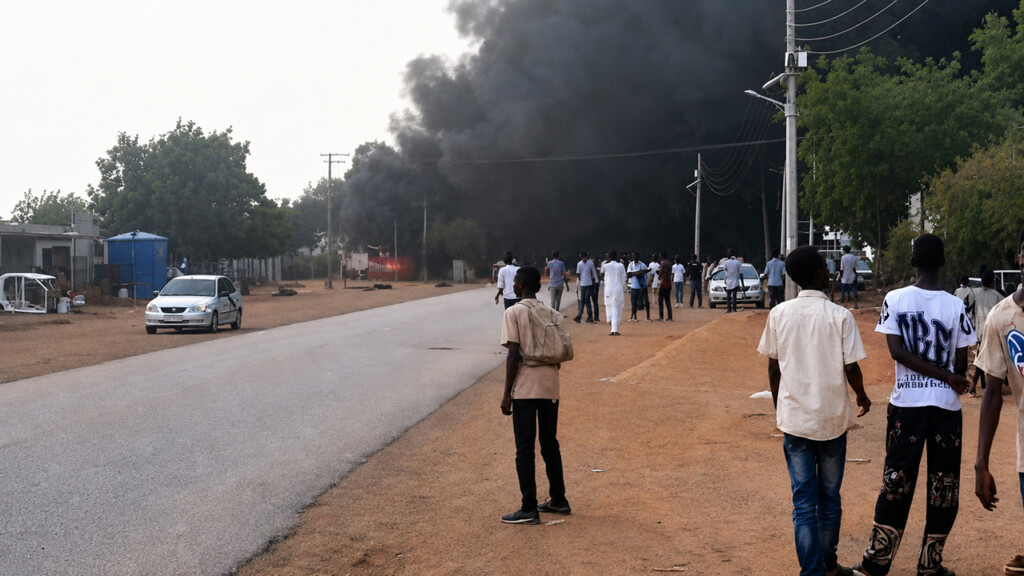
Smoke rises over El Obeid following a drone attack in June 2026 (File photo: supplied)
International efforts to address Sudan’s deepening crisis have intensified amid growing warnings from the United Nations and foreign governments about an expanding conflict and worsening humanitarian conditions, particularly in the city of El Obeid, capital of North Kordofan. As previously reported by Radio Dabanga, El Obeid has become the focus of mounting international concern, with diplomats and aid agencies warning that it could face a similar fate to El Fasher, where months of fighting have been accompanied by widespread reports of atrocities and civilian suffering.
Diplomatic push for new political process
Massad Boulos, the US president’s envoy for African and Arab affairs, said he had held what he described as a “highly productive” meeting with the UN secretary general’s personal envoy for Sudan, Pekka Haavisto, to discuss ways of ending the war and advancing a comprehensive political settlement.
According to Boulos, the talks focused on the work of the so-called Quint mechanism, which brings together the African Union, IGAD, the Arab League, the European Union, and the United Nations. The aim, he said, is to launch an inclusive political dialogue led by Sudanese civilians that could pave the way for a lasting ceasefire and a transition to civilian rule.
Boulos added that both he and Haavisto are due to brief the UN Security Council on Sudan, where they will stress the need for an urgent humanitarian truce and unhindered access for aid deliveries.
Warnings over a possible assault on El Obeid
In a post on X, Boulos said he had also spoken directly with the leadership of the Rapid Support Forces (RSF), urging them to refrain from any actions that could endanger civilians in and around El Obeid.
He said the United States was deeply concerned by reports that RSF forces and allied groups were massing around the city, increasing the risk of attacks on civilians and potential mass atrocities amid Sudan’s devastating humanitarian crisis.
On Wednesday, seven European countries called for an immediate halt to violence targeting El Obeid. In a joint statement issued by the UK Foreign Office and signed by Britain, France, Germany, Ireland, Italy, the Netherlands and Norway, the governments said there were credible indications that an attack on the city could be imminent.
The statement described the situation as a critical moment requiring international action and called on the RSF to halt its offensive immediately.
The UK foreign secretary, Yvette Cooper, warned that El Obeid was on the brink of atrocities that could deepen the wounds already inflicted on Sudan by the fighting in El Fasher.
“We cannot allow that to happen again,” she said.
Cooper added that the world had witnessed “the horrors” committed during the RSF assault on El Fasher last year, including reports of rape, looting, and killings of civilians.
“This cannot be repeated,” she said.
UN steps up efforts to prevent escalation
Meanwhile, the UN spokesperson Stéphane Dujarric revealed that Haavisto held talks last week with Mohamed Hamdan Dagalo, the RSF leader widely known as Hemedti.
According to Dujarric, the discussion focused on the need to reduce tensions in El Obeid, which has come under repeated drone attacks attributed to the RSF, and on concerns that continued military operations could further worsen an already dire humanitarian situation.
The two men also discussed efforts by the Quint group to support a political process through engagement with Sudanese civilian actors. Haavisto is continuing consultations with regional and international partners in an effort to prevent the city from descending into a wider confrontation.
Drone attacks damage civilian infrastructure
The United Nations has warned that the security situation in and around El Obeid is deteriorating rapidly, with escalating violence threatening civilians and disrupting essential services.
A UN spokesperson said drone attacks had struck several locations in the city in recent days, damaging an electricity substation and a fuel facility.
The organisation renewed its call for civilians and civilian infrastructure to be protected in accordance with international humanitarian law and urged all parties to ensure that humanitarian assistance can reach those in need safely and without delay.
‘Managing the crisis rather than solving it’
Not everyone is convinced that the flurry of diplomatic activity will produce meaningful results.
The Sudanese journalist Haidar El Mukashfi offered a critical assessment of international and UN efforts, arguing that they appear more focused on managing the crisis than resolving it.
Speaking to Radio Dabanga, he said the increase in diplomatic contacts reflected genuine concern that El Obeid could slide into a major confrontation, but questioned whether such efforts could succeed in the absence of effective mechanisms to compel the warring parties to change course.
El Mukashfi noted that the past two years had demonstrated the limited impact of international statements and warnings, despite repeated alerts over developments in Khartoum, El Fasher and elsewhere.
Political warnings alone, he argued, are insufficient without clear commitments on the ground.
He also highlighted El Obeid’s strategic and humanitarian importance. The city is home to large numbers of civilians and displaced people, meaning that any major escalation could carry a devastating human cost and potentially recreate the “El Fasher scenario” if large-scale fighting erupts.
At the same time, he suggested that the relatively early international response could help reduce the risk of escalation if it is accompanied by genuine political pressure, the opening of humanitarian corridors and clear obligations imposed on the parties to the conflict. As diplomatic efforts intensify, concerns continue to grow that the war could spread further across Sudan. For many observers, the key challenge is whether international diplomacy can be translated into concrete action capable of preventing another humanitarian catastrophe.



 and then