





Bank of Sudan’s banking sector reform strategy faces range of challenges, led by digital transformation
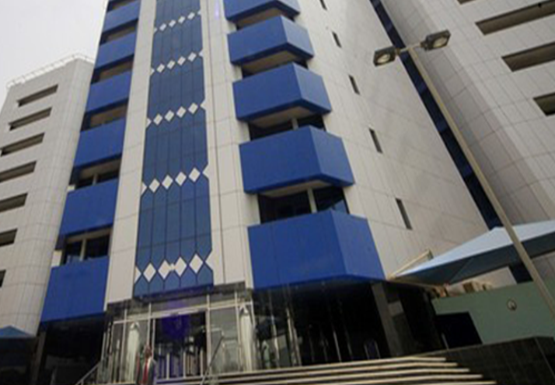
The Central Bank of Sudan in Khartoum before the war (File photo: CBoS)
By Suleiman Siri for Radio Dabanga
The Central Bank of Sudan has announced a new five-year strategic plan covering 2026 to 2030, aimed at conducting a comprehensive review to reform and strengthen the capacity of the banking sector and financial institutions, and improve their performance. The plan is part of the central bank’s efforts to strengthen financial stability, improve the efficiency of the banking system, and keep pace with economic changes.
The plan, prepared in December and published on the bank’s official website, seeks to address the challenges facing the banking sector, while developing banking systems, and strengthening governance and oversight. The aim is to support the national economy and improve banking services.
However, the plan faces a range of challenges and obstacles, chief among them the central bank’s inability to control the money supply, with about 98% of it held outside the banking system. It is also unable to control the exchange rate of the Sudanese pound, while the banking system itself faces management problems, declining capital as a result of the war that has continued since 15 April 2023, and the loss of branches in areas controlled by the Rapid Support Forces (RSF).
The strategy is not limited to restructuring. It also seeks to accelerate digital transformation within the Central Bank of Sudan and the banking system, with the aim of improving operational efficiency and creating a more conducive environment for innovation in banking services and operations, according to Sudanese news website Al Mashhad.
An executive overhaul
Banking and financial expert Omar Sid Ahmed says the Central Bank of Sudan’s five-year plan for 2026–2030 is a necessary step towards organising monetary and banking activity during the war and recovery period. However, he says it needs an executive overhaul to make it more flexible and realistic, and to link its objectives to available resources and changing security and economic conditions. He says it provides an important framework for restoring confidence in the banking system and organising the central bank’s work during this period.
He explains that the plan covers key areas including monetary and financial stability, governance, domestic and international relations, financial inclusion, digital transformation, and financial institution reform. Sid Ahmed says the broad areas are consistent with the needs of the Sudanese economy, particularly amid the war, declining economic activity, and damage to banking infrastructure. However, he says the main problem is that the plan could become a broad policy document unless it is linked to specific implementation programmes, clear budgets, and measurable performance indicators.
He points out that wartime conditions are not suitable for adopting a rigid plan that assumes stability in basic infrastructure, security, and the economy. What is needed, he says, is a flexible, scenario-based plan that is reviewed regularly in response to developments in the war, the economy, and foreign relations.
Strengths
On the plan’s strengths, Sid Ahmed says they include a five-year vision that provides a clear reference point for the central bank’s work, and the inclusion of monetary stability as a core priority. He stresses the need to include governance and institutional excellence as essential conditions for improving performance and restoring confidence.
He emphasises the importance of reforming financial institutions, strengthening capital adequacy, risk management, and compliance, while recognising the importance of developing payment systems and digital transformation. He also calls for financial inclusion to be included among the plan’s objectives to help serve affected groups and displaced people.
He says the plan should focus on improving coordination between the central bank, the Ministry of Finance, banks, and external partners. He also sees potential for using the plan as a tool to coordinate monetary, fiscal, and banking policies in order to rebuild the financial sector after the war ends or subsides.
Weaknesses
The banking and financial expert says the main weaknesses and risks include the breadth of the plan’s objectives compared with the financial, human, and technical resources available. He also points to the lack of clarity over the sequencing of emergency objectives, recovery measures, and longer-term reforms.
He says another weakness is the possibility of setting numerical targets that are not based on up-to-date data or a reliable baseline, as well as insufficiently clear responsibilities among the central bank, executive bodies, the Ministry of Finance, banks, and other government agencies. He also notes the lack of clarity over funding sources for the projects and programmes included in the plan.
He stresses the difficulty of implementing digital transformation projects amid deteriorating electricity, telecommunications, and infrastructure. There is also a risk, he says, that the central bank could expand into objectives that do not fall directly within its mandate, while the risk of financing the budget deficit through monetary expansion remains.
He also points to the limited ability of monetary policy to influence the market as transactions outside the banking system expand, declining confidence in banks, and difficulties in restoring deposits and banking services. Other challenges include the lack of clarity over how to deal with distressed or non-viable banks, and the difficulty of restoring relationships with correspondent banks and international financial institutions. These factors, he says, could turn the plan into little more than an administrative document disconnected from day-to-day decisions.
Overall assessment
Sid Ahmed’s assessment covers the plan’s various areas. On monetary stability, he says this is the foundation on which all the other areas depend. It should not be limited to reducing inflation, he says, but should also include controlling monetary base growth, managing liquidity, and managing the foreign exchange market.
He stresses the need to set clear limits on monetary financing of the government, develop monetary policy tools, and improve foreign reserve management, while establishing early-warning indicators for inflation and the exchange rate. He advises against setting rigid five-year targets, instead recommending ranges that can be reviewed in response to developments in the war.
On governance and institutional excellence, he says improving governance is a prerequisite for restoring confidence in the central bank and banking sector. He stresses the need to define the powers and relationships between the central bank, the Ministry of Finance, and regulatory bodies, while strengthening internal and external auditing and risk management.
He also calls for a business continuity plan, protection of data and media, regular performance reports, and a reduction in non-institutional interference in technical decisions.
On domestic and external relations, he says the central bank needs continuous coordination with the Ministry of Finance, banks, and economic authorities, as well as a unified database for the monetary and banking sector. Compliance with anti-money laundering and counter-terrorist financing requirements should also be improved.
He recommends preparing a technical file for restoring relations with correspondent banks, diversifying external financial relationships, and implementing reforms that could pave the way for the lifting of restrictions.
In financial inclusion, he says the focus during the war should be on ensuring access to money and safe transfers, providing low-cost payment accounts and appropriate services for displaced and affected people, establishing mobile service points, and developing solutions that can operate in areas with weak communications. He also calls for simplifying account-opening procedures.
Success, he says, should be measured by the number of active accounts and the volume of transactions, rather than registrations alone. Consumer protection and awareness of the risks of financial fraud should also be strengthened.
On recapitalisation and addressing losses, he recommends applying banking stress tests and early-intervention systems, protecting depositors, and establishing a clear mechanism for dealing with distressed banks.
Proposed alternative plan
The banking and financial expert has put forward a package of proposals as an alternative to the strategy developed by the Central Bank of Sudan, while retaining the five-year framework as a broad strategic vision.
He recommends a 12-month emergency programme focused on saving the banking system, annual implementation programmes setting out projects, costs, and responsibilities, and quarterly operational plans that can be adjusted.
He stresses the importance of adopting three possible scenarios — continued war, partial de-escalation, and gradual recovery — and defining clear indicators for moving from one stage to another. He also recommends establishing a unit within the central bank to monitor implementation and produce regular reports on progress and the reasons for delays, with every objective linked to a performance indicator, resources, and a responsible body.
He advises prioritising the continuity of payments, protection of deposits, and liquidity management before major transformational projects. His proposed priorities are protecting the continuity of the banking system and payment systems; controlling liquidity and monetary financing of the government; protecting deposits and restoring public confidence; assessing banking losses and war damage; strengthening oversight, governance, and risk management; restructuring weak banks and providing basic financial services to displaced people; securing data and digital infrastructure and gradually expanding digital transformation; and rebuilding external banking and financial relationships.
He concludes that the five-year plan is appropriate in terms of its broad areas, but needs changes to its implementation approach. A fixed plan is unsuitable during a war, he says, while a flexible strategic framework linked to annual programmes and short-term emergency plans is appropriate, with monetary stability and protection of the banking system taking precedence over long-term projects.
Digital transformation and institutional reform
Sid Ahmed concludes by noting that digital transformation and financial inclusion are important, but says they must be implemented gradually and in line with the reality of the country’s infrastructure. The better alternative, he says, is to turn the plan into an integrated system comprising a five-year framework, an emergency programme, annual plans, and quarterly reviews.
He says the success of the plan depends on flexibility, transparency, institutional coordination, technical decision-making, and the ability to adapt to developments in the war and the economy. Digital transformation, he stresses, should begin with data protection, backups, and alternative operating centres, alongside securing payment systems. More complex technology projects should be postponed until the underlying infrastructure is secure.
He concludes by saying that reforming financial institutions requires an assessment of the actual condition of each bank after the war, including an independent assessment of assets, non-performing loans, and collateral. Banks should then be classified into three categories: viable; those requiring restructuring or a merger; and those that are not viable.
Note: This report has beentranslated from Arabicwith the assistance of artificial intelligence tools, and subsequently reviewed and adapted by a human editor before publication.


 and then