





UNICEF: ‘Drone attacks unlike anything Sudan has seen before’
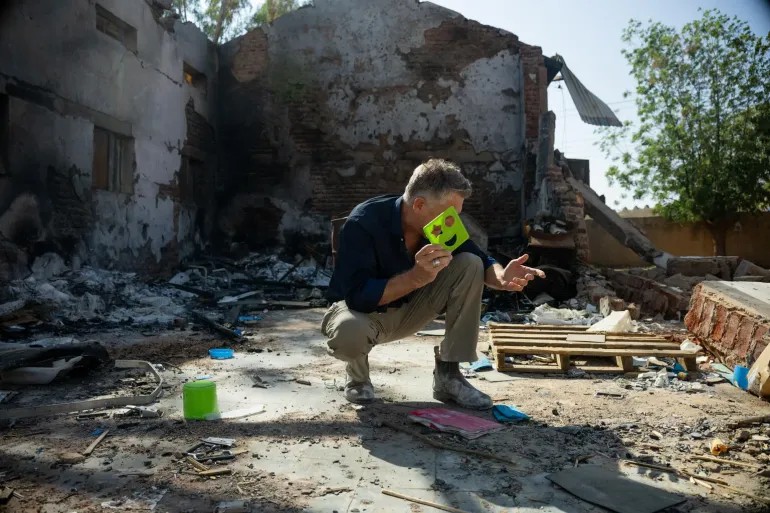
James Elder, UNICEF Spokesperson, picks up the remains (toys, books) at the UNICEF warehouse that was damaged by drones in El Obeid, North Kordofan on 20 September. The drone strikes destroyed over 292,000 school textbooks, 40,000 Arabic Language and Mathematics Review Books, and other learning materials intended for distribution to children (Photo: UNICEF/UNI1026149/Elfatih)
Drone strikes on Sudan’s power stations are cutting children off from water, education, and essential healthcare, as drought deepens the crisis, warns James Elder, UNICEF’s Senior Adviser and Spokesperson in Geneva.
Speaking to journalists at the UN Palais des Nations in Geneva after returning from Sudan, Elder described the combined impact of attacks on critical infrastructure and drought as an assault unlike anything the country had experienced before.
During the final week of October, not a single day passed without an armed drone striking a power station in Sudan. Up to 15 power stations were hit during the month.
‘Even if rains arrive late, they cannot undo the damage’
At the same time, as warnings over the El Niño phenomenon continued around the world, the effects of the damage had already begun to emerge in Sudan.
“Even if rains arrive late, they cannot undo the damage. The planting window for the 2026–27 cereal harvest has largely closed. But the drones keep coming,” Elder said.

He explained how the destruction of power infrastructure, combined with drought, posed a particularly serious threat to children.
“When a power station is struck, water pumps stop and water treatment stops. Families are forced into expensive and unsafe alternatives. Disease spreads,” he said.
The cold storage needed to keep vaccines and medicines viable is also threatened. Farmers are losing access to irrigation because pumps depend on electricity, while crippling fuel shortages are compounding the problem.
“Harvests suffer, prices keep rising, and food slips further and further out of reach. A lethal cycle kicks in,” Elder said.
He noted that an estimated 825,000 children under the age of five in Sudan were expected to suffer from severe acute malnutrition in 2026, the type that kills.
Elder said two in three child casualties in Sudan this year had been caused by armed drones, bringing the war to places that had previously been safe.
“People in Sudan talk about three things: safety, education, and water. Drones are taking all three,” he said.
During a visit to displacement camps the previous week, Elder met children who had lost their arms and hands in the war. One was Burie, a teenager who lost both hands in an explosion and lives in a tent.
“He spends the mornings learning online and the afternoons picking grass for animals with stumps for hands. His friends help him,” Elder said.
The teenager told him: “I must accept this.”
‘If the world is waiting for something worse, it will be waiting at their graves…’
“That is Sudan. It is relentless, it is crushing, and still Sudanese people hold each other up,” Elder said.
He praised the strength shown by people supporting one another, but warned that resilience could not be sustained through goodwill alone.
“For three and a half years, the suffering of Sudan’s children has largely been met with silence. So what does it take? Must Sudanese children face an existential threat for the world to take notice? Well, it’s here,” he said.
“When the power goes, the water pumps stop. When the rain fails, the food runs out. Sudan’s children are now facing both at once.”
Elder concluded: “If the world is waiting for something worse, it will be waiting at their graves.”


 and then