





Call for business world to cease trading Sudan’s ‘conflict gold’
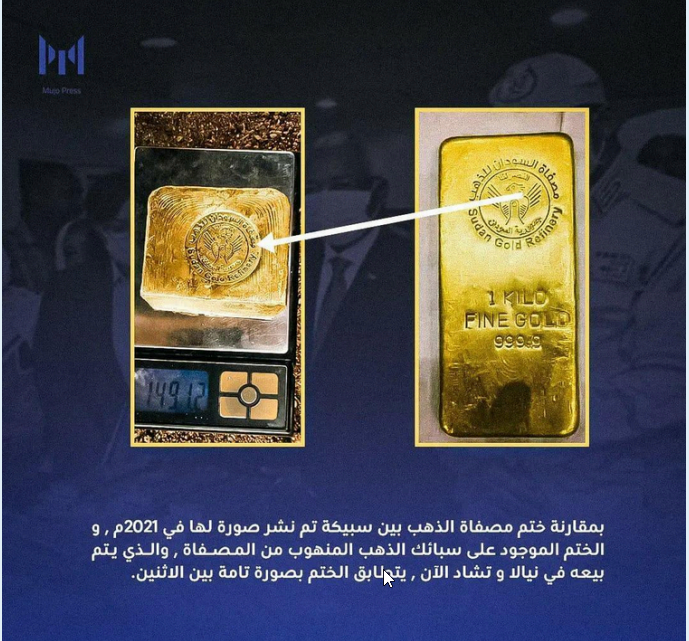
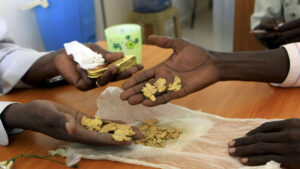
Sudanese Gold Refinery ingots identical to those sold in Chadian markets (Photo: Mojo Press – Report by the Center for Environmental and Social Studies)
A recent report by Sudan’s Centre for Environmental and Social Studies (CESS) reveals the continued appearance of conflict-related Sudanese gold in global supply chains, Including in German carmaker Volkswagen’s 2024 reports*. The field report underlines that the Rapid Support Forces (RSF) seized the Sudan Gold Refinery in May 2023, looting about 2.7 tons of gold before completely destroying it.

The report calls on all international companies and financial institutions to immediately suspend trading in Sudanese gold linked to war financing, and demanded the strengthening of transparency and accountability systems.
Since the outbreak of war in Sudan in April 2023, gold has become one of the most prominent resources used by the warring parties to finance their military operations, given the collapse of state institutions and the decline of official export channels. With the rise in global demand for gold due to economic and geopolitical instability, a favourable environment has emerged for integrating gold from conflict zones into international markets, including Sudanese gold, which now flows through complex and transnational smuggling networks.
The report indicated that Volkswagen’s case serves as a revealing example of the shortcomings in global supply chain tracking systems, particularly concerning minerals originating from conflict zones. The Sudanese gold refinery continued to appear in the company’s 2024 supply chain reports, even though it had ceased operations after being seized by the RSF in May 2023, followed by widespread looting and destruction of infrastructure.
The Sudan Gold Refinery was established in 2012 as the cornerstone of the gold sector’s regulation, responsible for refining gold, determining its quality, and controlling exports to ensure that revenues went into the state treasury. The refinery was assigned an identification code within international tracking systems, making it part of global supplier networks. However, this listing continued even after the refinery ceased operations entirely, raising serious questions about the credibility of verification mechanisms employed by international companies.
Turning point
The evidence suggests that the RSF takeover of the refinery marked a turning point in the use of natural resources to finance the war, as the forces seized large quantities of gold and silver valued at over $150 million. This incident has been officially documented, reinforcing the hypothesis that some of the gold subsequently appearing in international supply chains may be linked to these operations.
The report stated that satellite imagery supported these conclusions, with time-lapse analysis of the site between 2023 and 2025 showing a gradual destruction of the refinery’s infrastructure, culminating in a complete cessation of industrial activity. Therefore, the continued appearance of gold associated with this identifier in company reports raises two possibilities: either a flaw in the tracking systems or the reintegration of looted gold through informal channels.
Complex smuggling routes
Investigations reveal complex smuggling routes, with Sudanese gold being transported through neighbouring countries such as Chad and South Sudan before being re-exported via regional trading hubs, primarily Dubai. This pattern reflects the ability of informal networks to integrate conflict-related gold into global markets, exploiting regulatory gaps and discrepancies in production and export data between countries.
In this context, the Volkswagen case cannot be viewed as an isolated error, but rather as part of a broader structural problem related to weak due diligence systems at multinational corporations. International standards, including OECD guidelines, place the responsibility for verifying the sources of raw materials on companies, regardless of the complexity of their supply chains. Therefore, the continued listing of a non-compliant smelter located in a conflict zone reflects deficiencies in monitoring and early warning mechanisms.
This problem is not limited to a single company; reports indicate that several international companies continue to list the Sudanese gold refinery among their supplier networks, despite its confirmed closure. This underscores a systemic weakness in the governance of mineral supply chains, particularly in high-risk environments experiencing armed conflict.
Trading in global markets
Even more dangerous is the fact that trading in conflict-related gold on global markets directly contributes to prolonging wars by providing necessary funding to warring parties, bolstering a parallel, militarized economy, and undermining state institutions. This reality reflects a close link between the global economy and local conflicts, where natural resources become tools of conflict rather than engines of development.
In light of these facts, urgent action is needed on several levels. Firstly, companies, including Volkswagen, are required to fully disclose their supply chains and undergo independent and transparent audits, while strictly adhering to international standards. Secondly, the financial sector is urged to suspend dealings in conflict-related gold and strengthen early warning systems. Civil society also has a crucial role to play in tracking and exposing these flows and pressing for accountability for those involved.
Ultimately, halting the flow of conflict-related gold is not merely a moral imperative; it is a prerequisite for ending the financing of war in Sudan. Without addressing these complex economic networks, the conflict will persist, and the country’s natural resources will remain vulnerable to exploitation, at the expense of its stability and the future of its people.
* A March 2025 investigative report by German news channel DW and Dutch magazine De Groene Amsterdammer, asserts that 3TG raw materials — tantalum, tin, tungsten and gold — key as the auto industry strives to transition to electric vehicles (EV) are currently high in demand from carmakers in Europe and elsewhere. However, current profits from mining 3TG help fuel conflict in countries, so that they are often also called ‘conflict minerals’
According to the DW report, conflict minerals are very likely to have ended up in the electric vehicles of Europe’s biggest carmaker, Volkswagen (VW).
Based on VW’s own Responsible Raw Materials Report, DW found that at least six entities that have been linked by the DRC and the European Union to conflict minerals are part of the German company’s supply chain. Another supplier, a gold refinery in Sudan, was until recently controlled by an armed group that the United States has accused of genocide.
In an statement to the researchers at the time, a VW spokesperson wouldn’t “confirm or rule out with absolute certainty” that the smelters are supplying the carmaker.
“Their appearance in VW’s raw materials reporting system “does not indicate that they are necessarily part of our supply chain,” the statement added.
“Volkswagen Group does not have a direct business relationship with any of the listed companies or mines,” the statement said, and that the “complexity of global supply chains” was responsible.

 and then