





Op-ed: Performing refugeehood – How will Sudanese navigate Egypt’s incoming asylum system?
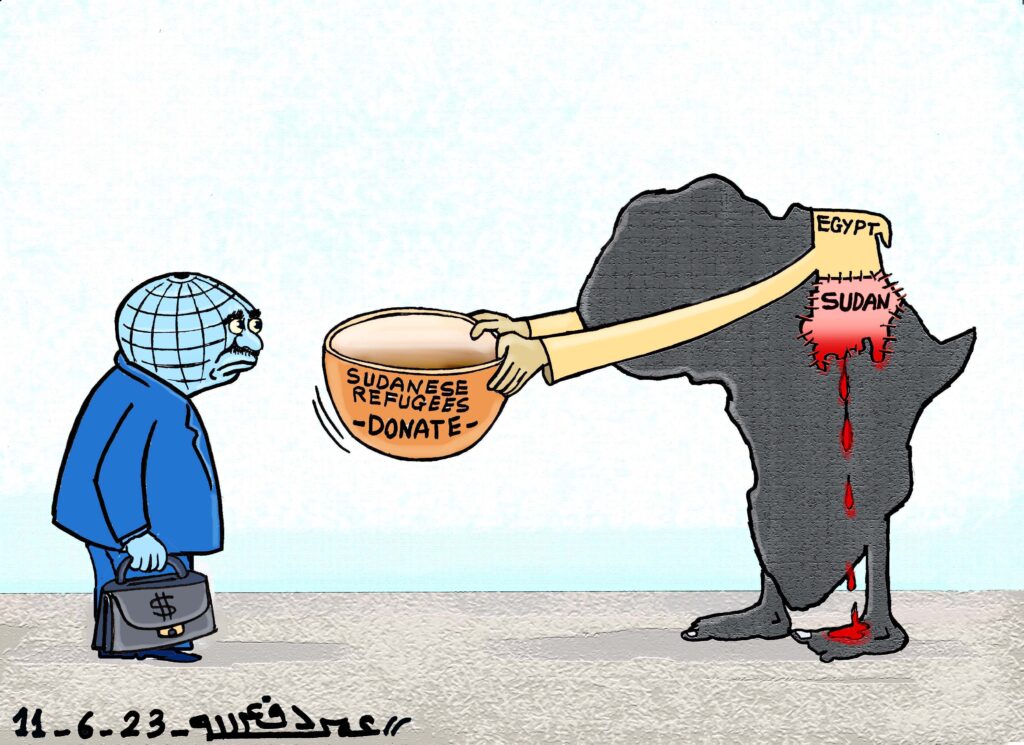
Sudanese refugees in Egypt asking for aid (Cartoon by Omar Dafallah / RD)
By Joseph A. Owens for Radio Dabanga
Egypt has slowly whittled down its commitments to the 1951 Refugee Convention. And now we wait for the final nail in the coffin: the implementation of Asylum Law No. 164, which gives the government the authority to decide who will be protected from violence and deportation.
For Sudanese in Egypt before 2023, registering with the United Nations High Commissioner for Refugees (UNHCR) and the subsequent wait, often years in limbo, for an interview to determine one’s refugee status, is an all-too familiar and exhausting process.
Under new regulations, decisions on refugee matters will shift from UNHCR. Commentators have warned that this risks the state arbitrarily denying or withdrawing asylum amid a history of documented human rights abuses against Sudanese.
Escalating deportations, police patrols, and a recent violent raid on gold miners in the Aswan and Red Sea Governorates have only sowed further distrust. These leave one wondering: how will Sudanese navigate an asylum service run by the persecutor?
UNHCR’s position in Egypt
UNHCR Egypt is often likened to a ‘surrogate state,’ an organisation fulfilling the basic duties of a government by providing meagre cash assistance, endorsement for residency, and referrals for medical assistance. It attempts to make life liveable in Egypt. Most importantly, UNHCR offers supposed safety from deportation and violence.
Yet this protection must be earned, defying the logic that it is a right enshrined in the Refugee Convention. I spoke to multiple Sudanese who felt they had to embellish their stories during their interactions with UNHCR officers. “You just call them and play the role of victim,” Eltahir told me. He recalled speaking with them thirteen times to find a solution to repeated arbitrary detentions he faced and violence on the street from those acting on behalf of the Government of Sudan, receiving one callback to advise him to move areas.
‘Performing for the UN’
For Sudanese, the most important interaction is the Refugee Status Determination (RSD) interview: a showdown between the UNHCR-appointed officer and one seeking protection. This interview will decide whether one can legally reside in Egypt based on a well-founded fear of persecution.
Before fleeing Sudan, Abdelrahman had written down all violent events he faced in Sudan and Egypt so he would remember them clearly. This is a common practice, often suggested by refugee-led organisations and community members throughout Cairo and Giza.
Others undergo mock interviews with fellow Sudanese or share their experiences through WhatsApp channels, warning other asylum-seekers of what to expect, such as how to navigate difficult interviewers.
While these are normal practices, the way applicants tell their story is critical. Interviewees are expected to recall violent incidents in chronological order, focusing on specific details, such as the colour of a torturer’s shirt or how many people were in a prison cell. Violence, and the subsequent victimisation one felt afterwards, are crucial to convincing the UNHCR officer that one does indeed need protection.
“The other reasons [for leaving Sudan], I did not mention. These are about personal wellbeing, doing a master’s degree and finding a good job. These are not reasons which will convince their claim … they would say, ‘We are not a charity.’ I focused on the conflict, the casualties, the people who were killed in my family, the safety of my life and the persecution,” Hassan, from North Darfur, said, describing his RSD interview in detail.
I asked him how he felt about this, but he said he had no option. “I should play that role well and just make sure that I send the message across well. If they think I really am a victim, then I can get some assistance.”
Despite his best efforts, Banda, “fresh from the trauma in Sudan,” could not continue his interview: “I know there are times you test if someone is consistent or not, but you feel they’re quite intense. It reminded me of my detention experiences.”
Banda was subsequently rejected. He believed he was not passive enough and “too articulate” to be considered a true victim. In the eyes of UNHCR, “some people are expected to suffer, to look poor, illiterate, not educated … they should be that way.” Upon appeal, with a more scrupulous officer, he was finally recognised.
Much has been written about the optics of refugeehood: how one should look or present oneself to receive assistance, or what Didier Fassin calls ‘humanitarian reason’. There is no hierarchy of suffering in the 1951 Refugee Convention, but it is often a determining factor in ‘earning’ the right to be recognised as one who genuinely has faced persecution.
UNHCR officers often begin from a place of suspicion. While fraud does exist, the parameters of what is ‘true’ and what is ‘not’ often depend on the temperament and ability of the interviewer and their supervisor. Abdelrahman was rejected due to credibility concerns regarding his Fur identity. He felt this was because of the interviewer’s lack of knowledge of Darfur and her scepticism of his confident understanding of refugee law; he was simply ‘too’ educated. It took an appeal with another officer who had researched his hometown more thoroughly to be recognised.
Demanding justice
Performing victimhood can be a tactic to secure residency, yet many have forced UNHCR to recognise their claims to justice. Hassan was deported from Jordan along with hundreds of other Sudanese after a sit-in outside UNHCR offices demanding protection and working rights. Despite the threat of removal, at the time he insisted that “we’re gonna fight.” He and others lay blame directly on UNHCR for not addressing their concerns, nor intervening in their forced removal back to Sudan.
Hassan was detained, released, and subsequently travelled to Egypt, meeting other deportees. He then confronted an officer at UNHCR Cairo, pointing to his document from Jordan which assured the organisation would protect him. Acquiescing, the officer agreed that what had happened was a violation of his human rights. “You have to hold them accountable,” he advised me.
Likewise, upon rejection, Abdelrahman explained in detail to the UNHCR officer conducting his appeal exactly how little knowledge the previous officer had about Darfur, besides quoting the Refugee Convention. Playing this game of victimhood while still affirming his rights, remained crucial not just for recognition, but for dignity and ownership over his own story.
More formalised resistance in Egypt is limited, as the social contract with UNHCR and promises of protection have remained fragile. Many Sudanese remember the fatal Mustafa Mahmoud sit-in of 2005 outside of their office and blame the agency for not acting quick enough to secure a solution to Sudanese’s protection issues before Egyptian police opened fire on protesters.
Between UNHCR and the Egyptian state
Navigating Egyptian bureaucracy is a lengthy, frustrating process for many Sudanese. Residency appointments, facilitated by UNHCR, now stretch months into the future and require multiple visits. Obtaining a birth certificate often requires the intervention of Egyptian lawyers. Requesting medical or police reports sometimes requires a bribe.
UNHCR has tried to make these processes easier by partnering with hospitals, referring people to local law firms, and negotiating with immigration officials in *Abbassia. Yet getting UNHCR’s attention is exhausting. This often means calling for hours or travelling to their office in 6th of October City before sunrise to secure a place in line. This is the reality for many of the almost 900,000 of Sudanese registered with the agency. In turn, UNHCR often decries the limited funding from resource-rich countries, while European money is increasingly being spent on policing migration.
Convincing Europe and Egypt
The European Union remains the architect behind Asylum Law No. 164. This is just one agreement among others with North African countries aimed to hold asylum-seekers and refugees in place, preventing their arrival in Europe in exchange for billions of euros. To create conditions for ‘local integration’, the EU has required Egypt to offer (through the new asylum law) pathways to citizenship, freedom to leave and return to the country, and unrestricted access to the labour market. These measures could theoretically lift Sudanese out of the precarious labour that is rife throughout the country.
Through this new asylum architecture, Sudanese will have to curate their own stories to convince a state which actively brutalises them to provide protection. The hierarchy of suffering and need to victimise oneself will intensify. Given the EU’s desire to stop migration from countries of origin, including through its funding of the paramilitary Rapid Support Forces to police migrant routes through and out of Darfur and closing maritime routes off the coast of Egypt, there is little reason to believe deportations will cease.
Community-based initiatives and information sharing among networks on how to navigate the new asylum service will need greater support. Demanding justice amid this hostility may require buying into the language of the Egyptian state, as demonstrated by Hassan and Abdelrahman toward UNHCR.
Living otherwise
Despite this repression, Sudanese have created a sense of place in Egypt. Established communities dating back decades were later joined by South Sudanese and, after 2003, by Darfuris and Nuba. Organisations run by Sudanese proliferate throughout Cairo and Giza, with mutual-aid networks providing support and basic safety nets which UNHCR and the Egyptian state do not.
Beyond these networks, many simply show up for each other. During phone calls with interviewees, some were interrupted by community members with requests to join an aid distribution meeting, or to go meet new arrivals to the country. This is the kind of solidarity which has travelled with those displaced. Despite relentless pressure by the Egyptian state, solidarity “makes you feel powerful,” one interviewee told me.
Sudanese may have to curate new narratives as the asylum service shifts hands to a state which is actively targeting them. However, these solidarity and mutual-aid networks will continue to foster a sense of place.
*The state’s administrative hub for General Department of Passports, Immigration and Nationality located in Cairo.


 and then