





World Teachers’ Day: Sudanese educators call for housing and better support
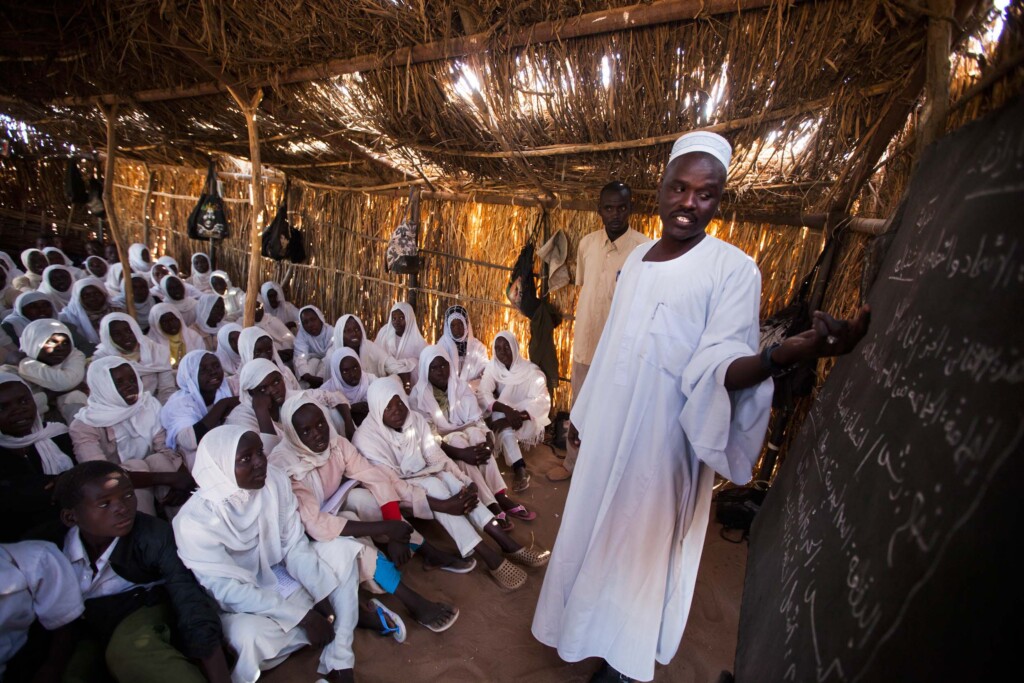
A teacher in his classroom in Darfur (Archive photo: Albert González Farran / UNAMID)
As Sudan’s war disrupts education, teachers say low pay and poor working conditions are forcing many to take second jobs. Sudan’s war has severely disrupted education, threatening a widening educational gap affecting tens of thousands of children, as teachers struggle with low pay and worsening working conditions, Sudanese educators lament, in statements to mark World Teachers’ Day*.
Teachers’ salaries are now barely enough to cover the cost of a gas cylinder or daily transport, prompting many to seek additional jobs alongside teaching. This leaves them with less time to fulfil the daily responsibilities of their profession.
Ali Said, a curriculum specialist and one of the leaders of the Popular Education Initiative, tells Radio Dabanga that “there is no school without a teacher”, describing teachers as the foundation and backbone of the education system.
He calls on the state to give teachers greater support, saying they practise the only profession that produces generations of engineers, doctors, politicians, and presidents.
A teacher who cannot provide a decent living for their family cannot deliver the required performance in the classroom, Said says. Someone preoccupied with rent, transport, food, and their children’s education cannot teach students in a way that prepares them for the future.
“The result is that we contribute to producing an underdeveloped nation,” he says, calling for teachers to receive the highest salaries in the country.
Said says teachers combine roles rarely found together in other professions, acting simultaneously as educators, professionals, technicians, administrators, and mentors. Their work does not end with normal school hours, he says, as they often work late into the night preparing lessons for the following day.
Providing essential resources
Said calls for teachers to be provided with all the necessary equipment, materials, and resources, including books, reference materials, radios, recording equipment, computers, and smartphones, either free of charge or at reduced prices.
Such resources, he says, benefit teachers less than their pupils.
He also calls for teachers to receive free travel tickets during their holidays to anywhere in the world, allowing them to learn from other countries’ educational systems and bring those experiences back to their schools.
Teachers should also be provided with free housing and given greater social security, he says.
Said criticises teachers’ reliance on private tuition, arguing that it undermines their status and how pupils view them. A pupil who pays a teacher for private lessons, he says, effectively becomes the teacher’s employer.
Criticism of authorities
Said criticises the authorities’ treatment of teachers’ demands, including arrests and portraying teachers as rebels or opponents of the state.
Teachers should instead be treated with the respect they deserve and held accountable under the law if they violate it or breach standards of public conduct, he says.
He argues that the impoverishment and neglect of educational institutions has contributed to the spread and proliferation of militias in different forms.
The current education budget is insufficient to accommodate all children entitled to attend school, he says, forcing some into the streets because of a shortage of schools and limited capacity.
Said says most schools have now become private, turning education into a commodity. He describes this as the worst development because it commercialises people’s knowledge, education, and upbringing, particularly when some people overseeing such investments have no connection to education or the teaching profession.
He recalls that schools established by benefactors in the past were known as “assisted schools”. They were established by educators such as El-Ahfad and El-Doush, while the Ministry of Education assigned teachers to them and paid some of their salaries, with the remainder paid by the school owner.
Some communities also raised funds to establish schools, including El-Mu’tamar and El-Ahlia University, he says.
Said says the situation has been further aggravated by the war, which has resulted in 75 per cent of the budget being allocated to defence. He argues that the real war should be against disease and illiteracy, and calls for education and health to receive between 75 per cent and 80 per cent of the budget.
He concludes by congratulating teachers around the world and expressing hope for the return of peace and the restoration of Sudanese society to its former strength and standing.
* World Teachers’ Day is held annually on 5 October to celebrate all teachers around the globe. It commemorates the anniversary of the adoption of the 1966 ILO/UNESCO Recommendation concerning the Status of Teachers, which sets benchmarks regarding the rights and responsibilities of teachers, and standards for their initial preparation and further education, recruitment, employment, and teaching and learning conditions. The Recommendation concerning the Status of Higher-Education Teaching Personnel was adopted in 1997 to complement the 1966 Recommendation by covering teaching personnel in higher education. World Teachers’ Day has been celebrated since 1994.
It is a day to celebrate how teachers are transforming education but also to reflect on the support they need to fully deploy their talent and vocation, and to rethink the way ahead for the profession globally.
World Teachers’ Day is co-convened in partnership with the International Labour Organization, UNICEF, and Education International.
2026 celebrations
In 2026, the Day marks the 60th anniversary of the 1966 ILO/UNESCO Recommendation concerning the Status of Teachers. Six decades on, as the Recommendation is being revised, new challenges have emerged for the profession, from digital technologies and climate change to inclusion, migration and displacement. These pressures affect several dimensions of the status of teachers: their symbolic status, when teaching is not sufficiently recognized or valued; their professional status, shaped by limited autonomy, support or voice in policy-making; and their material status, compromised by salaries, workloads and working environments that do not allow teachers to fully exercise their role.
Under the theme “Standing with teachers: 60 years of protecting the profession, advancing its status and shaping our futures,” the 2026 edition will centre on reviewing the current challenges related to teacher status and the strategies to address them, calling on society and policy-makers to protect, promote and elevate that status.
Source: UNESCO/Erika Pineros



 and then