




The European Union delegation in Sudan: A new political engagement or an attempt to exert pressure from within?
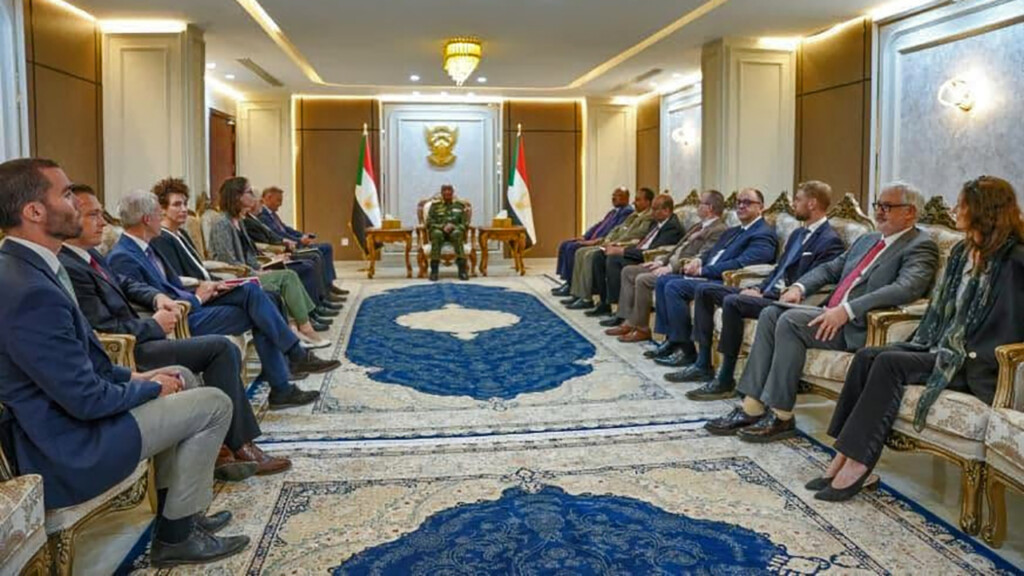
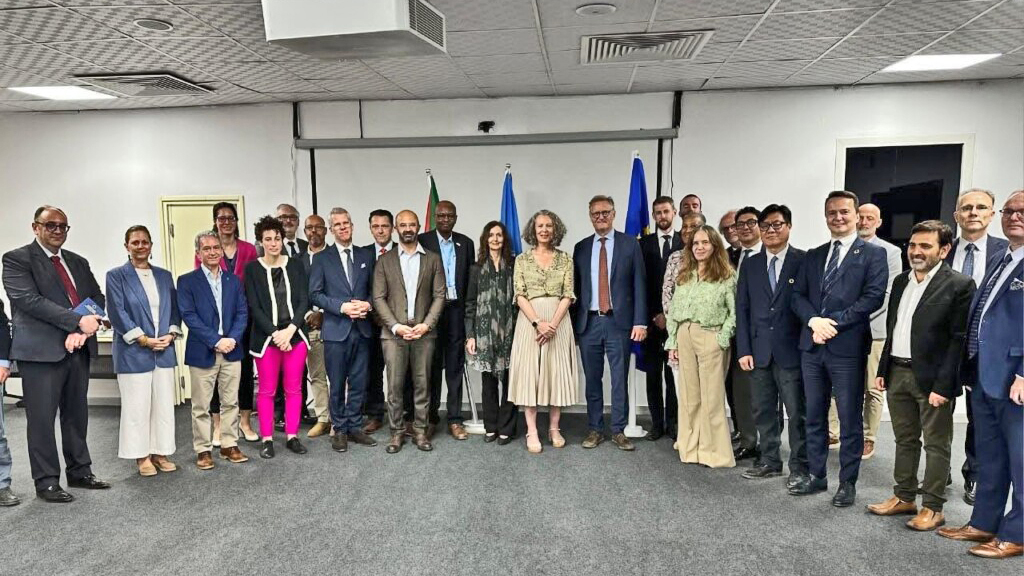
A high-level delegation of heads of European Union missions, comprising 14 diplomats and headed by the head of the mission to Sudan, Wolfram Vetter, concluded a visit to Sudan, the first of its kind since the outbreak of war on April 15, 2023. The two-day visit included a series of meetings with Sudanese officials, including the Chairman of the Sovereignty Council, his deputy, the Prime Minister, and other officials (Photo: EU)
Report by Suleiman Siri for Radio Dabanga
A high-level delegation of heads of European Union missions, comprising 14 diplomats and headed by the head of the mission to Sudan, Wolfram Vetter, concluded a visit to Sudan, the first of its kind since the outbreak of war on April 15, 2023. The two-day visit to Khartoum and Port Sudan included a series of meetings with Sudanese officials, including the Chairman of the Sovereignty Council, his deputy, the Prime Minister, and other officials. Discussions focused on several issues related to war and peace, primarily the escalating humanitarian crisis and the possibility of delivering aid to those affected.
In a statement following the conclusion, the delegations said that “the visit is a sign of the deepest sympathy for all Sudanese people in light of the immense suffering they have endured over four years of war. Heads of Mission come to listen and to get a deeper understanding of the situation in Sudan to which we are bound by a longstanding relationship and by shared interests in many areas.”
The visit sparked widespread controversy because of its diplomatic weight, raising questions about whether it reflects a shift in positions by softening the tone of the European Union, which had been characterised by imposing sanctions in dealing with the Sudanese issue, and the insistence of some member states on not recognising the Sudanese government and isolating it diplomatically and politically.
Although this escalation was coming directly from the European Union alone, it is now politically and diplomatically involved in the efforts of the Quintet group to end the war and achieve peace in Sudan.
Continued communication
A statement issued by the European Union, seen by Radio Dabanga, called on all parties to the conflict in Sudan to de-escalate as a crucial step towards a comprehensive ceasefire.
The delegation called for the establishment of safe zones and humanitarian corridors to efficiently provide aid, security and protection to civilians, stressing the need to prevent a recurrence of the horrific massacres and flagrant violations of the most basic human rights committed against civilians, particularly in El Fasher and Al Jazeera State, and demanding an immediate end to the humanitarian siege imposed on civilians and cities.
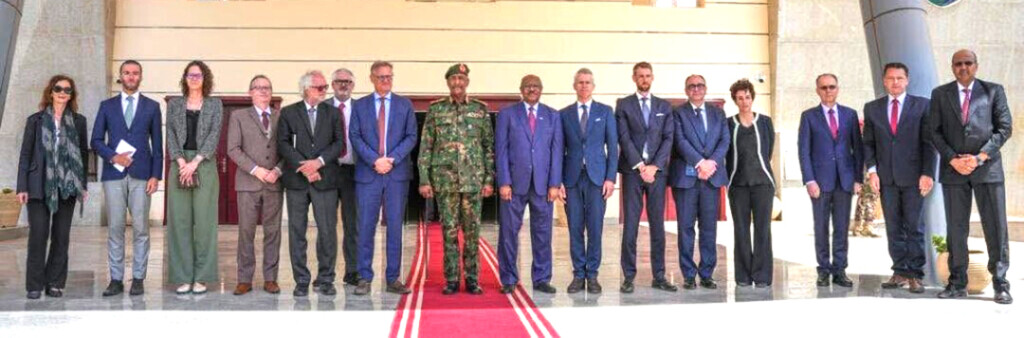
The heads of European missions emphasised the importance of preserving Sudan’s unity, territorial integrity, and sovereignty. They condemned efforts to establish parallel governance structures in the country, denounced external support that fuels the conflict, and criticised the illegal influx of weapons, mercenaries, and foreign fighters into Sudan. The heads of missions also stressed the importance of combating impunity and ensuring that perpetrators of these crimes are held accountable.
They affirmed the European Union’s continued support for the international peace efforts of the Quartet and the Quintet (the African Union, the United Nations, the Intergovernmental Authority on Development (IGAD), the League of Arab States, and the European Union) to facilitate a peaceful process leading to inclusive democratic governance. The EU ambassadors also encouraged the Sudanese authorities to engage constructively with the Quartet and Quintet, which they consider complementary to the efforts of the relevant authorities.
‘There’s nothing new in it’
Osman Mirghani, editor-in-chief of the Al Tayyar newspaper, believes that the final statement of the visit contained nothing new, and that everything in it was understandable within the context of the European Union’s previous positions. However, he points out that the points raised in the statement were phrased diplomatically, indicating that the European Union desires a solution to the Sudanese crisis, but not through direct mechanisms between it and the Sudanese government. Rather,
it proposes a four-party mechanism, followed by a five-party mechanism. The four-party mechanism comprises the United States, Saudi Arabia, Egypt, and the United Arab Emirates, while the five-party mechanism includes the United Nations, the European Union, the African Union, the Intergovernmental Authority on Development (IGAD), and the League of Arab States.
Mirghani told Radio Dabanga that, according to the statement, the European Union is trying to find solutions to some issues related to the humanitarian situation, considering them a top priority to be addressed immediately without waiting for a complete resolution to the political or military crisis. He added that there might be a desire to maintain communication with the Sudanese government through special envoys, rather than through direct contact between the European Union and the Sudanese government.
Mirghani believes that the European Union’s position during the past three years since the outbreak of the war on April 15, 2023, has not changed. Rather, it has always tried to make efforts with international supporters to reach a peaceful solution to the issue of war in Sudan, and has participated in several talks and rounds of negotiations, or even previous initiatives from various parties.
Contradiction in positions
Mirghani believes that the European Union has not adopted a singular position on issues that could represent a kind of engagement in peace efforts with the parties, but he notes a contradiction between the positions of the European Union as an institution and the positions of the member states; pointing out that many of the Union’s countries have adopted positions that carry a degree of non-recognition of the current government in Sudan after the outbreak of war.
He confirms that those countries have reinforced these positions more than once through statements, or by refraining from direct bilateral meetings with Sudanese parties, or by not inviting the Sudanese government to attend important conferences such as the London, Paris, and most recently the Berlin conference.
He believes that the European Union has decided at the moment to deal with the Sudanese crisis by engaging more with the reality on the ground, or trying to take an initial step by returning to work from within Sudan, after having continued to work through the European Union representation from Cairo.
Mirghani believes that the European Union is currently part of the five-member committee that is committed to dealing with the Sudanese political parties in the context of the four-member initiative, which deals with two tracks; one of which is military, related to direct negotiations between the Sudanese army and the Rapid Support Forces, which have not yet been carried out as required.
The second path, according to Mirghani, is the political process that the four-party initiative was unable to move forward with, so the five-party committee took it over and is now trying to reach political agreements between the Sudanese parties and societal components, so that it can be built on them in forming a roadmap for Sudanese dialogue that will result in an agreement on a post-war vision, and the formation of a national government that will be the way out of the current political crisis.
Mirghani adds that despite the European Union’s presence within the five-member committee, it did not form an independent position except for what it sometimes expressed by imposing sanctions that affected some parties connected to the war, according to specific positions and assessments of the Union.
Avoid excessive optimism
From another point of view, Ambassador Tariq El Kurdi believes it is necessary not to be overly optimistic about a complete shift in the European position towards the parties to the conflict or towards the Sudanese crisis through this visit.
He told Radio Dabanga that the European Union continues to affirm its support for the unity and territorial integrity of Sudan, considering this position firmly rooted in the EU’s foreign policy, stemming from its international obligations and consistent with the principles of international law. He explained that the EU continues to call for a ceasefire and a peaceful solution, noting that a military solution is neither possible nor available in the complex Sudanese crisis.
El Kurdi points out that the European Union’s move from managing the Sudanese file from the outside to sending a high-level delegation inside reflects a European desire to reassess the situation, deal with the existing facts and see the conditions on the ground, instead of being satisfied with information and reports coming from abroad.
El Kurdi believes that despite the war’s wide scope and complexities, the European Union, through this visit, sent clear messages indicating that it has no intention of withdrawing from the Sudanese issue, stressing that it is one of the largest donors of humanitarian aid in Sudan.
Ambassador El Kurdi noted that the visit could be seen as an attempt to explore opportunities for a political settlement and the extent to which the government side in Port Sudan is prepared to engage in such a settlement. He did not rule out the possibility that the European Union would also engage, in a similar manner, with other parties and civil and political forces opposed to the war in order to assess the prospects for a comprehensive settlement.
He concluded by saying that the European Union, through this visit, appears to be opening a new phase of dialogue and direct engagement with the various active and influential parties in the Sudanese crisis, with the aim of gauging opinions and finding opportunities for peace.
Strategic implications
Former Foreign Minister, Ambassador Ali Youssef describes the visit of the European Union delegation to Sudan as important and coming at a time that carries implications confirming the European Union’s interest in the course of the war and its impact on the Sudanese people, and the unprecedented humanitarian crisis that resulted from it.
In his interview with Radio Dabanga, he believes that regional and international tensions have prompted Europe to reassess a number of security and strategic issues, after recent crises demonstrated the limited role of Europe in some regional matters.
He says that Europe is trying to play a more positive and engaged role in issues affecting its own security and stability as European nations, as well as the security and stability of African countries, which are Europe’s immediate neighbours. He points out that there are many shared issues between the two continents, including trade and economic cooperation and the issue of illegal immigration, since instability and wars are the main drivers of increased migration to Europe. He emphasizes that the visit will explore the importance of regional security, given Sudan’s strategic location on the Red Sea.
Humanitarian crisis
The former minister believes the humanitarian aspect of the visit is of paramount importance, and indeed, it is a key indicator of the European Union’s concern for the Sudanese crisis, alongside international efforts aimed at ending the war and finding a peaceful solution to the conflict. He emphasised that stability in Africa is an integral part of Europe’s security and stability.
He pointed out that Sudan has historical ties with several European countries, particularly Britain (despite its current exclusion from the European Union), explaining that security and stability issues are not affected by Britain’s departure from the EU.
It is believed that all that is required for the European side is for the situation in Sudan to stabilise and for there to be peace, which would enable Sudan to return to its natural role as an important regional player in the region, noting that Europe is simultaneously seeking to strengthen its role and prove its presence in regional issues related to its security and interests.
He concludes by emphasising that although the American role remains the strongest in the region’s crises, the European role is important and complementary to it, and has its own political, diplomatic, and humanitarian tools and means to help the Sudanese parties reach peace.


 and then