




Fistula in Sudan, a wound the world refuses to look at
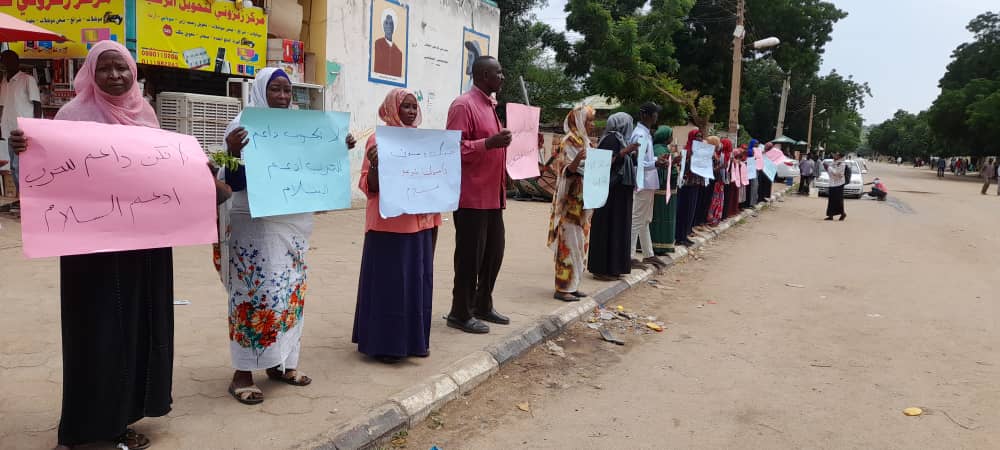
Women's groups staged a protest in Kadugli, South Kordofan, against the war and against the sexual violence accompanying war, July 2023 (File photo: RD)
As the United Nations marks the International Day to End Obstetric Fistula today, May 23, experts and aid workers on the ground in Sudan warn that the global conversation is missing a graver and more urgent dimension: the traumatic fistulas inflicted by the epidemic of sexual violence accompanying Sudan’s war.
Obstetric fistula is among the most debilitating (and preventable) injuries a woman can sustain during childbirth. It occurs when obstructed labour is not managed in time: a baby’s head becomes lodged in the pelvis, cutting off blood circulation to surrounding tissue. The resulting damage can open a hole in the wall separating the birth canal from the bladder or rectum, leaving a woman incontinent and, without surgery, permanently so.
In the Tina area on the Chad-Sudan border, hundreds of women are currently waiting for fistula surgery. According to Prof Eric Reeves — a Sudan scholar and founder of Team Zamzam, the community support programme coordinating their care — not one of them has an obstetric fistula. Every case, he told Radio Dabanga, is traumatic.
While obstetric fistula and traumatic fistula share a similar presentation and require similar surgical treatment, they differ fundamentally in cause and severity. Traumatic fistula is caused by sexual violence, including rape and penetration with objects. The women who sustain traumatic fistula are also, by the nature of conflict, far less likely to be anywhere near a functioning medical facility. “Those who are suffering from traumatic fistula are in places like Zamzam where there was nothing, or in rural villages that have been overrun where there’s no medical attention,” Reeves said.
Beyond the physical injury, fistula — obstetric or traumatic — carries a devastating psychosocial weight. “Given the cultural taboo associated with rape, women are reluctant to report it to the few medical workers present in refugee camps, which can lead to further medical complications of injuries they may have sustained during the rape,” a 2004 Amnesty International report noted.
Many are shunned or abandoned by family and community due to the physical realities of constant incontinence. “Most women will suffer serious psychological problems, having to bear and raise an unwanted child and suffering from social stigma and a lack of community support,” the report said.
Reeves emphasized that these psychosocial consequences are routinely underestimated precisely because the material needs in conflict zones are so overwhelming. “There’s so much violence, there’s so much brute physical injury, that what may be just as debilitating and damaging goes untreated.”
A pattern two decades in the making
“There is a reluctance to come to terms with the reality of rape in Darfur and elsewhere in Sudan with the expansion of the war by the RSF. To treat traumatic fistula is to come face-to-face with the consequences of a demonic violence.” – Eric Reeves
Sexual violence as a weapon of war is not a new phenomenon in Sudan. The country had once developed specialized networks for fistula care, including Dr. Abbo’s renowned fistula centre in Khartoum, a UNFPA-supported hub in Zalingei, and dedicated facilities in El Fasher.
Now, that map has been completely erased. In 2024, the Rapid Support Forces (RSF) bombed El Dayat Maternity Hospital for Obstetrics and Gynecology in Omdurman, Sudan’s largest maternity hospital, shutting down life-saving surgeries. The fall of El Fasher in late 2025, which was accompanied by mass rape, saw the Saudi Maternity Hospital in El Fasher sustain a brutal attack by the RSF. Approximately 460 people were killed inside, many of them patients.The broader healthcare infrastructure has been thoroughly gutted by staff displacement, critical supply shortages, and direct attacks on medical facilities, forcing a significant portion of the country’s hospitals to close entirely.
“That was one of the most shocking episodes of the war to date,” Reeves said. “There is a reluctance to come to terms with the reality of rape in Darfur and elsewhere in Sudan with the expansion of the war by the RSF. To treat traumatic fistula is to come face-to-face with the consequences of a demonic violence.”
‘They just give their tears and their thanks’
Since its founding, Team Zamzam has facilitated more than 90 fistula surgeries. Reeves describes the process as intensely labour-intensive. Staff must psychologically prepare women who have never undergone surgery for what lies ahead, support them through catheterisation — “which is very, very hard” — accompany them to and from the operating site, and monitor their recovery closely.
“The suffering was unspeakable,” Reeves said. “But it was one of the things I’m proudest of in what we’ve been able to do.”
The logistics of providing this care are becoming increasingly perilous. The roads connecting Tina to potential surgical sites are difficult to navigate, and, with the heavy rainy season fast approaching — Reeves expects it to be heavy this year — those roads risk being cut off entirely. Security is another constant threat: the RSF has crossed into Chad on multiple occasions, and Tina itself has been struck by drone attacks.
But what stays with Reeves, he told Radio Dabanga, is not the scale of the suffering but the moments of relief. Parents of women the programme has helped come to the counsellors overwhelmed with emotion. “They don’t know how to express it. They don’t have anything they can give; they just give their tears and their thanks,” Reeves said. “The idea of seeing one’s daughter suffer in this way is just excruciating beyond anything I can say.”
The bigger picture
The broader humanitarian picture offers little reason for optimism. The UN reported last month that only 16 percent of Sudan’s humanitarian funding needs for the year have been met. The shortfall has forced a “strict prioritization exercise,” a downsizing of aid to bare-minimum survival packages that leaves specialized programs, like medical care for sexual violence survivors, severely strained.
The dismantling of USAID has compounded the shortfall, Reeves said, adding that the UN Refugee Agency has cut programmes along the northern stretch of the Chad-Darfur border. “Things are getting worse, not better, in terms of humanitarian resources,” Reeves said. “We’re just trying to get through it month to month.”
For the women near Zamzam waiting for fistula surgery, that is the reality of what the International Day to End Obstetric Fistula looks like this year.
#EndFistula

 and then