




Sudan’s media mark World Press Freedom Day
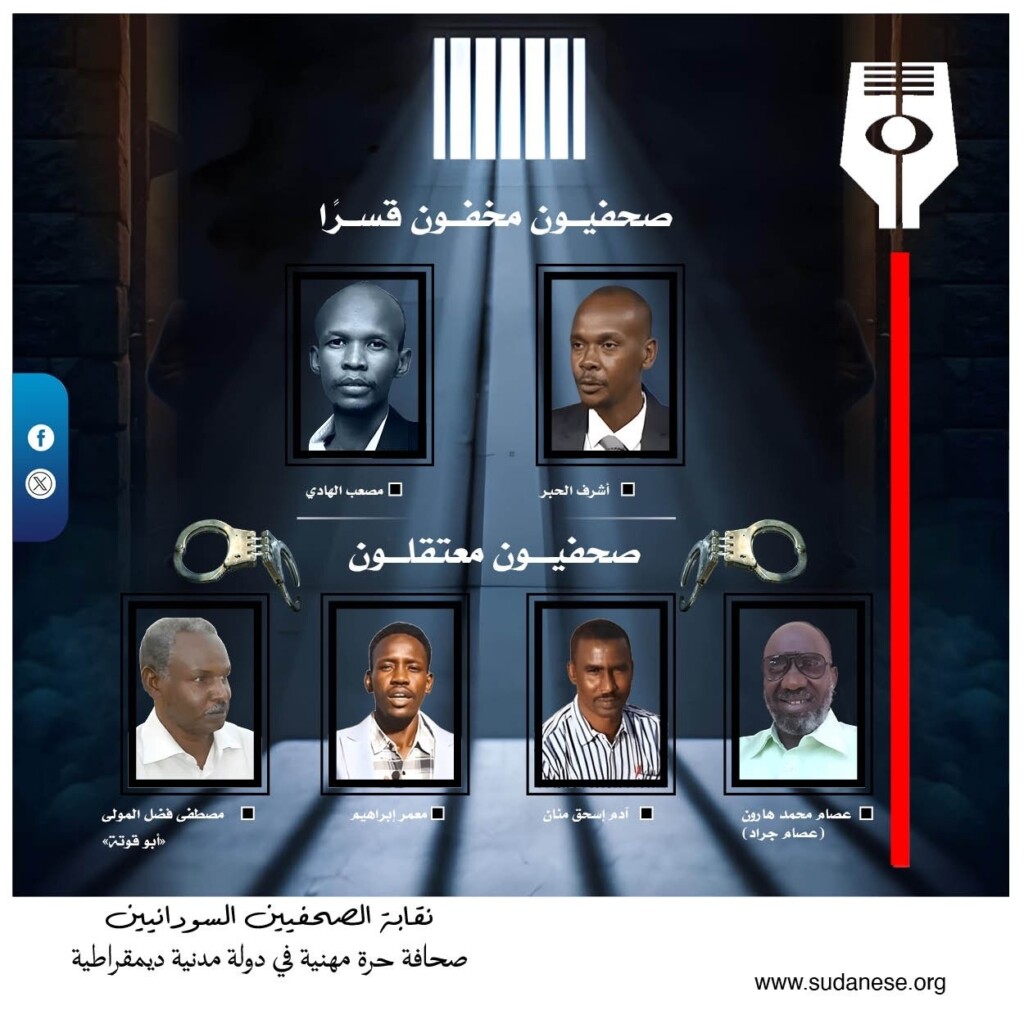
Journalists detained in Sudan (Source: Sudanese Journalists Syndicate)
As the world and Sudanese media mark World Press Freedom Day 2026, Sudan is in the midst of a war that has entered its fourth year with no clear horizon to stop it, with journalists continuing to be targeted by all parties to the conflict, and restrictions on freedom of expression and access to information. Under these extremely complex circumstances, journalists face high risks and deteriorating economic conditions inside and outside the country.
Despite grave risks, repeated violations and restrictions on journalistic work, Sudanese journalists continue to carry out their professional mission with courage and responsibility, by monitoring and documenting violations and reporting the suffering of civilians in one of the most difficult environments for journalistic work.
The past period has witnessed a significant escalation in violations against journalists, including killings, arrests, threats, and incitement campaigns in newspapers, websites and social media, in addition to displacement, arbitrary dismissal, confiscation of work tools, and restrictions on freedom of expression and access to information, in clear violation of international conventions that guarantee freedom of the press and the protection of journalists during conflicts.
‘85 per cent of crimes committed against journalists go uninvestigated and unpunished: an unacceptable level of impunity…’ — UN Secretary-General António Guterres
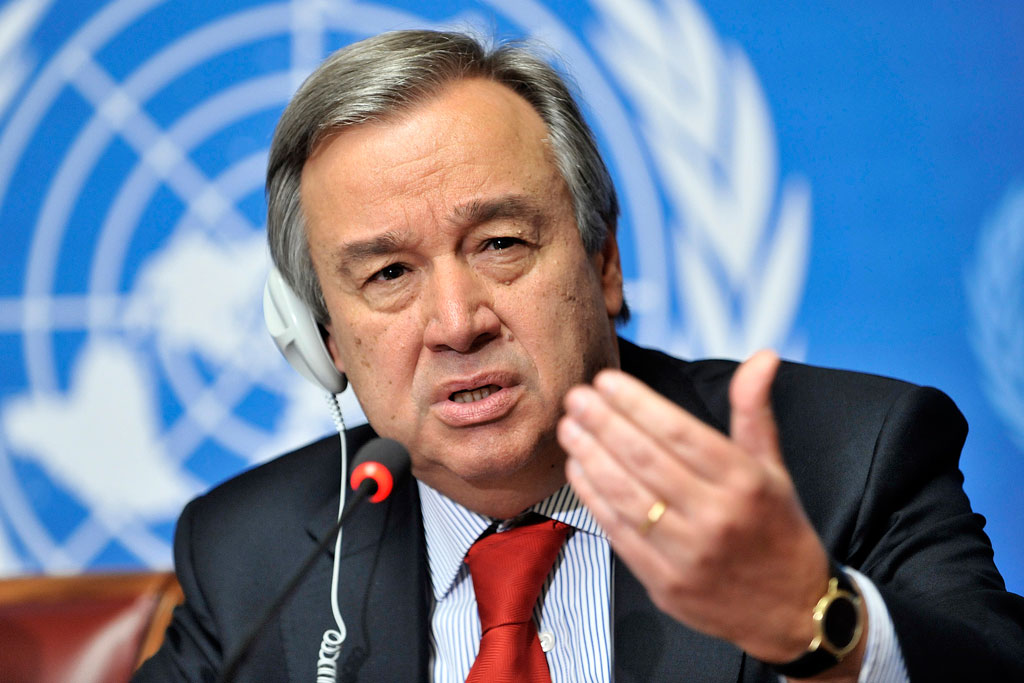
On this year’s celebration, themed Shaping a Peaceful Future, UN Secretary-General António Guterres notes that “people often say that in war, truth is the first casualty,” lamenting that “across the globe, media workers risk censorship, surveillance, legal harassment – and even death”.
Guterres underscores: “Recent years have seen a sharp rise in the number of journalists killed – often deliberately targeted – in war zones,” while highlighting that “85 per cent of the crimes committed against journalists go uninvestigated and unpunished: an unacceptable level of impunity.”
“Economic pressures, new technologies, and active manipulation are also putting press freedom under unprecedented strain. When access to reliable information erodes, mistrust takes root. When public debate is distorted, social cohesion weakens. And when journalism is undermined, crises become far more difficult to prevent and resolve,” Guterres says.
‘All freedom depends on press freedom. Without it, there can be no human rights, no sustainable development – and no peace…’ — UN Secretary-General António Guterres
“All freedom depends on press freedom. Without it, there can be no human rights, no sustainable development – and no peace.”
Guterres concludes by appealing to the world: “On this World Press Freedom Day, let us protect the rights of journalists, and build a world where the truth – and truth-tellers – are safe.”
UN High Commissioner for Human Rights
UN High Commissioner for Human Rights, Volker Türk argues that the absence of a free press would lead to “a world of indifference, where violence is met with silence, and where truth becomes a commodity.”
‘The absence of a free press would lead to a world of indifference, where violence is met with silence, and where truth becomes a commodity…’ — Volker Türk, UN High Commissioner for Human Rights
He also reaffirms the essential role of free, independent, and pluralistic media to identify and bring to light grievances, debate solutions and make decisions to serve the public good.
Global press freedom under threat
“Governments use laws to silence journalists, often in the name of ‘national security’,” says Ruth Kronenburg, Director of Netherlands-based international press freedom organisation Free Press Unlimited (FPU).
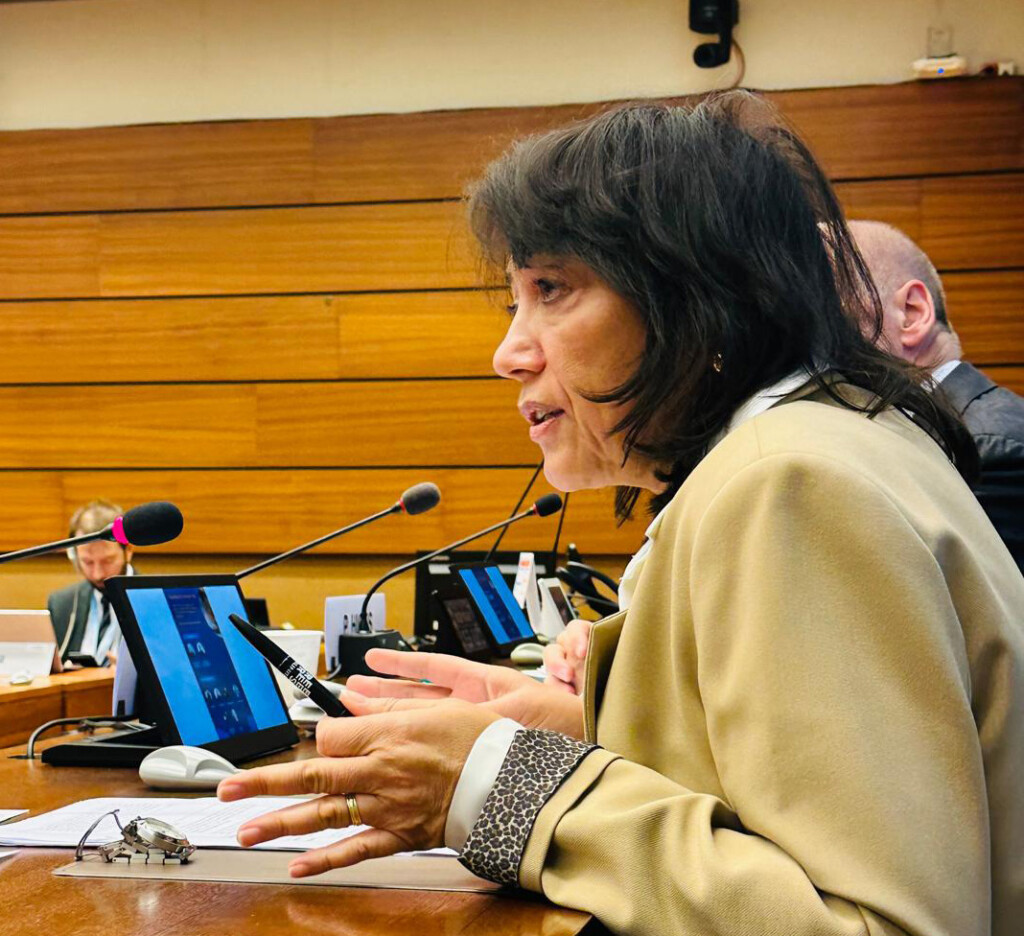
‘Governments use laws to silence journalists, often in the name of national security’… — Ruth Kronenburg, Director Free Press Unlimited
In its statement, FPU, which facilitated Radio Dabanga’s operations from its inception and still provides essential support, highlights: “For the first time in the history of the annual Reporters Without Borders World Press Freedom Index, more than half of all countries in the world now fall into the ‘difficult’ or ‘very serious’ categories in terms of press freedom. In 25 years, the average score of all 180 countries and territories in the ranking has never been this low. Only one per cent of the world’s population lives in a country where press freedom is categorised as ‘good’. In 2002, that was still 20 per cent.”
“An important reason for the deteriorating global situation is increasingly strict legislation that has been applied since 2001, the year of the 9/11 attacks, that erodes the right to information. This is done in the name of ‘national security.’ This trend, which is particularly prevalent in authoritarian regimes, is also gaining ground in democracies and is typically accompanied by the suppression of journalists’ freedom of information, particularly under the guise of counterterrorism.” FPU laments.
As previously reported by Radio Dabanga, in the annual 25th World Press Freedom Index published by international press freedom advocacy group Reporters Without Borders last week, Sudan is rated 161st out of 180 countries, having dropped to 156th in 2025 from 149th in 2024.
Sudanese Journalists Syndicate
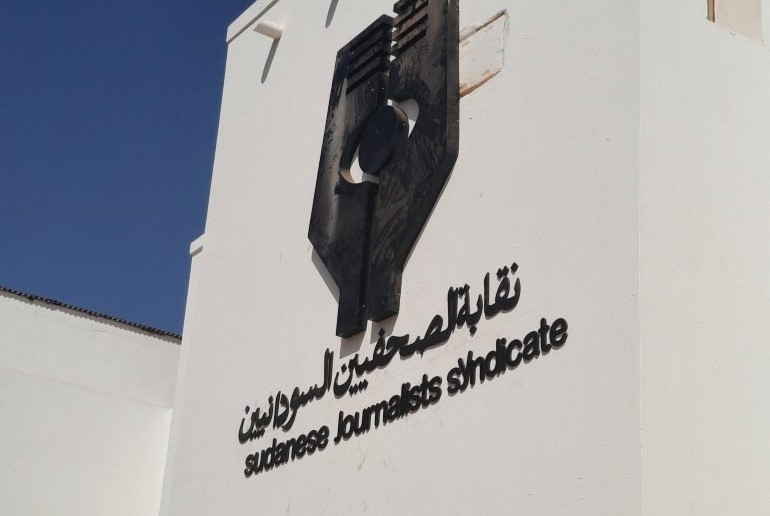
In a statement today, the Sudanese Journalists Syndicate “salute the courage of journalists in Sudan,” adding that “a network of journalists affirms that freedom of the press is not a luxury, but rather an essential pillar of any society that seeks justice and transparency, and an inherent right that cannot be derogated from under any circumstances”.
The statement coincides with the announcement that the Sudanese Journalists Syndicate has been named as winner of the UNESCO/Guillermo Cano World Press Freedom Prize, in recognition of the role the collective has played in condemning the deliberate targeting of journalists in the ongoing conflict in the country.
‘A network of journalists affirms that freedom of the press is not a luxury, but rather an essential pillar of any society that seeks justice and transparency…’ — Sudanese Journalists Syndicate
“The members of the Sudanese Journalists Syndicate have demonstrated extraordinary courage and unwavering dedication. Despite immense challenges, they continue, day after day, to deliver accurate, lifesaving information to their communities when it matters most. Their commitment is a powerful example to us all and a vital service to truth, accountability, and peace.,” said Khaled El Enany, UNESCO Director-General.
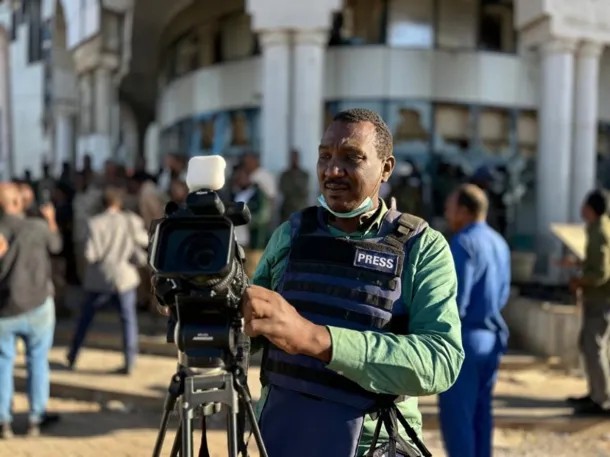
Receiving the award, Chair of the Sudanese Journalists Syndicate Abdelmoniem Abuedries Ali said: “This award is not only a recognition of the Sudanese Journalists Syndicate, but a tribute to all Sudanese journalists who continue to defend truth and press freedom under extremely difficult and dangerous conditions. It reaffirms the vital role of independent journalism in safeguarding democratic values and amplifying the voices of civilians affected by war.”
34 journalists killed
In its own statement, the Syndicate notes that 34 journalists, have been killed since the outbreak of the war, and that 680 violations have been recorded, including killing, displacement, arrest, enforced disappearance, physical assaults, threats, harassment, confiscation of equipment, and direct targeting of media institutions.
The Syndicate reiterates its demand for the immediate and unconditional release of all detained journalists, stressing that any process of dialogue or democratic transition in Sudan cannot succeed without guaranteeing the independence of the media.
It announces its categorical rejection of attempts to control the media through censorship, intimidation, or propaganda, noting that the militarisation of the media not only prolongs the conflict, but also deepens the division and undermines the chances of future reconciliation.
Independent investigation mechanism
The Syndicate calls for providing immediate legal and field protection for journalists, and establishing an independent and transparent mechanism to investigate crimes committed against them within a specific timeframe.
It also stresses the need to end impunity and hold those responsible for violations accountable, ensure unrestricted access to information, respect the independence of media institutions, and guarantee their free and safe operation.
It calls on all parties to immediately cease targeting journalists, to unconditionally release detainees, to disclose the fate of the forcibly disappeared, and to embark on a path of justice that ensures there is no impunity.
Condemnation of the violations
In a separate statement, as reported elsehwere on Radio Dabanga’s platforms today, the Sudan Media Forum coalition of independent media institutions, congratulates the Sudanese Journalists Syndicate – a member of the Forum – for winning the UNESCO/Guillermo Cano World Press Freedom Prize, in recognition of its prominent role in condemning the deliberate targeting of journalists in the context of the ongoing war in the country.
The Sudan Media Forum confirms that journalists in Sudan have suffered horrific violations including murder, direct targeting, arbitrary arrest, enforced disappearance, threats and intimidation, as well as displacement and homelessness.
Any serious process of dialogue or democratic transition in Sudan cannot succeed without independent media at the heart of the process… an essential part of any framework for dialogue, consultation and peaceful transition… — Sudan Media Forum
The Sudan Media Forum condemns in the strongest terms all violations against journalists and media professionals in Sudan, calling on the parties to the conflict to immediately cease all forms of targeting against them, and to guarantee their safety and protection in accordance with international humanitarian law.
The Sudan Media Forum calls for the immediate and unconditional release of all arbitrarily detained journalists, and for the disclosure of the fate of those forcibly disappeared.
Call to intensify pressure
It also urges the international community to intensify pressure on the parties to the conflict to stop the violations and to conduct independent investigations to hold those responsible for crimes committed against journalists accountable, noting that no investigation has yet been conducted into the killing of any journalists.
The Sudan Media Forum stresses that any serious process of dialogue or democratic transition in Sudan cannot succeed without guaranteeing the independence of the media and placing it at the heart of this process, reiterating the need for the freedom and independence of the media to be an essential part of any framework for dialogue, consultation and peaceful transition.
‘Journalists, and women journalists in particular, have a right to protection… independent investigations should ensure that there is no impunity for crimes against journalists…’ independent investigations into crimes committed during the war against journalists and for ensuring that there is no impunity…’ — Network of Women Journalists
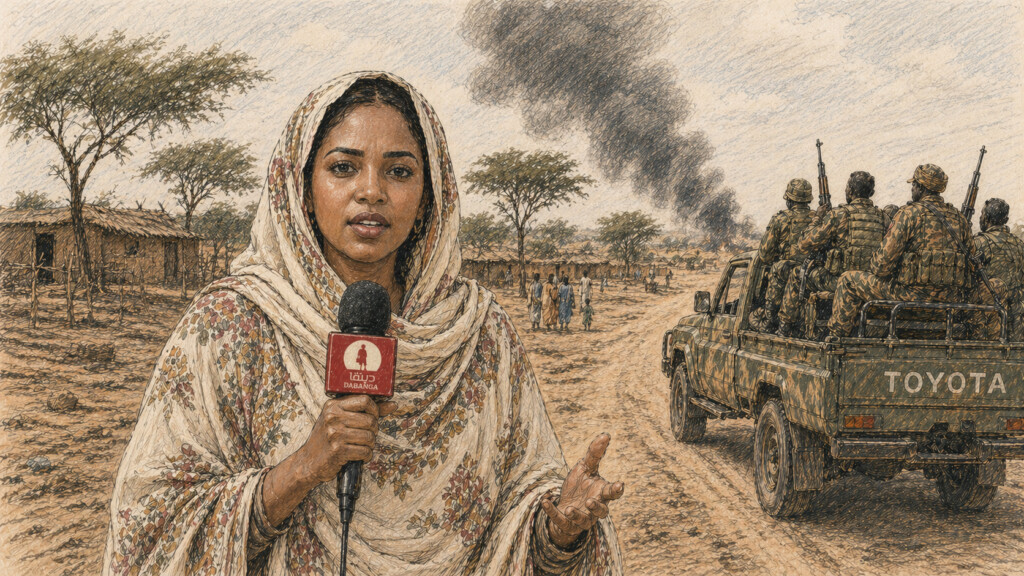
Network of Women Journalists
The Network of Women Journalists calls for an immediate cessation of the war and the protection of civilians, including women journalists, all journalists, and media institutions. It also calls on media and press institutions to pay attention to the catastrophic effects of the war on the situation of women journalists, and to work to provide them with job opportunities on fair and equitable terms.
The network emphasises the importance of improving the working environment for women journalists and protecting them from any form of gender-based violence, both within institutions and in the workspaces created by the war, as well as providing training and professional support opportunities to compensate for the acute lack of skills associated with crisis coverage.
The network also calls for independent investigations into crimes committed during the war against journalists and for ensuring that there is no impunity.

 and then