





Op-ed: The role of civilians in the path(s) to peace in Sudan
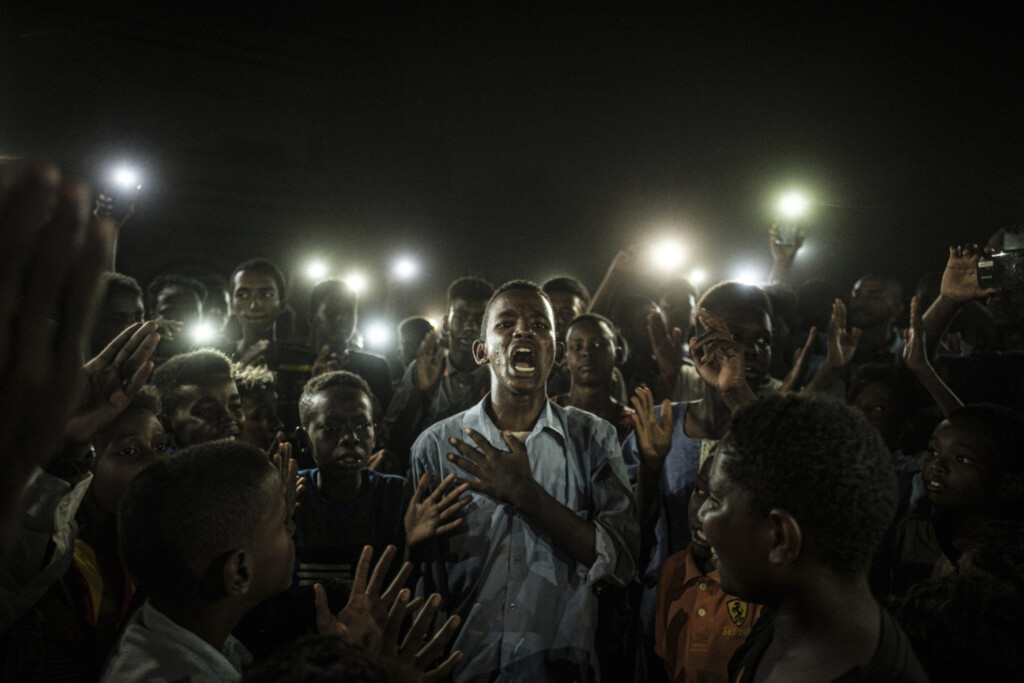
World Press Photo of the Year 2020: A young man recites a poem, illuminated by mobile phones, before the opposition's direct dialog with people in Khartoum on June 19, 2019 (Photo by Yasuyoshi CHIBA / AFP)
By Michelle D’Arcy for Sudan Transparency and Policy Tracker (STPT)
As we near three years of war in Sudan, there seems to be increasing international momentum and efforts to resolve the conflict. The attempts of the US-led Quad, the newly formed Quintet and the upcoming Sudan conference in Berlin have brought hope to many Sudanese who are tired of this war and the suffering it continues to cause day in and day out. However, as regional volatility in the Middle East intensifies, and includes members of the Quad, it is unclear how these shifting dynamics will affect the efforts to mediate peace in Sudan.
Given the uncertainties about how international and regional players will engage to bring peace to Sudan, key questions present themselves: what actions can Sudanese civilians—who work tirelessly every day to end the conflict—actually take? what aspects of the situation are beyond their control?
Sudanese people were admired globally for their efforts in overthrowing a 30-year-old dictatorship in 2019 through the December Revolution, which included mass protests, strikes, and a three-month-long sit-in. This impressive achievement may have been reversed, but the years of resistance, organizing and the efforts, lessons learned and movements created on which it rested have not been lost. Yet the current context is very different and organizing people in the midst of a war, massive displacement, hunger, violence, polarization, political surveillance and targeting and shrinking civic space is no small feat. New tools, efforts, and ways of organizing are needed to combat the oppressors operating within such a complex context and move towards peace in Sudan.
Let us start with defining and looking closer at who Sudanese civilians are. Beyond the minimum of citizens not holding guns, this is a complex undertaking. Sudanese are often organized according to multiple identities and social roles, which have increasingly come into conflict due to the polarization resulting from the ongoing war. This is often confusing for outsiders, but important to understand when analysing the civilian political terrain and multitude of bodies, initiatives, and efforts.
It is not uncommon to find a single individual who is part of a community association, part of a political party or armed movement, has been a member of a resistance committee, worked in a civil society organization and is also a member in women’s network or a youth network, has volunteered in an ERR and/or is now part of a political or civil society coalition or even both. Understanding the civilian political landscape in Sudan requires recognizing the fluidity of roles and political positions. Many leading peace advocates in Sudan have dedicated the majority of their lives—often serving in multiple capacities—to promoting freedom, equality, and justice.
When discussing Sudanese civilians from a critical perspective, international policymakers often use terms such as “grassroots”, “new faces” and “emerging voices”, and ask about credible and legitimate representation. Although often well-intentioned, there is a risk of oversimplifying Sudan’s complicated political and civilian landscape and a danger of diminishing the long histories, deep networks, and layered identities that make up organizing in Sudan. Grassroot presence or being a new generation are not the only conditions for claiming legitimacy. Coalitions, networks, politicians, and civilian activists operate within a layered history of resistance, repression, fragmentation, re-branding, and alliance-building that cannot be reduced to generic labels. When analysing civilian actors, it is important to also consider their mandate, accountability, and the clarity of their positions and agendas.
The definition of who is a civilian is also increasingly contested. Civilians should be understood primarily as those who use peaceful tools to achieve their objectives. This includes a wide range of actors, including civil society, youth, women, peace and pro-democracy coalitions, networks, and political parties. There are also armed groups not engaging in the conflict and advocating for peace such as the Sudanese Liberations Army — Abdel Wahid Faction. IT is essential to note the alignment of civilians, and the focus should be on those who are non-aligned, meaning not supporting any of the warring parties. This is important as the warring parties are using civilian bodies or actors as proxies to increase their level of influence on future political processes. It is better to classify these groups as political forces such as Tasis and Democratic Bloc, which are a mix of civilians and armed groups, but are often described as civilian. Defining political forces as civilians creates significant difficulties for genuinely non-aligned civilians, who are often subjected to harassment and targeting due to their advocacy for peace, both in person and within digital platforms.
The term “non-aligned civilian bloc” – is now being used within the mediation space in Sudan to describe Somoud and other civilians who have not sided with either of the warring parties but have taken the position of the need for a peaceful resolution to end the war. This encompasses youth, women, civil society, and various political groups such as the Ba’ath Party, the Communist Party and SLA- Abdel Wahid. It is clear that this bloc will not represent all non-aligned civilians – which is a near impossible task, and it remains to be seen how selection and participation within this bloc will be determined if a political process begins. Yet it is critical to understand what kind of representation is needed in a Sudanese – Sudanese Dialogue and who should be in the room to ensure the process is “inclusive enough.”
Sudanese civilian efforts to end war to date
The diversity and depth of civilian and political organizing in Sudan has created a wide range of expertise, consistencies, and roles to play in building peace in Sudan. This war has layers of conflict and thus will also need layers of peace, service, and action. There are currently three main areas within which Sudanese civilians are contributing their efforts;
1) The first is local-level peacebuilding efforts within communities in Sudan. After the war broke out in April 2023, many cases of local-level mediation efforts were documented. Community leaders negotiated for access on issues such as opening markets and creating safe evacuation routes. Civil society, traditional and faith-based leaders also organized community dialogues and worked on issues of social cohesion. It is important to continue recognizing, learning from, and supporting these efforts. However, local peacebuilders still face significant challenges, including limited civic space and bureaucratic obstacles.
2) The next are the local responders providing lifesaving assistance. Sudanese civilians have also shown leadership delivering lifesaving services to their communities through initiatives like Emergency Response Rooms (ERRs), women-led initiatives, and other mutual aid groups. Building off traditional practices such as nafeer, these widespread volunteer efforts have gained international recognition for their humanitarian efforts, many who are young people risking their lives to serve others. Yet these decentralized groups are also facing increasing challenges and restrictions on their work due to the insecurity and targeting by local authorities.
3) Finally, advocacy to end the war and engagement with international mediation efforts. Since 2023, Sudanese have organized and called publicly to end the war. Many of those who led this call were forced to flee the country, including civilian members of the transitional government, political party members, activists, and pro-democracy civil society. Over the past three years, they have been organizing, developing clear political visions, and advocating for a way forward beyond the war and a return to democracy and a civilian-led government in Sudan. These groups have faced numerous challenges due both to the increasing polarization of society and targeted attacks due to their calls for peace. In the coming period, the roles to play in this theater will be many, from those who will likely participate directly in a political process and others who will influence the dialogue through technical support, advocacy, and campaigns. Civil society is also well positioned to hold public consultations to ensure that any political process is connected to the wider aspirations of Sudanese calling for peace.
Limitations of civilians and the need for an international response
It is clear that many Sudanese civilians have remained engaged citizens, making meaningful and constructive contributions to address the impacts of war. Their efforts should be recognized, and they have demonstrated they are not just passive victims of this conflict but everyday heroes doing all they can. Yet, as the war continues to rage, we must acknowledge what remains beyond their influence. While choosing the path of nonviolent resistance has taken Sudanese far in the past and continues to be of importance, it will not stop the war alone at this juncture. There is a need for international and regional support to hold the warring parties to account and push them put down their guns (or at this point, drones).
In a recent advocacy engagement, I witnessed a young Sudanese woman break into tears as she spoke to international mediators, pleading for them to do something, stating that “as young people we have tried our best to call for peace over the past three years, but we need help, we are pleading with you to help us. For us, this is not just words, but our lives at stake, alongside millions of our fellow Sudanese who will continue to suffer and die if this war is not stopped.”
We need to stop placing the burden on Sudanese civilians alone in the difficult task of ending this war. Sure, they can support mediation on local humanitarian access, or build trust across the political blocs within consultations and are likely the best placed to draft what a post war Sudan governance should look like. But they need our support in the first step of ending the violence.
As we move ahead and engage with Sudanese civilians in this process, let us take the following into consideration:
Recommendations to international meditators & policy makers;
1) Local-level peacebuilding should not be supported at the expense of pushing for a ceasefire and peaceful resolution of the conflict; both are needed and they are intricately connected. While local-level peacebuilding is necessary in all situations, its potential impact is inherently restricted when a national conflict persists. Thus, we need an end to the war for local peacebuilders to have a more conducive space to work for peace within their communities.
2) Recognise and respect the various roles civilians play, understanding that the multiple layers of effort are interconnected through individuals who transition between initiatives and foster close relationships that serve as bridges. There is significant risk in including those working in humanitarian activities in political processes. For instance, if members of ERRs began participating in political talks, this could put volunteers on the ground in danger of being targeted and branded as political rather than humanitarian actors. Additionally, it would confuse mandates as such groups are not organized around a political vision and represent very different views across their membership. Yet including their voices through other organized bodies is possible, and in fact, many first responders are also active members of various peace coalitions or networks.
3) Support Sudanese civilians in their respective spaces, tracks, and efforts – knowing that to build a sustainable peace in Sudan, there will need to be a multi-layered engagement and peace architecture. Do not place the emphasis on the political negotiations and who sits at the table alone. Support civil society and civilian stakeholders in organizing spaces to develop positions and engage in consultations with the broader Sudanese public, including those displaced within and outside the country, where conditions permit.
4) There is also a risk that the term ‘civilian’ will be weaponized by the warring parties as part of their quest to gain legitimacy or to push for increased presence in a political process. The term civilian is likely to be co-opted to bolster credibility with international mediators or dilute the voices of genuine civilian participants. This is already evident, and there is a need to protect the presence and participation of genuine non-violent and non-aligned civilians in any political process, while inclusion of others should come with a different categorization related to their political affiliations.
 and then