





Sudan war as recounted by women of Khartoum neighbourhood
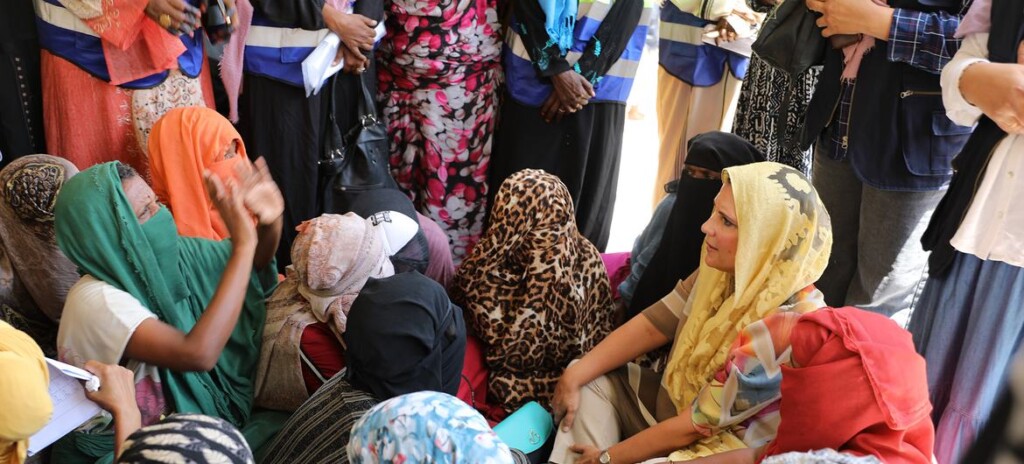
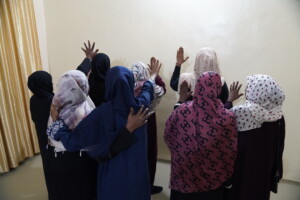
UNFPA Regional Director for Arab States, Leila Bakr, is pictured with a group of displaced women in a safe space in Port Sudan (File photo: UN News)
Report by Hawa Rahma of Al-Alaq Centre for Press Services for Sudan Media Forum
In Sudan, citizens trapped in conflict zones have not only been besieged by direct war violence, but also by social and economic complexities and harmful habits that civil society institutions, organizations, and community initiatives have been fighting for years, especially in relation to gender-based violence.
In various community sessions organized by the Al-Alaq Centre in Khartoum, many human images of the suffering of women who tried hard to fight harmful phenomena, such as child marriage and female genital mutilation.
It has not been easy for women in the absence of legal oversight and community awareness. Below the women recount what happened to them and what they saw during the two years when Khartoum was an active military operations area between the army and the Rapid Support Forces (RSF), and the latter controlled almost entirely a large swath of Khartoum.
Beatings and threats
The sessions confirmed that there were women who were beaten and threatened by the Rapid Support Forces, and others who lost their husbands due to the war, faced the most severe types of psychological punishment, and lived difficult moments, without providing any assistance from any side. There are many tears, a sense of oppression and loneliness.
Women in the Kirkuk neighbourhood in East Nile expressed their sense of psychological comfort after the lifting of a two-year siege during which they were stuck in direct war, and pointed out that they needed psychological support sessions and venting what happened to them. A mother (who preferred her name Jahab) who was stuck in the neighborhood said that a member of the Rapid Support Forces came to the house and asked for her 14-year-old daughter to be handed over. “I stood up to him, and I begged him to leave her,” she said. After we reached the stage of collapse, he left it and left. Here I breathed a sigh of relief, but we remained in a state of terror and fear until today.”
A woman who spoke about some families forcing girls of marriageable age to undergo circumcision operations, says that women faced a resurgence of these phenomena during the siege of Khartoum by the Rapid Support Forces, as some families reverted to the practice of circumcision in the absence of the law.
Lack of community awareness
In the same session, a worker at a girls’ school for more than 30 years in the Kirkuj neighborhood spoke about the lack of social counseling for teenage girls, which made them vulnerable to harassment, rape or lure, and added that some mothers find it embarrassing to guide their children, especially teenage girls, and called for the introduction of an educational approach to protect girls from violations and violence.
In this context, Asia Adam, an activist in the field of social welfare, revealed that the children of Riyadh have been subjected to harassment and domestic violence, and called for increasing the doses of psychological support for children, especially those who have been subjected to psychological trauma, as well as children stuck in the areas of clashes, in addition to community awareness for mothers, and fighting harmful habits, such as child marriage, amputation and genital mutilation, and pointed to an increase in reports of rape and harassment in the Hajj Youssef area for children under the age of five.
A legal midwife in the (Hajj Youssef) area stresses the application of the legal article on non-tolerance of female genital mutilation and mutilation, and revealed trials of mothers and midwives who have performed circumcision operations, adding: “There is a cover-up from society against such practices.”
Widows and orphans without subsidies
Through the community session organized by the Al-Alaq Centre, it was found that there were a number of widowed women due to the war, and most of the husbands who died were killed inside their homes by the Rapid Support Forces, and others due to the fall of the Danat on homes and markets, and a number of women revealed the great psychological damage due to the loss of a breadwinner and the lack of bodies providing care and economic support to families, and more than one woman who was beaten and experienced told about the need to provide psychological support in an urgent way due to their inability to overcome the trauma. The effects of terror are visible in their daily lives, and the woman revealed that they are unable to care for their children due to the severe psychological damage.
Child harassment and mothers confused by stigma
Shireen Rahmatullah, an employee in the East Nile locality, revealed that she practices the practice of circumcision secretly, especially in the areas of Mayquma and Waad Babiker. He pointed out that there is secrecy by families about the secrecy of the circumcision process, which threatens to increase the practice of amputation without revealing the perpetrators, the first of whom is the midwife, and that areas such as um Doum, Abu Daliq and a number of areas in East Nile are still practiced under the cover of the community, and need organized awareness campaigns.
Regarding violence inside schools, she pointed out that there are real incidents that require attention from the school administration and parents, adding: “We caught students carrying narcotic pills inside the school bag, and we conducted investigations to find out their source, and we deceived students for treatment until the stage of recovery from addiction.”
Afaf, an employee, attributed the return of circumcision to the society’s adherence to old customs and their refusal to abandon them, and they have become inherited despite fighting and limiting them, adding: “Community awareness plays an important role in fighting harmful customs and violence against women.”
Intisar Abdel Salam, spoke about the impact of the war on families, especially after displacement and mixing with families in other areas, and protecting children from violence has become a haunting concern.
The mother of a girl who participated in the session says that societal pressures and fear led her to accept her daughter’s marriage when she is 16 years old and studying in the second grade of secondary school, adding that her daughter gave birth to a child.
Another mother tells of the experience of her 16-year-old daughter who asked for a divorce on the first night of marriage, after discovering that she did not know anything about the wife’s life, and threatened to commit suicide, saying that her daughter’s husband is 20 years older than her. She said she thought her daughter would live happily with an expatriate man in a Gulf country, but regretted the move, and her daughter went back to school divorced.
Doria Noureen, a member of an association for the fight against harmful habits, called for the implementation of awareness sessions on sexual violence in schools, and revealed cases of harassment, pointing out that these phenomena are prevalent in the absence of supervision in schools, and pointed out that families need awareness doses to help children correct behavior and not be vulnerable to violations.
Hana Mustafa believes that the school alone does not play the educational role, but the role starts from home, pointing to the need for the integration of roles between school and home, and said: “Monitoring children is important, and awareness must take a warning and alert character to the sources of danger, and she also pointed out that mothers should not leave children alone for long periods so that they are not easily exploited.”
Another participant believes that customs and traditions stand in the way of implementing the practice of circumcision, and added: It is necessary to get rid of harmful customs and lack of courtesy, to maintain the safety of girls, and added: There are those who practice the habit of circumcision secretly, and many families, after the migration trip to the states, practiced circumcision on girls as young as 13 years old, and this is one of the harms of the war that contributed to the doubling of violence against women.
The Sudan Media Forum and its member organisations publish this article prepared by Hawa Rahma of Al-Alaq Centre for Press Services, as the article reflects women’s view of the war that they are living through, and tells how the war has bounced back on societies and pushed them to practice customs that were buried in the past, such as female genital mutilation and child marriage, as well as the repercussions of the war represented in rape, harassment and the spread of drugs. The article also deals with women’s confrontation with these regressive habits. Some resisted, while others gave up and asked for as urgent support as possible.
Find Sudan Media Forum on Facebook and on X (formerly Twitter): #StandWithSudan #SilenceKills #الصمت_يقتل #NoTimeToWasteForSudan #الوضع_في_السودان_لايحتمل_التأجيل #SudanMediaForum

 and then