




Quartet settlement in Sudan: Between Boulos’s optimism and observers’ scepticism
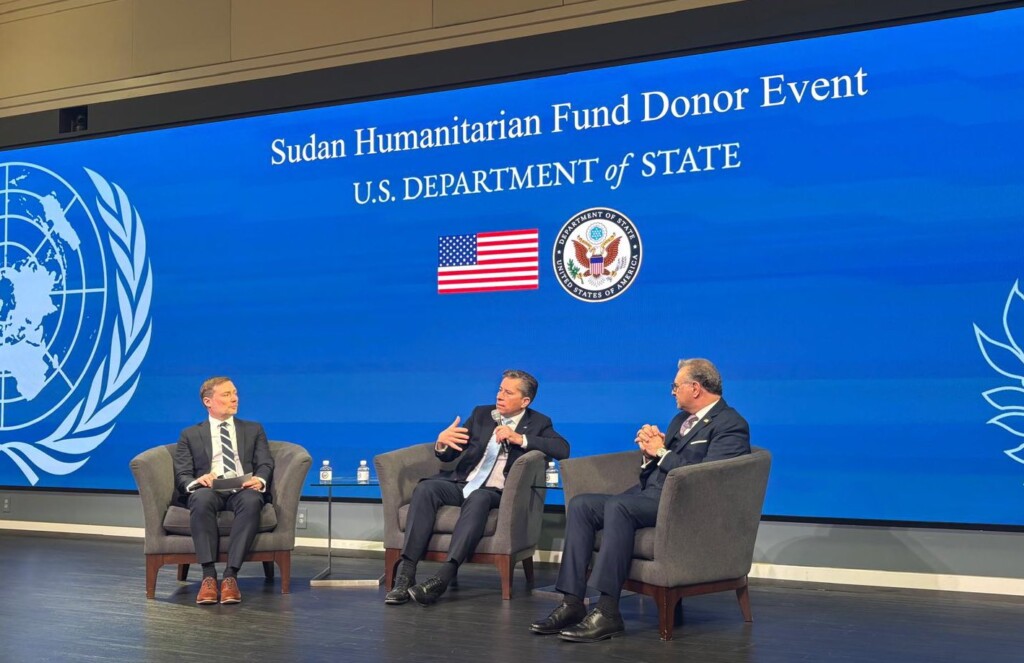
Delgates at the Humanitarian Conference on Sudan in Washington - February 2026 (Photo: Radio Dabanga)
The recent remarks by Massad Boulos, adviser to the US president, have sparked a wave of controversy and analysis about the future of the conflict in Sudan, after he spoke of the imminent arrival of a humanitarian truce and an internationally backed peace roadmap. While some see these statements as a real diplomatic breakthrough, others see them as mere “expectations” that do not touch reality.
‘Escalate to UN Security Council’
In an interview with Radio Dabanga, journalist Shawki Abdelazim said that Massad Boulos’ statements are of great importance because they revealed the tireless efforts that lasted for about three months, which reflected the existence of permanent channels of communication between him and the parties to the conflict. Abdelazim pointed out that Boulos clearly disclosed cooperation on the part of the army leadership, and touched on essential details, including the initial agreement by the parties to a roadmap and an imminent truce.
Abdelazim also drew attention to a qualitative development represented in the proposal to transfer Sudan’s file from the Quartet to the United Nations through the Security Council, where the map will be presented immediately after its approval. Boulos was quoted as saying that the Quartet agreed to this solution, and that the parties to the war agreed in principle to withdraw from some areas to replace them with a “UN mechanism”, including the approval of the Rapid Support Forces to withdraw from El Fasher. Abdelazim added that the submission of the agreement to the “US Peace Council” headed by Trump gives it more momentum, considering that The presence of the Saudi delegate in these statements is an indication of the imminent approach of a solution, which is consistent with a shift in the tone of General Abdelfattah El Burhan towards accepting peace conditional on the dignity of the Sudanese, as the beginning of a path that begins with the humanitarian aspect and ends with the political one.
‘Guardianship language’
Journalist Makki El Maghrabi presents a different reading on Radio Dabanga, questioning the accuracy of these predictions. El Maghrabi said that this is not the first time that Massad Boulos has spoken about the approach of a peace agreement, considering that his speech is often just political expectations based on the assumption that the army and the government will respond or submit to external pressures, which has not been achieved on the ground.
El Maghrabi criticised what he described as “guardianship language” towards the Sudanese, noting that while the Quartet was more cohesive, Boulos did not succeed in his efforts. El Maghrabi questioned the current chances of success in light of the clear divisions within the Quartet, especially between Saudi Arabia and the United Arab Emirates, citing reports of tensions that have reached the point of targeting arms shipments, which weakens the cohesion of the international powers on which Boulos relies in his proposal.
Between optimism about the imminence of silence for the war machine and questioning the effectiveness of international pressures, the coming days will be the decisive factor in determining the realism of the “Boulos’s Map” and its ability to move Sudan towards the desired truce.
‘First serious attempt’
As reported previously by Radio Dabanga, Dr Suleiman Baldo, Executive Director of the Sudanese Observatory for Transparency and Policy, said in a separate interview with Radio Dabanga that the peace plan pushed by the Quartet is the first serious attempt to stop the fighting in Sudan and restore calm and stability to civilians.

 and then