





Testimony from El Fasher: ‘We found the head, hands, and entrails, but we did not find the rest of the body…’
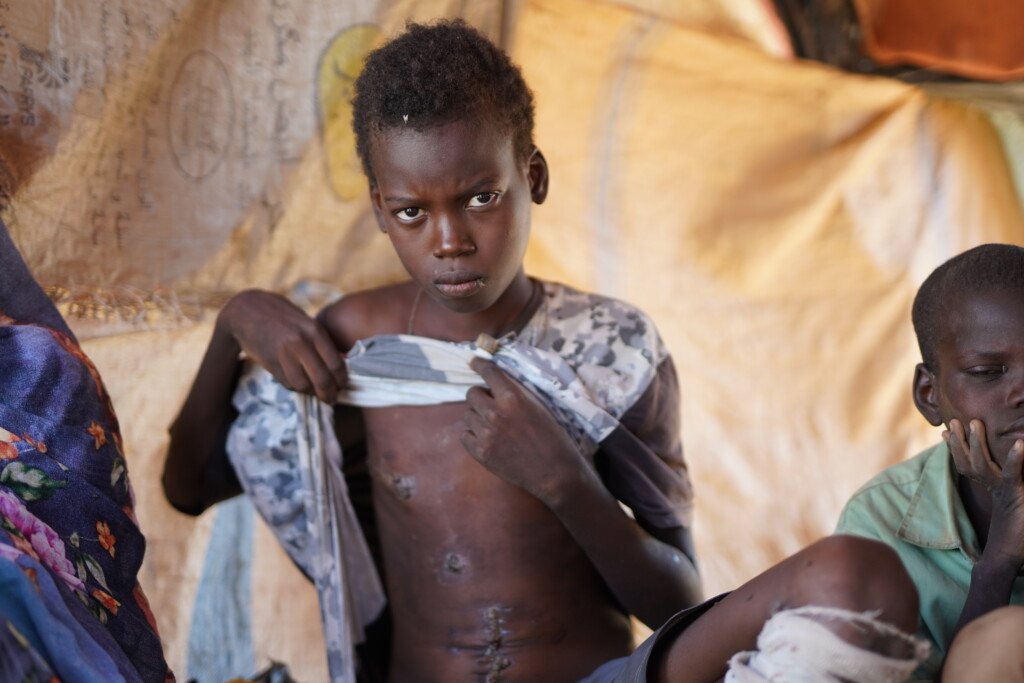
A child who fled with his family from El Fasher to Tawila shows signs of beatings and injuries (Photo: ICRC)
Report by: Fathalrahman Hamouda of Al-Taghyeer for Sudan Media Forum
Salima*, a displaced woman, once walked through the narrow alleys of El Fasher as though treading on the memory of a dead city. In the early mornings, she recalls, the sound of her footsteps blended with the thunder of artillery shells and the buzz of drones. Around her stood houses abandoned by families fleeing death, and others reduced to rubble by heavy weapons. At her side was her daughter, whom she tried to reassure that things would soon improve, that they would survive.
Speaking to Al-Taghyeer after fleeing El Fasher — a city that became a battleground between the Sudanese Armed Forces and the Rapid Support Forces (RSF) — Salima was not recounting a personal tragedy alone. Her testimony opens a window onto thousands of similar human stories carried by survivors who escaped with indelible images of a city that ultimately fell under RSF control.
El Fasher endured its darkest days during an intense siege imposed by the RSF. At the same time, the Sudanese army and allied forces clung to their positions in the area, a standoff that led to a catastrophic deterioration of humanitarian conditions for civilians.
The city witnessed a brutal siege and fierce fighting between the army and its allies — notably the Joint Forces aligned with the movements of Minni Arko Minnawi, leader of the Sudan Liberation Movement, and Jibril Ibrahim, head of the Justice and Equality Movement — on one side, and the RSF on the other. The battle for El Fasher was particularly ferocious due to its strategic importance in Darfur, as well as intense ethnic-based rivalry between the Minnawi and Jibril factions and the RSF over dominance in the region.
El Fasher is also home to displacement camps sheltering hundreds of thousands of victims of Darfur’s protracted war, which first erupted in 2003.
Observers have sharply criticised the Sudanese army for rejecting a proposed humanitarian truce put forward by the so-called “Quartet” and for choosing to continue fighting despite military indicators suggesting that El Fasher was likely to fall. Critics argue that a planned withdrawal by the army and its allies could have spared the lives of both soldiers and civilians.
According to human rights organisations, El Fasher witnessed widespread violations both before and after the RSF took control. While the world watched from afar, civilians endured a suffocating siege in which consumer prices soared to unprecedented levels and basic services — including healthcare — all but collapsed amid daily, hours-long military operations.
Salima recalls how death and killing became routine. From six in the morning until six in the evening, she says, violent clashes never ceased. “Every day, at least 200 to 300 people were dying,” she told Al-Taghyeer. “It became normal for everyone.”
Unidentified civilian bodies were buried hastily, while other remains were collected from streets, alleys, trees and walls. One incident remains seared into her memory: a shell struck a man, tearing his body apart. “We found his right arm, left arm and head in one place,” she said, “and his liver and entrails somewhere else. We never found the rest of him.”
As the fighting dragged on, Salima explains, killing was no longer the only threat — hunger followed close behind. Food prices spiralled beyond reach: a kilogram of flour cost 60,000 Sudanese pounds, a cup of rice 70,000, and half a pound of sugar 10,000. Even a bar of soap reached 70,000 pounds. (At the time, one US dollar was equivalent to approximately 3,550 Sudanese pounds.)
Her decision to leave the city came when staying became impossible. There was no food, no medicine and no safety. On what was meant to be an ordinary day, heavy clashes erupted as they attempted to flee, forcing them to lie flat on the ground for a full hour before they could move again.
When the fighting subsided, they began their escape — only to find the road littered with corpses. No one dared to bury them; anyone who tried risked being killed, as heavy artillery shelling continued.
Along the escape route, thirst and hunger threatened their lives. The distance was long, there was no shade, and no transport. At one point, a vehicle driven by an RSF soldier stopped and took women, children and those unable to walk, ordering them to abandon their belongings.
Salima continued on foot with a group of fleeing civilians for four uninterrupted hours until they reached the area of Qarni, from where they moved on to other locations. It was, she says, a journey fraught with danger and uncertainty.
She also recounts how a group of 75 young men were arrested en masse before their eyes, accused of belonging to the Sudanese army or allied forces. Exhausted by hunger and thirst, barely able to sit, they were held for hours before three military vehicles arrived and took them away to an unknown destination.
By the following morning, none of the detained men had returned. Salima was told that they would most likely be forcibly recruited to fight with the RSF — if they were not executed.
Her account continues along the road stretching through Abuja, Hadda, Turba and Um Shujaira, towards Zamzam camp and finally to Tawila, where hundreds of thousands of displaced people have sought refuge. Along the way, she says, the road was lined with vast numbers of bloated and decomposing bodies, some of which were being eaten by animals, including dogs.
Among the most harrowing sights, she recalls, were at least 12 bodies of young women, who appeared to have been killed no more than two days earlier.
Upon reaching Tawila, local residents welcomed the displaced families warmly, providing them with meals in the morning and later in the day. Yet their suffering did not end there. Basic necessities remain scarce, most notably toilets, forcing families and their children to relieve themselves in the open.
*Salima is a pseudonym designed to protect the privacy of the interviewee
This report is published by the Sudan Media Forum and its member institutions, prepared by Al-Taghyeer newspaper. Based on eyewitness testimony, it documents a fragment of the immense suffering endured by civilians in El Fasher during the height of fighting between the Sudanese army and the Rapid Support Forces. The city experienced widespread violations before and after its capture, endured a devastating siege marked by soaring prices and the collapse of basic services, and paid a heavy human toll — with lives lost, communities uprooted, and countless civilians forced into displacement.

Find the Sudan Media Forum on Facebook and on X: #StandWithSudan #SilenceKills #الصمت_يقتل #NoTimeToWasteForSudan #الوضع_في_السودان_لايحتمل_التأجيل #Stand #SudanMediaForum


 and then