




Exiled Human Rights Defenders Group reveals extent of violations by SAF and RSF in Sudan war

A mother sits with the body of her ten-year-old daughter, Hajar Ishaq, who died of hunger and thirst as they emerged from El Fasher in search of a way out of their lives on the way to a Tawila area in North Darfur (Photo: RD Correspondent)

Report by Abdelmoneim Madibu for Radio Dabanga

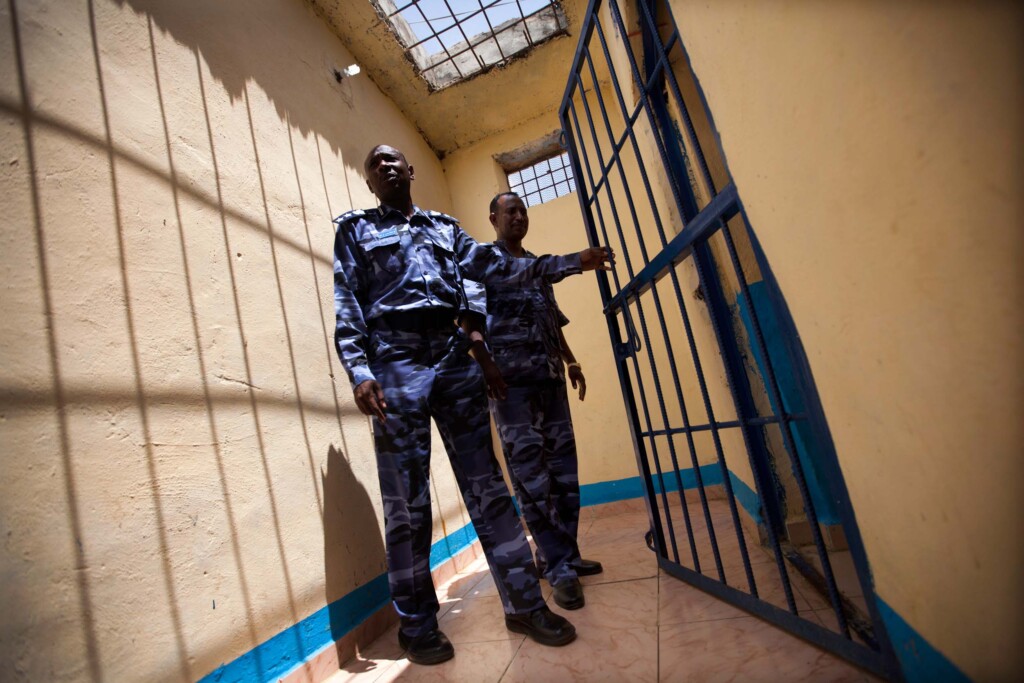
Inside a dark detention room on the outskirts of Khartoum, Adam* hung suspended by his feet, his hands tied behind his back. He recounts:

“I was left hanging for a very long time… I could no longer feel my body. They kept beating me and asking about things I knew nothing about. All I had done was participate as an activist in the Resistance Committees.” He adds: “It seems my arrest was a direct result of my political activism, not for any legal reason.”

In West Darfur, Maryam* and four other women were walking along a displacement route when they were stopped by fighters from the Rapid Support Forces (RSF). “They raped us one after the other,” she says. “They accused us of supporting the army. No one could protect us.” Adam’s wife still recalls the night thirty soldiers stormed their home: “They took him without saying why. Since that day, we don’t know where he is,” she says. “We heard rumours he was being held in an intelligence building known as a ‘ghost house’, but when we went to ask, they denied any knowledge of him.”

Another survivor, Musa*, recounts: “While we were in the vehicle, they ordered us to keep our heads down and beat us if we lifted them. When we arrived, they beat me with metal tools and electric cables.” He adds: “We were forced to unload trucks of cement and iron for hours, even when exhausted. There was barely any food, and the place was infested with insects.”

These accounts are only a glimpse of a series of testimonies documented in a new report compiled by the Exiled Human Rights Defenders Group. The report includes more than 15 statements from victims, survivors, and families of the forcibly disappeared inside and outside Sudan.

The report — reviewed by Radio Dabanga — paints a bleak picture of a war the United Nations has described as “a conflict of atrocities”, a cycle of abuses with no red lines and no distinction between man, woman, child, or elder. It documents arbitrary detention, torture, enforced disappearance, and sexual violence between April 2023 and August 2025, gathered through interviews with 17 individuals including survivors, eyewitnesses, and families, as well as documents, photos, and medical reports.

A war that created a climate of fear

The 23-page report states that since the outbreak of conflict on 15 April 2023 between the Sudanese Armed Forces (SAF) and the RSF, the lives of millions have turned into an open tragedy:

7.7 million people have been internally displaced, 16 million face food insecurity, cities have been destroyed, the healthcare system has collapsed, and sexual violence, arbitrary arrests, and extrajudicial killings have become widespread.

Unlike previous conflicts, this war has swept across nearly the entire country. Both sides have taken and lost control of Khartoum, Kordofan, El Gezira, and Darfur. Civilians have been easy targets for violations at checkpoints, inside homes, or in secret detention centres.

Enforced disappearance on the rise

The report confirms that “ghost house” practices, notorious during the Bashir regime, have returned with even greater brutality.

Seven men testified to being detained without legal warrants, some disappearing for days or weeks.

Hamed has no idea where his father went after being taken from Wad Madani:

“They kidnapped him at night. They left no paper, no sign. He just disappeared.”

The wife of another detainee says she later heard rumours he was being held in an intelligence facility, but officials denied everything when she enquired.

Musa was arrested at a checkpoint in River Nile State. Contact with him was cut off for days before the family received a short message saying only: “He is alive.”

Torture and Forced Labour

The report documents multiple methods of torture used in detention sites run by either the army or the RSF:

suspension by the feet, beatings with cables and metal tools, electric shocks, deprivation of food and water, confinement inside airless metal containers, and forcing detainees into long hours of hard labour.

“They forced us to unload cement and iron from trucks. They beat us if we stopped even for a moment,” Musa says.

Ali recounts:

“I heard men screaming in the cells next to mine. I knew my turn would come.”

Khalid describes the detention conditions:

“The place was extremely cramped; there was nowhere to sleep. We took turns sleeping while sitting up. Food was one small piece of bread per person per day.”

Although Sudanese and international law guarantee the right to appear before a court within a set period, all interviewees confirmed they were never presented to a court nor allowed access to a lawyer.

UN Assistant Secretary-General for Humanitarian Affairs Tom Fletcher during his visit to Tawila in North Darfur on Friday 14 November 2024 (File photo: Supplied)

Sexual violence: A weapon of war from Khartoum to Darfur

Perhaps the most brutal aspect of this conflict is the shocking rise in sexual violence across large parts of Sudan.

UN reports state that such crimes are often used as a weapon of war to terrorise communities.

Violations include rape, gang rape, sexual slavery, abduction, and forced marriage. Women and girls have been targeted based on ethnicity, geographic origin, or presumed allegiance.

In El-Geneina, the report documents attacks targeting Masalit women. One survivor said:

“They chose us because we are Masalit. They shouted that we support the army. They took five of us and raped us one after the other.”

Another said: “They would pick young girls and take them by force. No one could intervene — they were fully armed.”

In Khartoum and Omdurman, the report uncovered women-only detention rooms. A woman from Bahri recounts:

“They knocked on doors at dawn and took the girls. I heard the screams of my neighbours from the street.”

Another said: “Three of them raped me. They kept saying we were ‘army women’ and insulting us the entire time.”

In El Gezira and Darfur, the report describes abduction, trafficking, and sexual enslavement carried out by parties to the conflict.

In El Gezira state, families reported their daughters being abducted from roads and military checkpoints. Some were used as forced labourers for cooking and cleaning inside military camps, while also subjected to repeated rape.

One mother described the week-long disappearance of her 16-year-old daughter:

“They took my daughter. We searched everywhere. After a week, we found her dumped near the village. She was in severe shock.”

The report also notes accounts of women and girls being sold in exchange for weapons or money.

Other reports indicate sexual violence perpetrated by members of the Sudanese Armed Forces, particularly when retaking areas previously held by the RSF.

Under international law, such crimes amount to war crimes and may constitute crimes against humanity.

The psychological and physical effects on survivors are profound: severe injuries, unwanted pregnancies, social stigma, loss of status within the community, fear of movement, and chronic trauma.

Many struggle to access healthcare due to the collapse of the medical system and the scarcity of functioning hospitals.

‘Do not leave us Alone’

The report urges the international community, the African Union, and the United Nations to impose an arms embargo on both warring parties, prosecute perpetrators through the International Criminal Court, reveal the fate of the forcibly disappeared, and provide medical and psychological support for victims.

It also calls for protection of women and girls from sexual violence and the deployment of a monitoring mission to protect civilians.

The testimonies collected by the Exiled Human Rights Defenders Group show that the suffering of Sudanese people is not an unintended consequence of war, but rather the product of a systematic policy of violations and impunity — from ghost houses to displacement routes to refugee camps.

Victims continue to repeat the same plea voiced by one survivor at the end of his statement:

“Stop the war… protect civilians… hold accountable those who did this to us.”

A child sits beside a cooking stove in Tawila after his family fled El-Fasher. Source: UNICEF / Mohammed Jamal

* All names have been anonymised for privacy/security

A child sits next to a cooking stove in Tawila after his family fled El Fasher. (UNICEF/Mohammed Jamal)

Welcome

Install
×